AP 118 · No. 10 Section II · Aircraft Collection 11 / 12

Aircraft/Collections/Airliners

Airport · 1946–2001

Classic British airliners

Turboprops, rear-engined jets and a supersonic delta: half a century of British airliners, sharing one runway.

12
Aircraft
1946–2001
Period
21
UK museums hold them

The diorama

Diorama · 1946–2001

Loading the airfield…

A British airport of the jet age: a long runway with threshold markings, a parallel taxiway, an apron in front of the terminal and its piers, a maintenance hangar and a tall control tower. Airliners large and small take their turns on the runway.

Drag to look around · ctrl + scroll to zoom · pick an aircraft to follow it

After the Second World War Britain set out to build the airliners of the future, and for a while it did. The de Havilland Dove brought modern comfort to feeder routes, the Vickers Viscount became the world’s first turboprop airliner in regular service in 1953 and sold all over the world, and the de Havilland Comet, the first jet airliner, flew passengers in 1952.

In the 1960s came the rear-engined jets: the Trident, which made the first fully automatic landings in airline service, the VC10, beloved of passengers and pilots, and the BAC One-Eleven, a short-haul best-seller. With France, Britain built Concorde, which flew passengers at twice the speed of sound from 1976 to 2003.

Smaller types did well too. The Britten-Norman Islander became one of the best-selling British civil aircraft of all, the Hawker Siddeley 748 and Jetstream served regional airlines worldwide, and the BAe 146 and its Avro RJ successors, built until 2001, were the last airliners designed and built in Britain.

To scale

The collection side by side

Every aircraft drawn at the same scale, so a Concorde and a BN-2A-26 Islander can be compared at a glance.

  • de Havilland Dove side profile, to scaleDove · 11.96 m
  • Douglas C-47 Dakota side profile, to scaleDakota IV · 19.65 m
  • Vickers Viscount side profile, to scaleViscount 701 · 24.74 m
  • Armstrong Whitworth Argosy C.1 side profile, to scaleArgosy · 27.18 m
  • Hawker Siddeley Trident side profile, to scaleTrident 2E · 34.98 m
  • Vickers VC10 side profile, to scaleVC10 · 48.36 m
  • BAC One-Eleven side profile, to scaleOne-Eleven 510ED · 32.61 m
  • Hawker Siddeley Andover E.3A side profile, to scaleAndover · 23.77 m
  • Britten-Norman Islander side profile, to scaleBN-2A-26 Islander · 10.86 m
  • Aérospatiale-BAC Concorde side profile, to scaleConcorde · 61.66 m
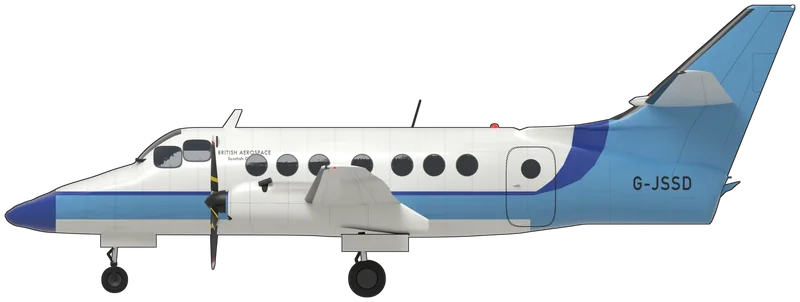
  • British Aerospace Jetstream 31 side profile, to scaleJetstream 31 · 14.37 m
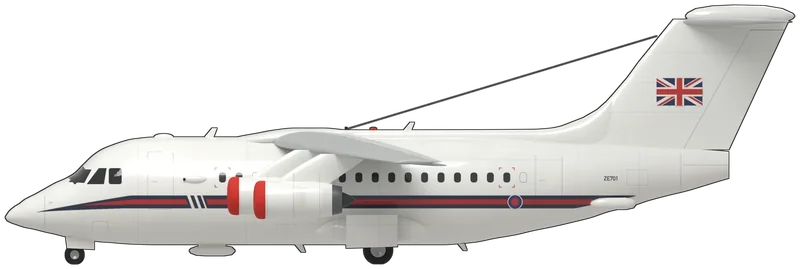
  • British Aerospace 146 side profile, to scaleBAe 146 CC.2 · 26.19 m

10 m

Profiles

Side, top and front

Each aircraft drawn from its 3D model, painted as one real airframe, with its specification.

de Havilland Dove

01 · Feeder airliner & communications · Dove 6 G-ALFU
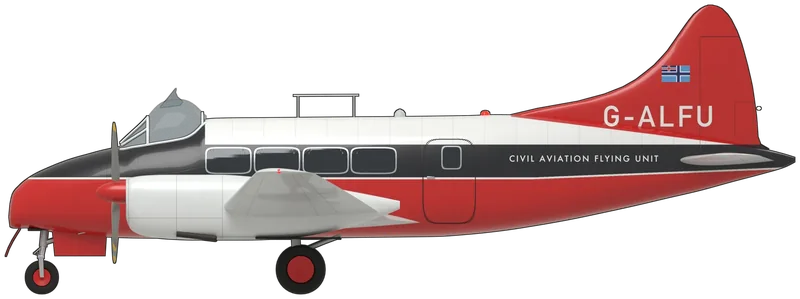
Side view of the de Havilland Dove, Dove 6 G-ALFU
Port side
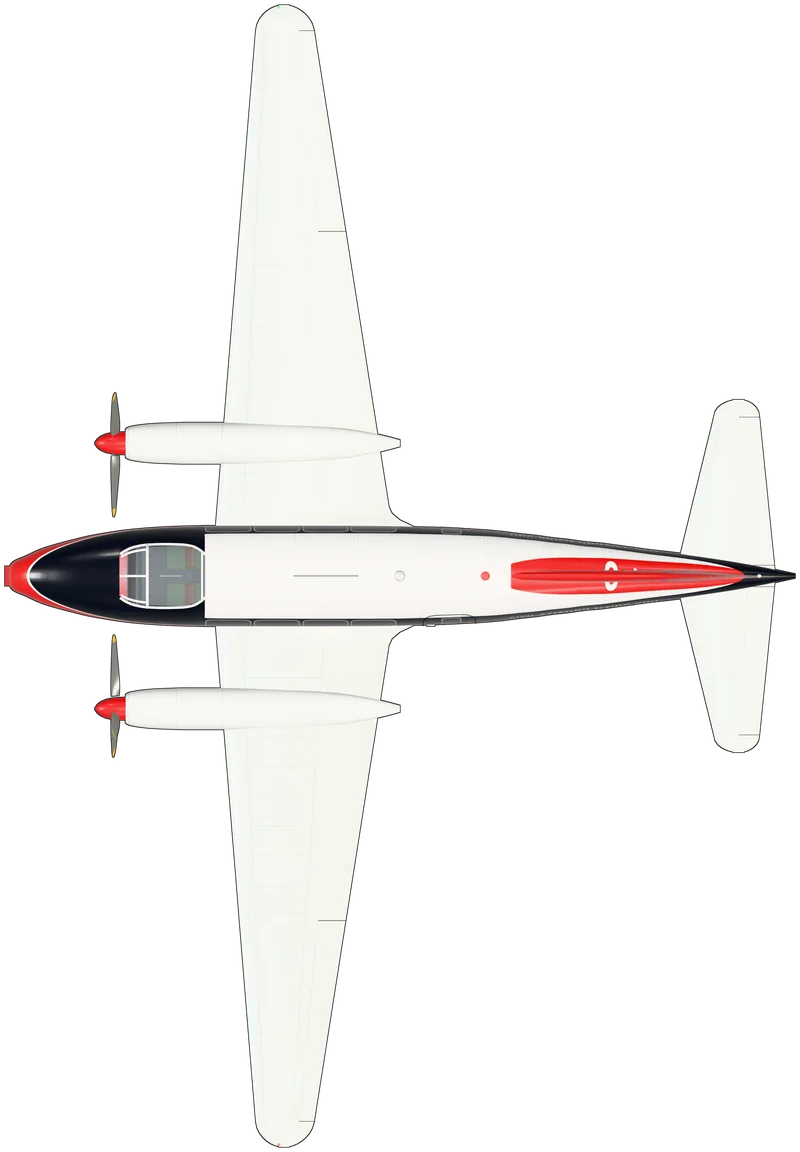
Top view of the de Havilland Dove, Dove 6 G-ALFU
Plan, from above
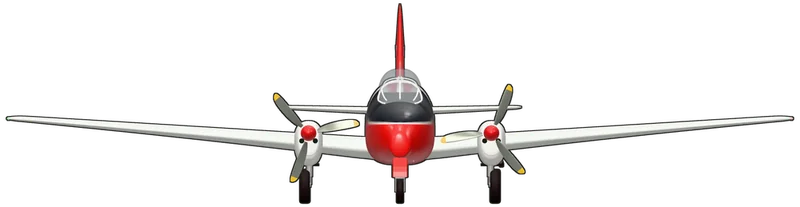
Front view of the de Havilland Dove, Dove 6 G-ALFU
Head-on

During the war the Brabazon Committee drew up the airliners Britain would need once peace came. One was a small feeder-liner to replace the wooden Dragon Rapide, and de Havilland answered it with the DH.104 Dove: an all-metal, low-winged twin with flaps, constant-speed propellers and a retractable tricycle undercarriage. The prototype first flew at Hatfield on 25 September 1945.

The RAF and Royal Navy flew the Dove, as the Devon and Sea Devon, for more than thirty years from 1948.

G-ALFU was built as a Dove 4 and later brought up to Dove 6 standard with more powerful engines.

First flight
25 September 1945
Role
Feeder airliner & communications
Maker
de Havilland, Britain
Engine
2 × de Havilland Gipsy Queen 70 Mk 2 six-cylinder inverted inlines, 380 hp each
Crew
2
Wingspan
17.37 m (57 ft 0 in)
Length
11.96 m (39 ft 3 in)
Height
4.06 m (13 ft 4 in)
Top speed
230 mph
Built
~690
In service
1946–1980s

Douglas C-47 Dakota

02 · Military transport · Dakota IV KN645
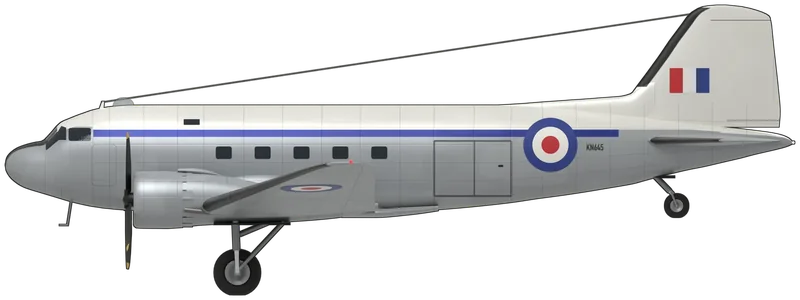
Side view of the Douglas C-47 Dakota, Dakota IV KN645
Port side
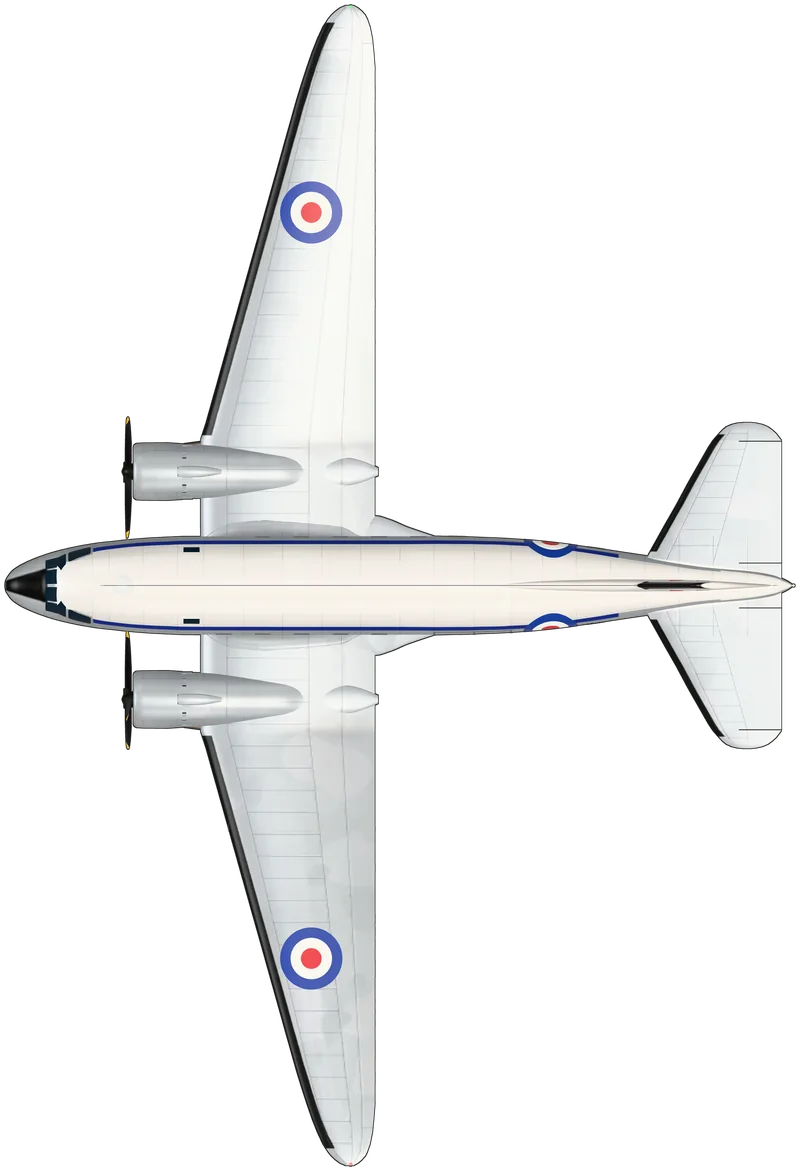
Top view of the Douglas C-47 Dakota, Dakota IV KN645
Plan, from above
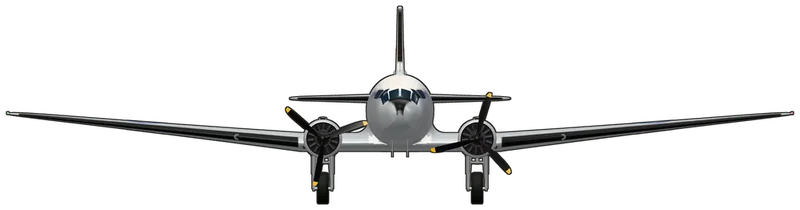
Front view of the Douglas C-47 Dakota, Dakota IV KN645
Head-on

The Dakota began as an airliner. In 1934 American Airlines asked Douglas for a wider sleeper version of its DC-2, and the Douglas Sleeper Transport flew at Santa Monica on 17 December 1935, 32 years to the day after the Wright brothers’ first flight. Its day-coach sister, the 21-seat DC-3, could cross the United States in about 15 hours with three stops and was the first airliner that could make a profit from passengers alone, without a mail contract.

David Lord’s Victoria Cross was the only one ever won by a member of Transport Command. Over Arnhem on 19 September 1944, with his starboard engine on fire, he held Dakota KG374 low over the drop zone for a second run to deliver the last of its supply panniers, and ordered his crew to jump moments before the wing gave way.

KN645 was built at Oklahoma City as a C-47B, USAAF serial 44-77003, and taken on RAF charge under Lend-Lease on 18 May 1945.

First flight
17 December 1935
Role
Military transport
Maker
Douglas Aircraft Company, United States
Engine
2 × Pratt & Whitney R-1830-90C Twin Wasp fourteen-cylinder radials, 1,200 hp each
Crew
3 or 4 (pilots, navigator and wireless operator), with up to 28 troops or 6,000 lb of freight
Wingspan
28.96 m (95 ft 0 in)
Length
19.65 m (64 ft 6 in)
Height
5.16 m (16 ft 11 in)
Top speed
224 mph
Built
~16,000
In service
1942–1970 (RAF)

Vickers Viscount

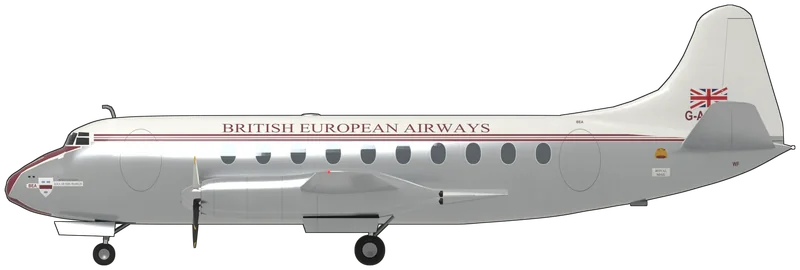
03 · Turboprop airliner · Viscount 701 G-ALWF
Side view of the Vickers Viscount, Viscount 701 G-ALWF
Port side
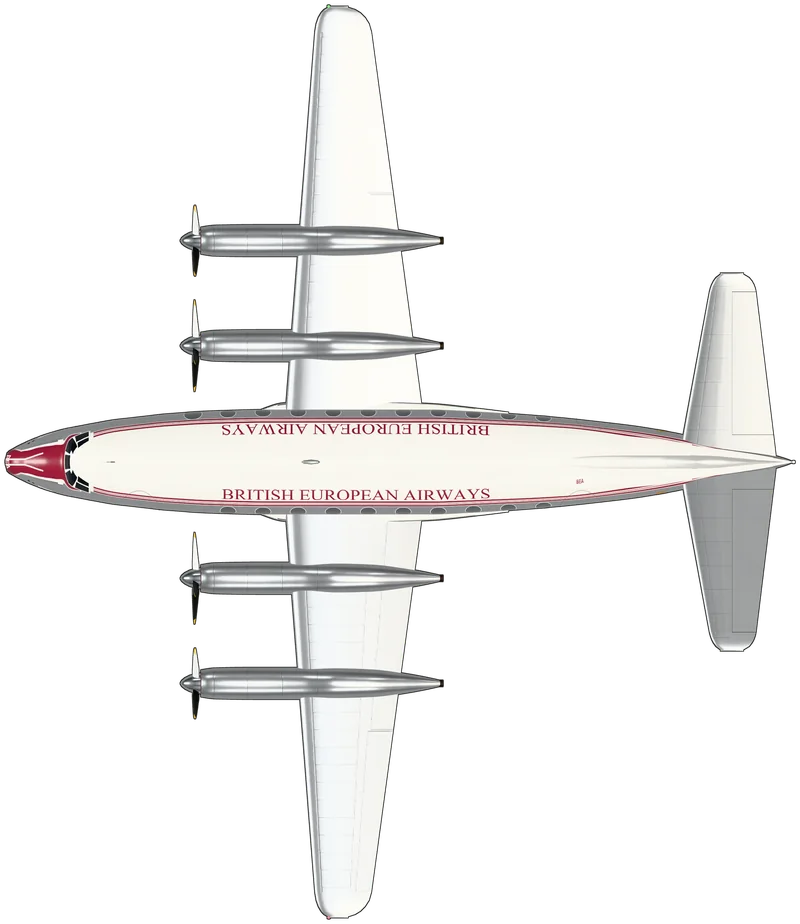
Top view of the Vickers Viscount, Viscount 701 G-ALWF
Plan, from above
Front view of the Vickers Viscount, Viscount 701 G-ALWF
Head-on

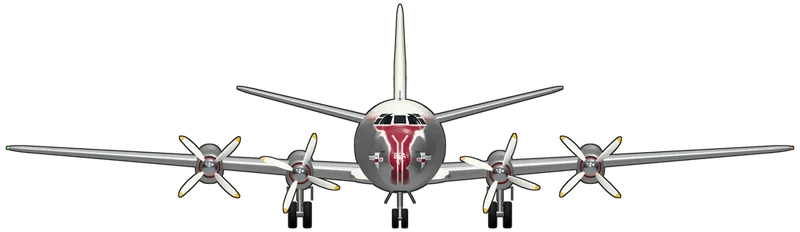
The Viscount began with the wartime Brabazon Committee, which asked for a short-range airliner to replace the DC-3 after the war. Vickers chose four of Rolls-Royce’s new Dart turboprops, a gas turbine driving an ordinary propeller, and a pressurised cabin with large oval windows. The prototype, G-AHRF, first flew from Wisley on 16 July 1948 with Mutt Summers and Jock Bryce at the controls.

The Rolls-Royce Dart, first proven on the Viscount, stayed in production until 1987 and went on to power the Fokker F27, the Hawker Siddeley 748 and the Handley Page Herald.

G-ALWF, Vickers’ fifth production Viscount, first flew at Weybridge on 3 December 1952 and was delivered to BEA on 13 February 1953, in time for the first Viscount services that April.

First flight
16 July 1948
Role
Turboprop airliner
Maker
Vickers-Armstrongs, Britain
Engine
4 × Rolls-Royce Dart 505 turboprops, about 1,400 shp each
Crew
3 flight crew and 47–53 passengers
Wingspan
28.56 m (93 ft 8 in)
Length
24.74 m (81 ft 2 in)
Height
8.15 m (26 ft 9 in)
Top speed
352 mph
Built
445
In service
1953–2000s

Armstrong Whitworth Argosy C.1

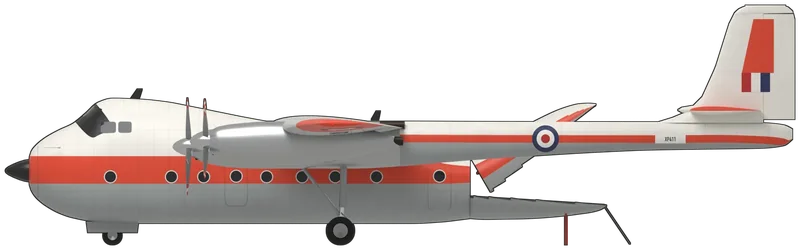
04 · Twin-boom tactical freighter · Argosy C.1 XP411
Side view of the Armstrong Whitworth Argosy C.1, Argosy C.1 XP411
Port side
Top view of the Armstrong Whitworth Argosy C.1, Argosy C.1 XP411
Plan, from above
Front view of the Armstrong Whitworth Argosy C.1, Argosy C.1 XP411
Head-on

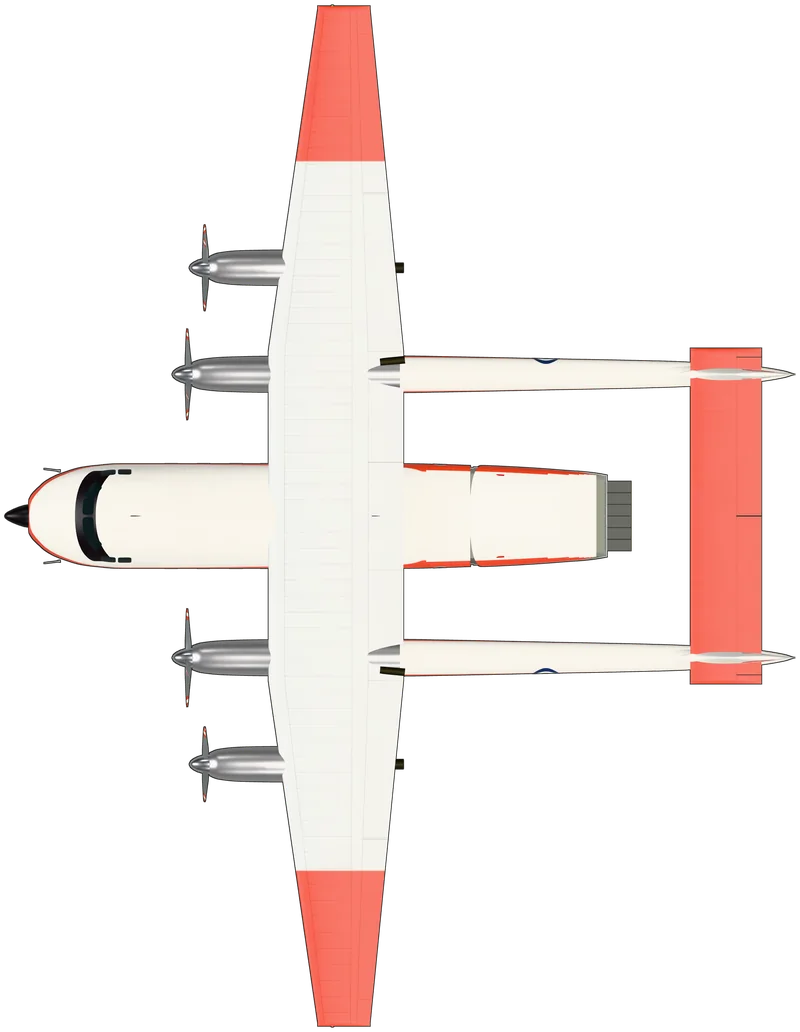
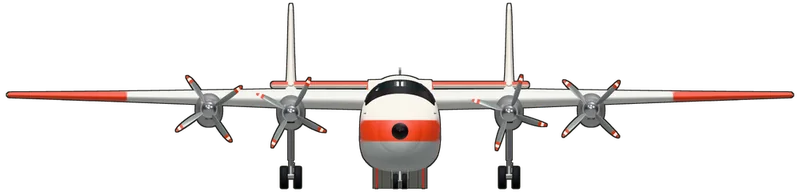
Armstrong Whitworth designed the Argosy in the late 1950s as a freighter that could be loaded like a lorry. The fuselage was a short, square-sided pod slung beneath a high wing, with the tail carried on two slim booms, so that the hold could open at both ends and be loaded straight in from a truck bed. Four Rolls-Royce Dart turboprops, the engine of the Viscount, gave it a reliable, familiar power plant.

Both halves of the Argosy C.1’s rear door could be opened in flight: the lower half swung down and the upper half up, leaving a clear opening across the full width of the hold for dropping paratroops and loads on parachutes.

XP411, construction number 6766, was built by Armstrong Whitworth at Bitteswell as one of the RAF’s 56 Argosies and first flew on 6 April 1962.

First flight
8 January 1959
Role
Twin-boom tactical freighter
Maker
Armstrong Whitworth (Hawker Siddeley), Britain
Engine
4 × Rolls-Royce Dart RDa.8 Mk 101 turboprops, 2,470 shp each
Crew
4, plus up to 69 troops
Wingspan
35.05 m (115 ft 0 in)
Length
27.18 m (89 ft 2 in)
Height
8.23 m (27 ft 0 in)
Top speed
285 mph
Built
74
In service
1961–1978

Hawker Siddeley Trident

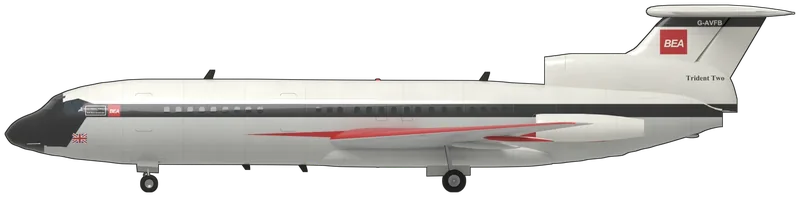
05 · Short-haul airliner · Trident 2E G-AVFB
Side view of the Hawker Siddeley Trident, Trident 2E G-AVFB
Port side
Top view of the Hawker Siddeley Trident, Trident 2E G-AVFB
Plan, from above
Front view of the Hawker Siddeley Trident, Trident 2E G-AVFB
Head-on

The Trident began as the de Havilland DH.121, chosen in 1958 to meet a British European Airways requirement for a jet to replace the Viscount and Vanguard on Europe’s busier routes. As first designed it would have carried 111 passengers behind three Rolls-Royce Medway engines, but BEA, expecting a slump in traffic, had it cut down in 1959 to about a hundred seats and the smaller Spey. The result fitted BEA’s routes almost exactly and few others, and the Boeing 727, launched a year later to the larger specification, went on to sell more than 1,800 against the Trident’s 117.

G-AVFB was hit by gunfire on the ground at Nicosia during the Turkish invasion of Cyprus in July 1974, while on lease to Cyprus Airways as 5B-DAC, and the repair patches can still be found on its starboard side; it is the aircraft shown here.

G-AVFB was the second of the fifty Trident 2Es ordered by BEA; it first flew at Hatfield on 2 November 1967 and was delivered on 6 June 1968.

First flight
9 January 1962
Role
Short-haul airliner
Maker
de Havilland, then Hawker Siddeley Aviation, at Hatfield, Britain
Engine
3 × Rolls-Royce Spey 512-5W turbofans, 11,960 lb thrust each
Crew
3 flight crew, with up to 115 passengers
Wingspan
29.87 m (98 ft 0 in)
Length
34.98 m (114 ft 9 in)
Height
8.23 m (27 ft 0 in)
Top speed
610 mph
Built
117
In service
1964–1995

Vickers VC10

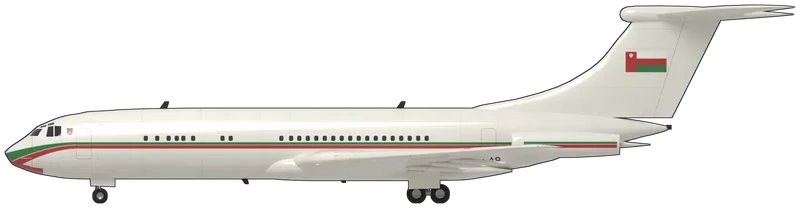
06 · Long-range airliner · VC10 Type 1103 G-ASIX
Side view of the Vickers VC10, VC10 Type 1103 G-ASIX
Port side
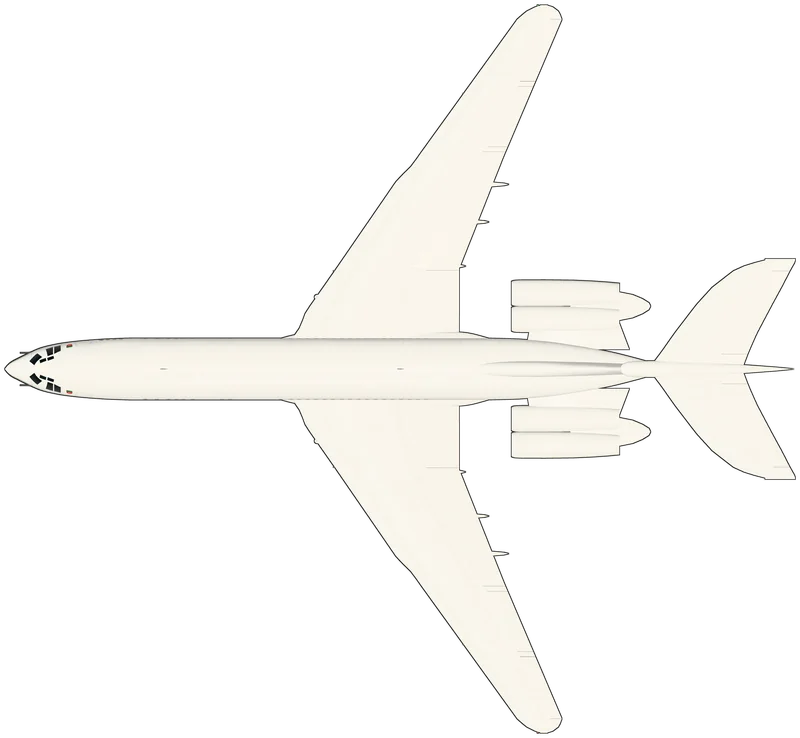
Top view of the Vickers VC10, VC10 Type 1103 G-ASIX
Plan, from above
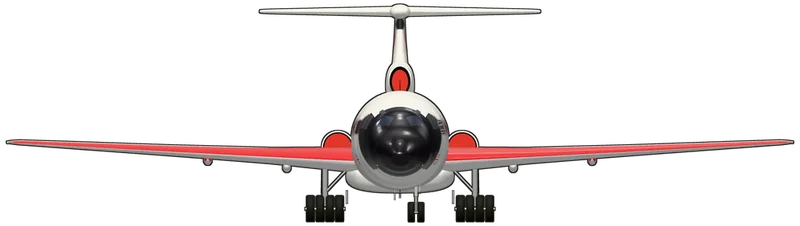
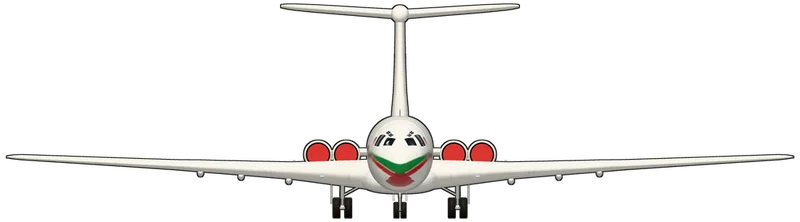
Front view of the Vickers VC10, VC10 Type 1103 G-ASIX
Head-on

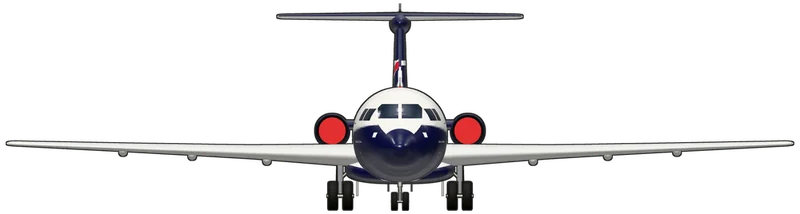
The VC10 was built to a BOAC requirement of 1957 for a jet that could fly the Empire routes: the hot, high and short runways of Africa and the Far East, where the Boeing 707 could not lift a full load. Vickers answered with a clean, highly efficient wing with full-span slats and big flaps, and hung all four Rolls-Royce Conway turbofans in pairs on the rear fuselage, which left the wing uncluttered and gave the cabin a quietness passengers never forgot. The prototype, G-ARTA, first flew from the short runway at Brooklands on 29 June 1962, and BOAC put the type into service to Lagos in April 1964.

G-ASIX made the last flight by a civil VC10 when it landed at Brooklands on 6 July 1987, back on the runway from which the prototype had first flown twenty-five years earlier; it is the aircraft shown here.

G-ASIX was the second of three Type 1103 VC10s built for British United Airways, with a main-deck cargo door in the forward fuselage and a lengthened leading edge over the inner wing; it first flew at Weybridge on 17 October 1964 and flew BUA’s South American and West African routes before passing to British Caledonian in 1970.

First flight
29 June 1962
Role
Long-range airliner
Maker
Vickers-Armstrongs (Aircraft), later the British Aircraft Corporation, at Weybridge, Britain
Engine
4 × Rolls-Royce Conway RCo.42 turbofans, 20,370 lb thrust each
Crew
4 flight crew, with up to 151 passengers
Wingspan
44.55 m (146 ft 2 in)
Length
48.36 m (158 ft 8 in)
Height
12.04 m (39 ft 6 in)
Top speed
580 mph
Built
54
In service
1964–2013

BAC One-Eleven

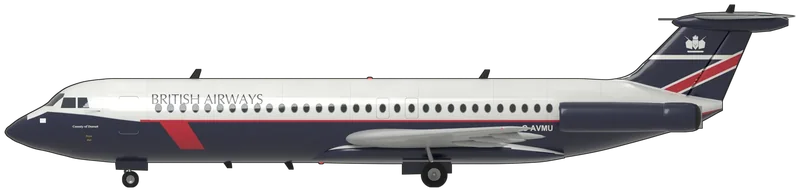
07 · Short-haul airliner · One-Eleven 510ED G-AVMU
Side view of the BAC One-Eleven, One-Eleven 510ED G-AVMU
Port side
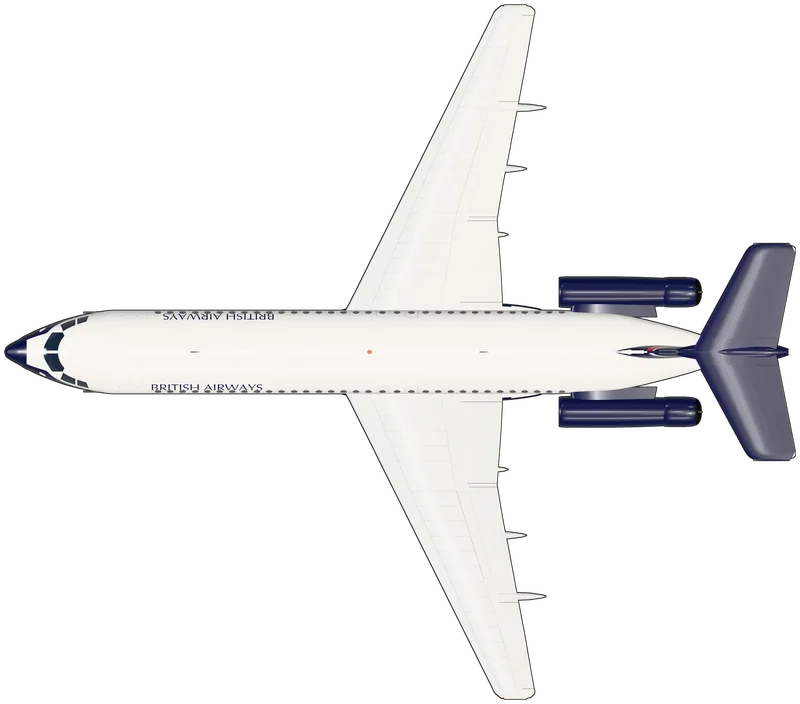
Top view of the BAC One-Eleven, One-Eleven 510ED G-AVMU
Plan, from above
Front view of the BAC One-Eleven, One-Eleven 510ED G-AVMU
Head-on

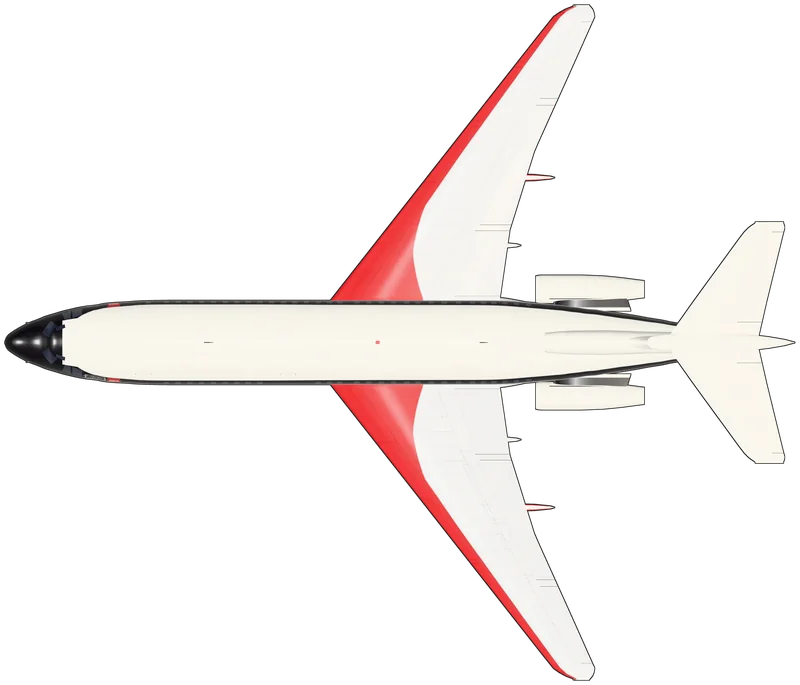
The One-Eleven began at Hunting Aircraft in 1956 as the H.107, a thirty-seat jet for short routes. Hunting passed into the British Aircraft Corporation in 1960, and BAC reworked the design the following year into an eighty-seat airliner with two Rolls-Royce Speys at the tail and a T-tail, the layout the Caravelle had introduced. British United Airways placed the launch order for ten on 9 May 1961, Braniff of Texas followed that autumn, and in July 1963 American Airlines ordered fifteen, the first of thirty: the One-Eleven was the short-haul jet Britain sold to America.

BEA had its 510EDs built with a cockpit laid out like the Trident’s, so that its pilots could switch between the two types; the result was a One-Eleven that needed a type rating of its own.

G-AVMU, construction number 148, was one of the eighteen Series 510EDs that BEA ordered for its domestic and European routes, and it was delivered to the airline in 1969.

First flight
20 August 1963
Role
Short-haul airliner
Maker
British Aircraft Corporation at Hurn, Bournemouth, Britain
Engine
2 × Rolls-Royce Spey 512-14DW turbofans, 12,550 lb thrust each
Crew
2 flight crew, with up to 119 passengers
Wingspan
28.5 m (93 ft 6 in)
Length
32.61 m (107 ft 0 in)
Height
7.47 m (24 ft 6 in)
Top speed
541 mph
Built
244
In service
1965–2019

Hawker Siddeley Andover E.3A

08 · Kneeling rear-loading tactical freighter · Andover E.3A XS639
Side view of the Hawker Siddeley Andover E.3A, Andover E.3A XS639
Port side
Top view of the Hawker Siddeley Andover E.3A, Andover E.3A XS639
Plan, from above
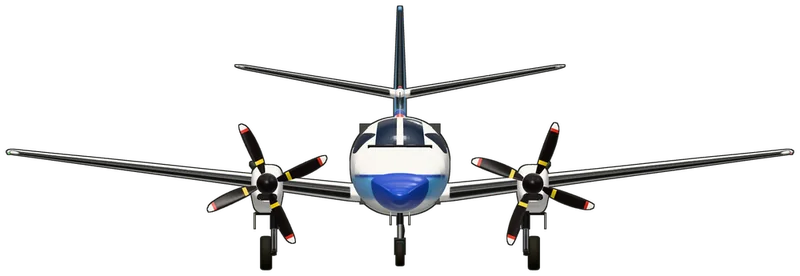
Front view of the Hawker Siddeley Andover E.3A, Andover E.3A XS639
Head-on

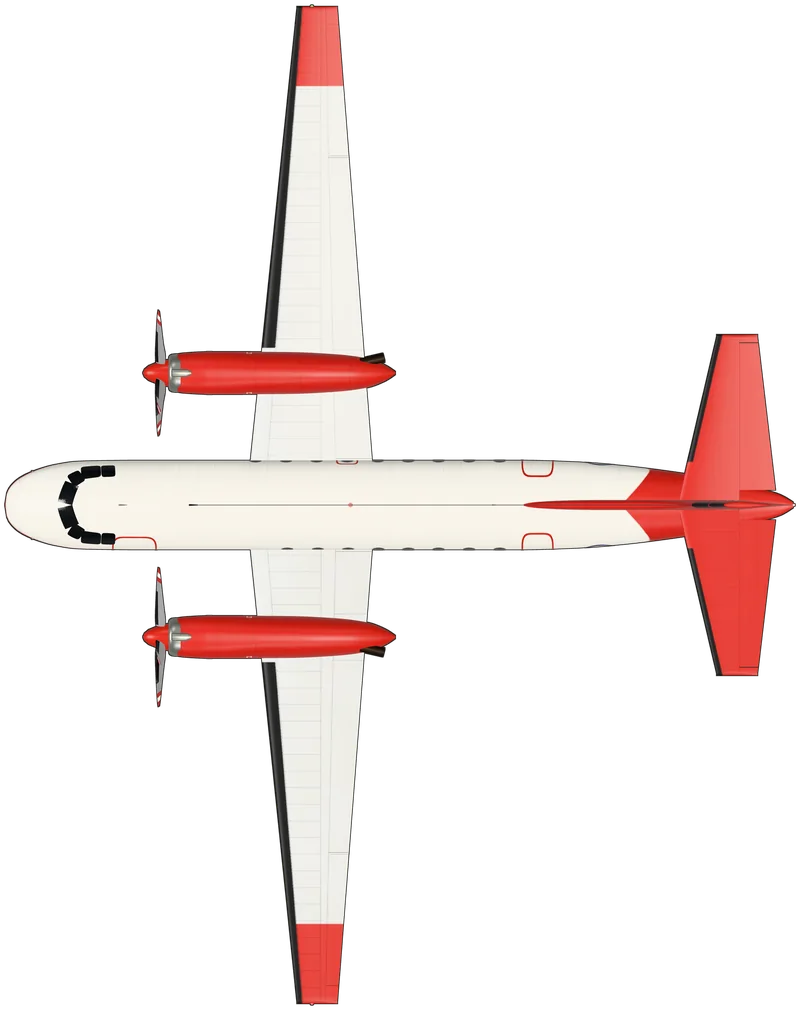
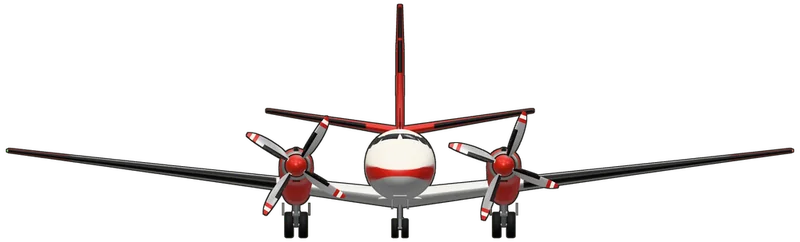
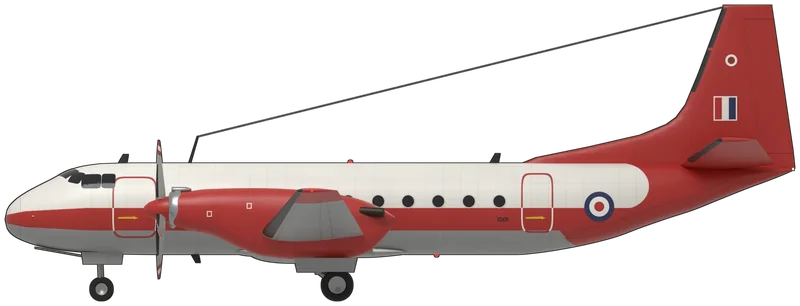
The Andover grew out of the Avro 748, a short-haul airliner designed at Woodford in the late 1950s to replace the Dakota, with a low wing and two Rolls-Royce Dart turboprops. When the RAF asked for a tactical freighter that could carry troops, vehicles and stores into short, rough strips, Hawker Siddeley, which had absorbed Avro, reworked the 748 rather than start again. The fuselage behind the wing was swept up to make room for a full-width loading ramp under a raised tail, the tailplane was given marked dihedral, the wing was lengthened at the root, and more powerful Darts were moved further out to swing bigger propellers.

The Andover could “kneel”: its main undercarriage legs shortened hydraulically to tilt the cabin floor down to the height of a lorry bed or bring the rear ramp to the ground.

XS639, construction number BN23, was built at Woodford as an Andover C.1 and joined No. 46 Squadron in May 1967, moving with it to Thorney Island in 1970.

First flight
21 December 1963
Role
Kneeling rear-loading tactical freighter
Maker
Hawker Siddeley (Avro), Britain
Engine
2 × Rolls-Royce Dart RDa.12 Mk 201 turboprops, 3,245 shp each
Crew
2–3, plus up to 52 troops
Wingspan
29.95 m (98 ft 3 in)
Length
23.77 m (78 ft 0 in)
Height
9.17 m (30 ft 1 in)
Top speed
326 mph
Built
~380
In service
1966–2010s

Britten-Norman Islander

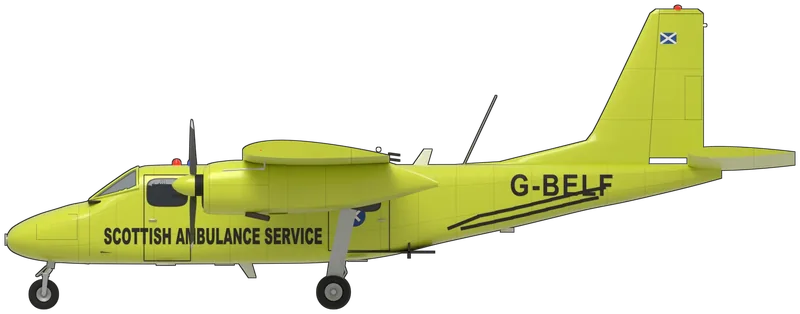
09 · Light utility transport · Islander G-BELF
Side view of the Britten-Norman Islander, Islander G-BELF
Port side
Top view of the Britten-Norman Islander, Islander G-BELF
Plan, from above
Front view of the Britten-Norman Islander, Islander G-BELF
Head-on

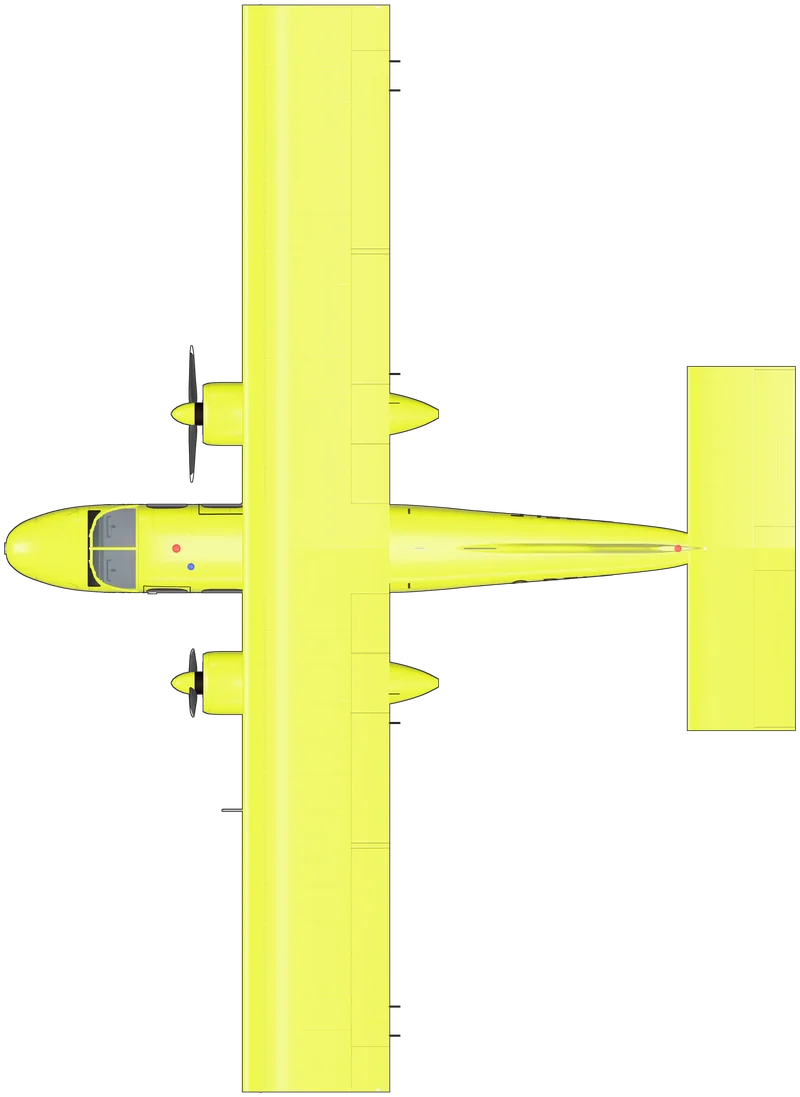
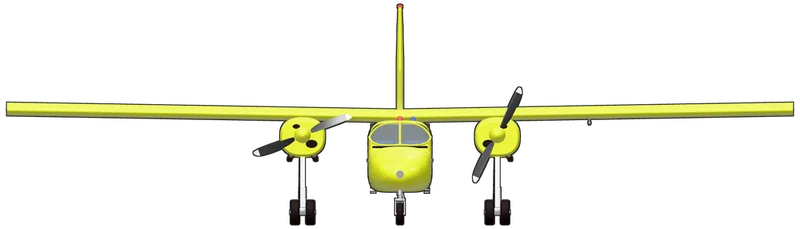
John Britten and Desmond Norman met as apprentices at de Havilland, built a light aircraft of their own in a shed on the Isle of Wight and in 1954 set up in business at Bembridge converting Tiger Moths for crop spraying. Flying their sprayers round the islands of the Caribbean and the Gulf of Guinea, they saw what the old Dragon Rapides and Herons were doing on short hops between poor strips and drew a replacement for them: a square-sided box of a fuselage seating ten in five rows, each pair of seats with its own door, a plain rectangular wing set high on the roof, two engines slung beneath it and a fixed undercarriage with twin wheels on each main leg. The prototype, G-ATCT, flew from Bembridge on 13 June 1965 on two 210 hp Continentals.

Loganair’s Islanders fly the shortest scheduled service in the world, the hop between Westray and Papa Westray in Orkney: timetabled at two minutes and flown in under one with a following wind.

G-BELF, construction number 823, was built at Bembridge as a BN-2A-26 and registered in January 1977.

First flight
13 June 1965
Role
Light utility transport
Maker
Britten-Norman at Bembridge, Isle of Wight, Britain
Engine
2 × Lycoming O-540-E4C5 flat-six pistons, 260 hp each
Crew
1 pilot, with up to 9 passengers
Wingspan
14.94 m (49 ft 0 in)
Length
10.86 m (35 ft 8 in)
Height
4.18 m (13 ft 9 in)
Top speed
170 mph
Built
~1,280
In service
1967–present

Aérospatiale-BAC Concorde

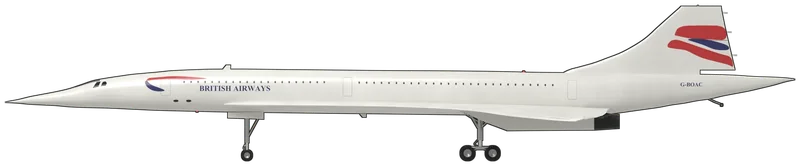
10 · Supersonic airliner · 102 G-BOAC
Side view of the Aérospatiale-BAC Concorde, 102 G-BOAC
Port side
Top view of the Aérospatiale-BAC Concorde, 102 G-BOAC
Plan, from above
Front view of the Aérospatiale-BAC Concorde, 102 G-BOAC
Head-on

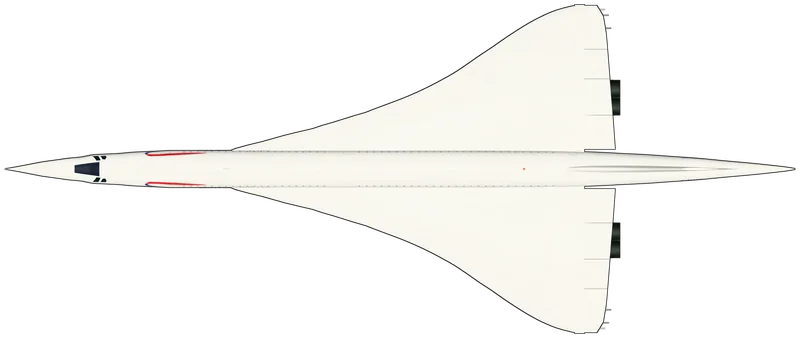
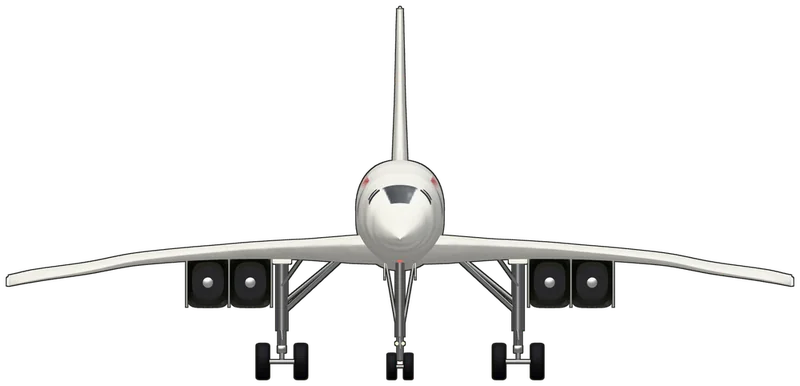
Concorde was a joint Anglo-French programme, agreed by treaty in 1962, to build an airliner that flew at twice the speed of sound. Its slender ogival delta wing and drooping nose gave it a shape unlike any other airliner. The French prototype first flew at Toulouse on 2 March 1969, and the British prototype followed from Filton on 9 April.

Heated by air friction at Mach 2, Concorde’s airframe stretched by up to about 25 centimetres in flight and shrank back again after landing.

G-BOAC was one of British Airways’ original Concordes and served with the airline until the fleet was retired in 2003.

First flight
2 March 1969
Role
Supersonic airliner
Maker
Aérospatiale and British Aircraft Corporation, Britain
Engine
4 × Rolls-Royce/Snecma Olympus 593 Mk 610 turbojets with reheat, 38,050 lbf each
Crew
3 flight crew and up to 100 passengers
Wingspan
25.6 m (84 ft 0 in)
Length
61.66 m (202 ft 4 in)
Height
12.19 m (40 ft 0 in)
Top speed
Mach 2.04
Built
20
In service
1976–2003

British Aerospace Jetstream 31

11 · Commuter airliner · Jetstream 31 G-JSSD
Side view of the British Aerospace Jetstream 31, Jetstream 31 G-JSSD
Port side
Top view of the British Aerospace Jetstream 31, Jetstream 31 G-JSSD
Plan, from above
Front view of the British Aerospace Jetstream 31, Jetstream 31 G-JSSD
Head-on

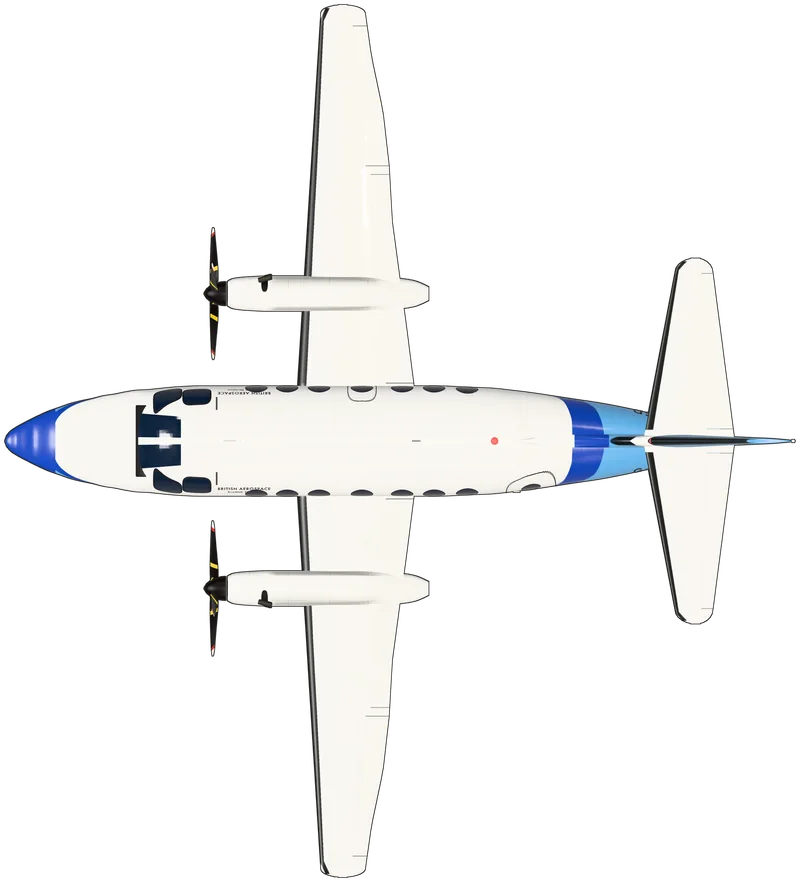
The Jetstream was Handley Page’s last design and the one that sank the firm. The HP.137 was a small pressurised turboprop with eighteen seats, aimed at the American commuter airlines, and it first flew from Radlett on 18 August 1967 on two Turbomeca Astazou engines. The engines were late and underpowered, an order from the United States Air Force was cancelled, and the development bill overwhelmed a company that had built the Halifax and the Victor.

The Jetstream 31 prototype G-JSSD began life in 1969 as one of Handley Page’s own Jetstream 1s and was rebuilt with new engines eleven years later; it is the aircraft shown here.

G-JSSD was built by Handley Page at Radlett in 1969 as Jetstream 1 G-AXJZ and sold at once to the United States.

First flight
28 March 1980
Role
Commuter airliner
Maker
Handley Page, then Scottish Aviation and British Aerospace at Prestwick, Britain
Engine
2 × Garrett TPE331-10 turboprops, 900 shp each
Crew
2, with up to 19 passengers
Wingspan
15.85 m (52 ft 0 in)
Length
14.37 m (47 ft 2 in)
Height
5.37 m (17 ft 7 in)
Top speed
275 mph
Built
~90
In service
1982–present (Jetstream family from 1969)

British Aerospace 146

12 · VIP and communications transport · BAe 146 CC.2 ZE701
Side view of the British Aerospace 146, BAe 146 CC.2 ZE701
Port side
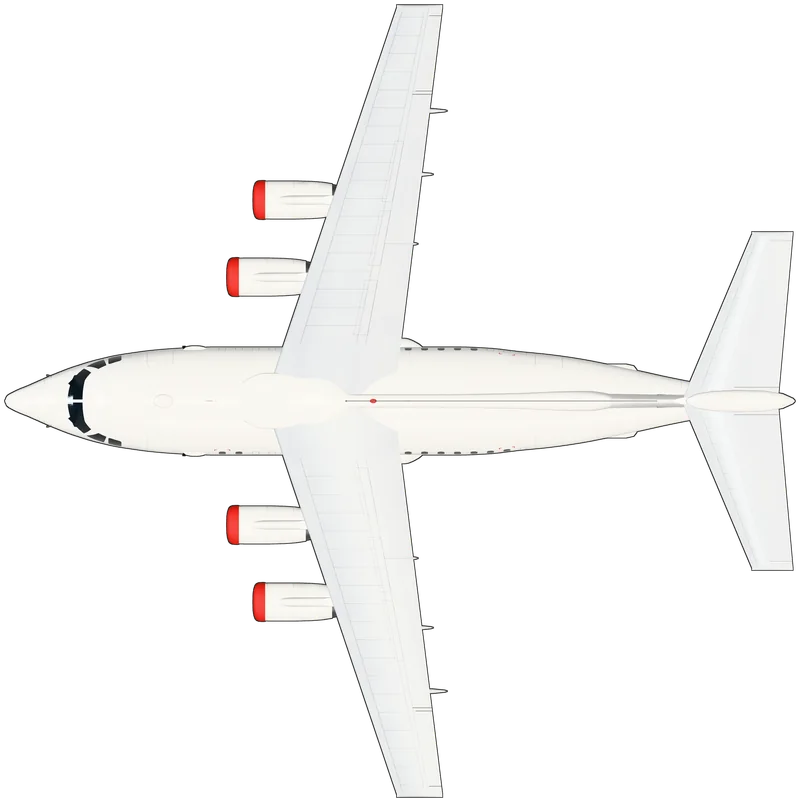
Top view of the British Aerospace 146, BAe 146 CC.2 ZE701
Plan, from above
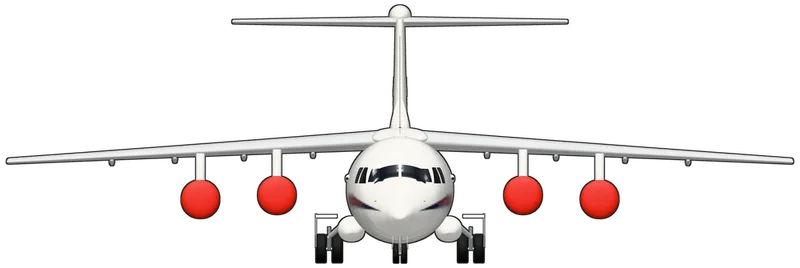
Front view of the British Aerospace 146, BAe 146 CC.2 ZE701
Head-on

Hawker Siddeley launched the HS.146 in August 1973 as a quiet regional airliner able to work from short runways close to towns. Rather than two big engines it used four small Lycoming ALF 502 turbofans, slung in pods beneath a high wing, with a T-tail and a tail cone that split open as an airbrake for steep approaches. The oil crisis halted work in October 1974, but the newly formed British Aerospace relaunched the design in July 1978, and the first 146-100 flew from Hatfield on 3 September 1981.

The 146’s tail cone splits into two petals that open as an airbrake, letting it descend steeply and slowly without extra engine noise, which helped it into noise-sensitive airports such as London City.

ZE701 was one of the two 146 ‘Statesman’ VIP aircraft delivered to The Queen’s Flight in 1986, and for almost nine years it flew the Royal Family from Benson.

First flight
3 September 1981
Role
VIP and communications transport
Maker
British Aerospace (Hawker Siddeley design), Britain
Engine
4 × Avco Lycoming ALF 502R-5 turbofans, about 6,970 lbf each
Crew
2 pilots and cabin crew, with a VIP cabin for royal and ministerial passengers
Wingspan
26.21 m (86 ft 0 in)
Length
26.19 m (85 ft 11 in)
Height
8.59 m (28 ft 2 in)
Top speed
498 mph
Built
387
In service
1986–2022

Compared

Specifications at a glance

Span, length, speed and production for every aircraft on this page.

Specifications compared
AircraftFirst flewRoleSpanLengthTop speedBuiltUK museums
de Havilland Dove1945Feeder airliner & communications17.37 m11.96 m230 mph~6909
Douglas C-47 Dakota1935Military transport28.96 m19.65 m224 mph~16,0005
Vickers Viscount1948Turboprop airliner28.56 m24.74 m352 mph4455
Armstrong Whitworth Argosy C.11959Twin-boom tactical freighter35.05 m27.18 m285 mph743
Hawker Siddeley Trident1962Short-haul airliner29.87 m34.98 m610 mph1176
Vickers VC101962Long-range airliner44.55 m48.36 m580 mph545
BAC One-Eleven1963Short-haul airliner28.5 m32.61 m541 mph2445
Hawker Siddeley Andover E.3A1963Kneeling rear-loading tactical freighter29.95 m23.77 m326 mph~3803
Britten-Norman Islander1965Light utility transport14.94 m10.86 m170 mph~1,2804
Aérospatiale-BAC Concorde1969Supersonic airliner25.6 m61.66 mMach 2.04206
British Aerospace Jetstream 311980Commuter airliner15.85 m14.37 m275 mph~906
British Aerospace 1461981VIP and communications transport26.21 m26.19 m498 mph3875

Questions

Asked and answered

What was the first turboprop airliner?

The Vickers Viscount, which began scheduled services with British European Airways in April 1953.

What was the last British airliner?

The BAe 146 and its development, the Avro RJ, built at Woodford until 2001.

Where can I see Concorde?

Concordes are preserved at Brooklands, Aerospace Bristol, IWM Duxford, the Fleet Air Arm Museum, Manchester Airport and East Fortune. See where to see Concorde.

More dioramas

Other collections

The models and drawings are procedural interpretations built from published dimensions, three-view drawings and photographs of each airframe, and the airfield is a compressed impression of its period, not a plan of a real station. Treat the museum aircraft as the reference.