Types you’ll see alongside
Bristol F.2b Fighter, Bristol Scout, Aérospatiale-BAC Concorde, ANEC II, Avro 504.
Aircraft hub · 1910 · Pioneer era
A box of sticks that taught Britain to fly; Shuttleworth’s came from a 1965 film set and still performs. The gazetteer currently lists it at 2 UK museums.
Last verified 2026-10-11 against the gazetteer Compendium. Airframes move — confirm on museum pages before travel.
On charge
The gazetteer records 2 Bristol Boxkite airframes (including cockpit sections and replicas where noted) across 2 UK collections, in 2 regions: East of England, South West England.
| Museum | City | Region | Airframes recorded |
|---|---|---|---|
| Aerospace BristolChecked 2026-10-08 | Bristol | South West England | Bristol Boxkite replica Replica |
| The Shuttleworth CollectionChecked 2026-10-08 | Biggleswade | East of England | Bristol Boxkite replica G-ASPP Replica |
3D model
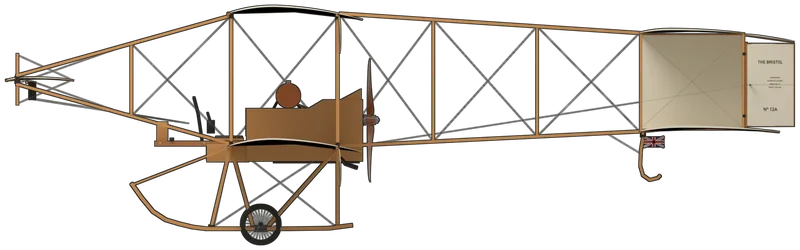
A procedural model built in Blender from the type’s published dimensions, painted as G-ASPP, The Shuttleworth Collection’s flying reproduction of the Bristol Boxkite, built by F.G. Miles in 1964 for the film ‘Those Magnificent Men in their Flying Machines’ and still flown from Old Warden: the Farman-style pusher biplane with which the British & Colonial Aeroplane Company of Filton began building aeroplanes in 1910 and trained many of Britain’s first military pilots, with equal-span wings of 34 ft 6 in, a biplane elevator carried out in front on long booms, a biplane tail with twin rudders at the back, the pilot’s seat on the lower wing’s leading edge, a long plywood box behind it housing the replica’s Continental engine with a copper fuel tank strapped on top, a two-bladed wooden pusher propeller, and twin skids each carrying a pair of spoked wheels, shown standing tail-down on its skid as parked in the hangar with the ailerons hanging: clear-doped unbleached linen with the varnished ribs showing beneath and the trailing edges scalloped between them, orange varnished wooden struts, booms and skids, a varnished plywood engine box, black fittings, a small Union flag on the tail-skid post, and ‘THE BRISTOL’, the constructor’s panel and ‘Nº 12A’ on the outer faces of both rudders, as on the original No 12A (the geometry follows the Flight three-view of the standard Boxkite scaled to the published dimensions; the wing gap, ailerons, rudders and central tail fin are taken from photographs of G-ASPP). Drag to orbit, scroll or pinch to zoom · all 215 models · download .glb (660 KB) · Plate 07 in The Hangar
Computed from the survey
Bristol F.2b Fighter, Bristol Scout, Aérospatiale-BAC Concorde, ANEC II, Avro 504.
East of England has 1 collection recording the type.
Type notes
| Type | Bristol Boxkite (flying reproduction) |
|---|---|
| UK museums holding one | 2 |
| Airframes recorded in this survey | 2 |
Serials are the gazetteer's survey snapshot of what each collection records on charge — restorations move between workshops and reserve hangars, so check the museum page for opening times and current display status before travelling. Every type across 119 museums is indexed in the Compendium.
Aircraft questions
The Aviation Gazetteer records 2 Bristol Boxkite airframes in UK collections.
Aerospace Bristol has the most in this survey, with 1 recorded airframe.