Specifications compared
| Variant compared | Lightning F.6 | Phantom (British Spey versions) |
|---|---|---|
| First flight | 4 Aug 1954 (P.1A) | 27 Jun 1966 (F-4K); 17 Feb 1967 (F-4M) |
| Entered service | Jul 1960 (type) | 1968 (Royal Navy); 1969 (RAF) |
| Max speed | Mach 2.0+ (with Red Top, 36,000 ft) | Mach 1.9 at 40,000 ft |
| Engine | 2 × Rolls-Royce Avon 301R, 12,690 lbf dry / 16,360 lbf with reheat | 2 × Rolls-Royce Spey, 12,140 lbf dry / 20,500 lbf with reheat |
| Armament | 2 × 30 mm ADEN cannon; 2 × Red Top or Firestreak missiles | Up to 4 Sparrow or Skyflash and 4 Sidewinder missiles; bombs and rockets |
| Number built | 337 (including prototypes) | 170 new for the UK (52 F-4K, 118 F-4M) |
| Crew | 1 | 2 |
British rocket, American workhorse
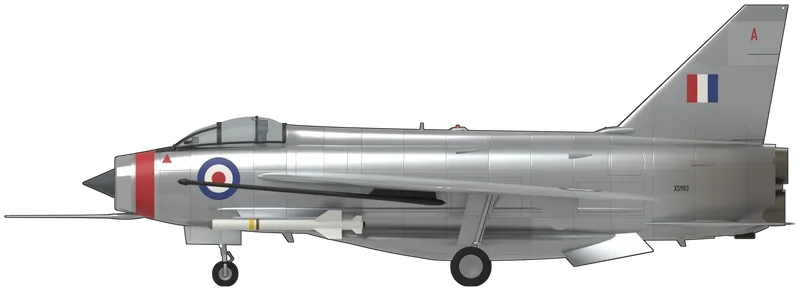
The Lightning was designed by English Electric for Mach 2. The P.1A research aircraft flew on 4 August 1954, and the fighter entered front-line service in July 1960. Its thin wings held most of its fuel, so capacity was small.
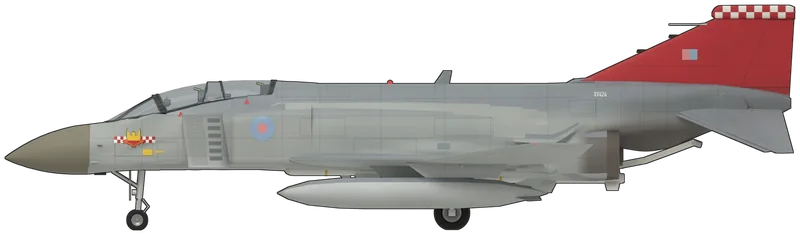
The Phantom was an American design re-engined for Britain with Rolls-Royce Spey turbofans. The Royal Navy's version flew on 27 June 1966 and the RAF's on 17 February 1967. The Speys needed intakes 20% larger, which added drag.
The Lightning's two Avons were stacked one above the other in the fuselage, an unusual layout among fighters.
Performance and use
Pilots likened the Lightning to being saddled to a skyrocket. An F.6 with Red Top missiles could reach Mach 2.0 at 36,000 ft. Its supersonic intercept radius was only 135 nautical miles.
The Phantom could carry up to eight missiles to the Lightning's two. It also had more fuel and a more powerful radar. From 1969, Phantoms at Leuchars shared the northern quick reaction alert with Lightnings.
The Spey made British Phantoms quicker off the deck and better at low level. At height they were slower than American J79-engined versions.
The record
English Electric built 337 Lightnings, including prototypes. The RAF flew them from 1960 until April 1988.
Britain bought 52 Phantoms for the Navy and 118 for the RAF. Fifteen second-hand F-4Js were added in 1984. The last RAF Phantoms retired in 1992.
Lightnings were also sold to Saudi Arabia and Kuwait. Several F.53s now in British museums came back from Saudi service.
The myth: faster means better
The Lightning's speed and climb were remarkable, but its fuel shaped every sortie. Overwing tanks on the F.6 extended its range but reduced its top speed. Against bombers far out over the North Sea, the Phantom's endurance counted for more.
Nor were British Phantoms simply better than American ones. The RAF rated the J79-engined F-4J(UK) the best of its three Phantom versions.
Where to see a Lightning and a Phantom
Eleven gazetteer museums hold both, including the Royal Air Force Museum London and IWM Duxford, which adds an F-4J(UK). Bentwaters Cold War Museum, Tangmere Military Aviation Museum and Solway Aviation Museum each show a complete Lightning and Phantom FGR.2.
| Museum | Adult entry | Airframes | Headline exhibit |
|---|---|---|---|
| Bentwaters Cold War MuseumWoodbridge, Suffolk | £7.50 | 9 | Bentwaters Cold War Museum occupies the actual USAF hardened command post — war room, battle cabin and decontamination showers intact —… |
| City of Norwich Aviation MuseumNorwich, Norfolk | £9 | 33 | City of Norwich Aviation Museum at Horsham St Faith: Norfolk's largest, ~30 airframes including a Vulcan and Nimrod with bookable… |
| IWM DuxfordCambridge, Cambridgeshire | £29 | 146 | Concorde 101 (G-AXDN), the pre-production development aircraft and the fastest Concorde of them all at Mach 2.23 — plus an SR-71A… |
| Midland Air MuseumCoventry, Warwickshire | £11 | 66 | Vulcan XL360 with cockpit access and volunteer-led tours (ask for the instrumentation talk), plus the Whittle jet heritage collection a… |
| MorayviaForres, Moray | £8 | 35 | Nimrod XV244 (complete, and the crew who operated her sometimes give the tours) alongside a Sea King in RAF SAR yellow — the machine that… |
| National Museum Of FlightNorth Berwick, East Lothian | £15 | 47 | Concorde G-BOAA, which flew British Airways' first commercial supersonic service in 1976 and arrived here by barge and giant road-crawl… |
| Norfolk and Suffolk Aviation MuseumBungay, Suffolk | £10 | 65 | Depends who you ask — the joy is the oddities. Come for the Bloodhound missiles and decoy rarities; stay for volunteer flight-simulator… |
| Royal Air Force Museum LondonLondon, Greater London | Free | 88 | Avro Lancaster R5868 'S-Sugar' — 137 operations, the RAF's highest-scoring surviving heavy — under the same roof as a Vulcan, a… |
| Royal Air Force Museum MidlandsShifnal, Shropshire | Free | 78 | TSR-2 XR220, one of two survivors of the most gifted aircraft Britain ever cancelled, sharing floor space with the stainless-steel… |
| Solway Aviation MuseumCrosby on Eden, Cumbria | £8 | 21 | Vulcan XJ823 with pre-bookable crew-compartment visits; a Phantom, Lightning and Canberra (whose three-crew cockpit reviewers describe as… |
| Tangmere Military Aviation MuseumChichester, West Sussex | £15 | 23 | Hawker Hunter WB188 in one-off scarlet, in which Neville Duke took the world air speed record to 727.63 mph off this coast in 1953;… |
Frequently asked
Was the Lightning faster than the Phantom?
Slightly, and it climbed faster. But the Phantom had far more fuel and could carry eight missiles to the Lightning's two.
Why did the RAF buy Phantoms when it had Lightnings?
The Lightning had limited range, radar and weapons. The Phantom could patrol further and longer, which suited long interceptions of Soviet bombers.
Where can I see a Lightning and a Phantom together?
Many places: the Royal Air Force Museum London, IWM Duxford, Bentwaters Cold War Museum, Tangmere Military Aviation Museum and Solway Aviation Museum among them.