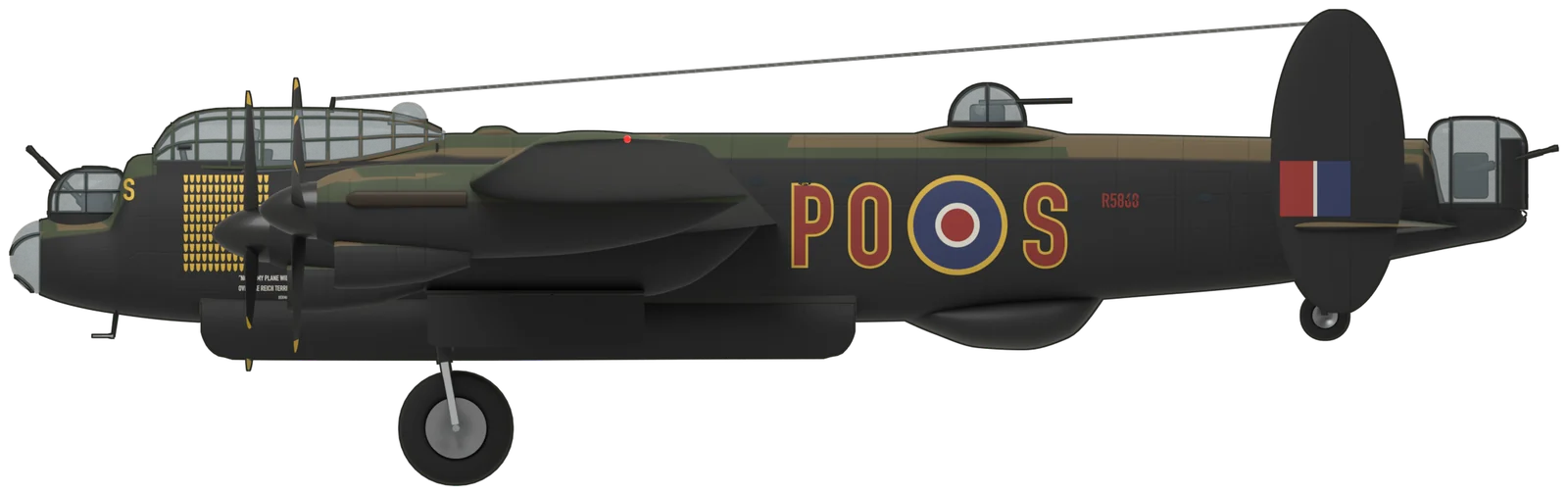
3D model
Turn it over
A procedural model built in Blender from published dimensions, drawings and photographs, painted as R5868, PO-S “S for Sugar” of No. 467 Squadron in 1944. Drag to orbit, scroll or pinch to zoom · download .glb (1.9 MB)
History
The Lancaster
The Lancaster rose from a failure. Avro’s twin-engined Manchester was let down by its Rolls-Royce Vulture engines, so Roy Chadwick’s team gave it a longer wing and four Merlins. The prototype flew in January 1941, and the Lancaster became Bomber Command’s most successful heavy bomber.
Its long, unobstructed bomb bay could carry the 22,000 lb Grand Slam and the bouncing bombs of the Dams raid. Lancasters flew some 156,000 sorties, and more than 3,000 were lost in action with their crews of seven.
7,377 were built. Two still fly, the Battle of Britain Memorial Flight’s PA474 and Canada’s FM213, and “Just Jane” still taxies at East Kirkby.
This airframe
B.I R5868 “S for Sugar”
R5868 was built by Metropolitan-Vickers in 1942 and flew 68 sorties with No. 83 Squadron as OL-Q before joining No. 467 Squadron RAAF at Bottesford as PO-S, “S for Sugar”. Beneath its tally of 137 sorties is Hermann Göring’s boast that no enemy aircraft would fly over the Reich. It is the centrepiece of the Bomber Hall at the RAF Museum London.
Where to see one
In the gazetteer
The gazetteer records the Lancaster in 6 UK collections. The airframe modelled here is marked.