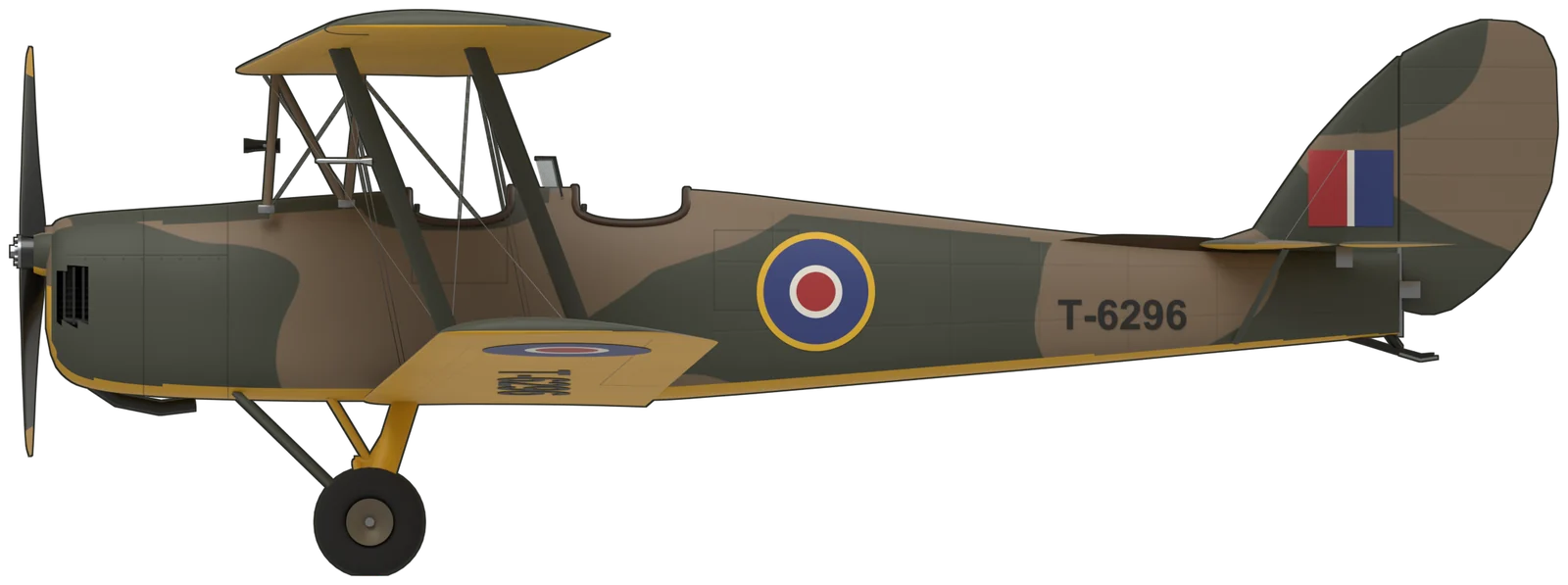
3D model
Turn it over
A procedural model built in Blender from published dimensions, drawings and photographs, painted as T6296, a wartime DH.82A Tiger Moth II, in Dark Earth and Dark Green camouflage over trainer-yellow undersides, with Type B upper-wing roundels, Type C1 fuselage roundels and a red, white and blue fin flash, as it is preserved by the Royal Air Force Museum at Cosford. Drag to orbit, scroll or pinch to zoom · download .glb (808 KB)
History
The Tiger Moth II
The Tiger Moth grew out of de Havilland’s DH.60 Moth. To let the instructor in the front seat bail out wearing a parachute, the upper wing’s centre section was moved forward, clear of the front cockpit, and the wings were swept back slightly to keep the balance right. The first DH.82 flew at Stag Lane on 26 October 1931, and the RAF ordered it as an elementary trainer the following year.
The DH.82A Tiger Moth II of 1934 had the more powerful Gipsy Major engine and a plywood rear decking in place of fabric. When war came it became the standard first trainer of the RAF and the Empire air training schemes, and it was built in Canada, Australia and New Zealand as well as Britain. From 1940 Morris Motors at Cowley took over British production so that Hatfield could concentrate on the Mosquito. A radio-controlled target version, the DH.82B Queen Bee, gave us the word ‘drone’.
The Chipmunk replaced it in the RAF in the early 1950s, and hundreds of surplus Tiger Moths went to flying clubs, crop-sprayers and private owners, many of which still fly. The Royal Navy kept a few for glider towing and to give Dartmouth cadets their first taste of flying until 1972.
This airframe
Tiger Moth II T6296
T6296 was built by Morris Motors at Cowley in 1941 and taught RAF pupils at No. 1 Elementary Flying Training School at Hatfield and No. 7 EFTS at Desford. In December 1946 it passed to the Royal Navy, where it spent more than twenty years towing gliders, giving Dartmouth cadets air experience and flying communications with No. 781 Squadron at Lee-on-Solent. It made its last flight in December 1969 and joined the RAF Museum in 1972. It was displayed at Hendon for many years and is now at RAF Museum Midlands, Cosford. The model shows it in wartime Dark Earth and Dark Green camouflage over trainer-yellow undersides, with Type B roundels on the upper wing, Type C1 roundels on the fuselage, Type C roundels and the serial under the lower wings, and a red, white and blue fin flash.
Where to see one
In the gazetteer
The gazetteer records the Tiger Moth II in 5 UK collections. The airframe modelled here is marked.