AP 118 · No. 10 Section II · Aircraft Collection 12 / 12

Aircraft/Collections/Trainers

Flying training school · 1932–today

Learning to fly: RAF trainers

Every RAF pilot started somewhere: biplanes, piston monoplanes, the first jet trainers and the Hawk, flying circuits and bumps together.

11
Aircraft
1932–present
Period
22
UK museums hold them

The diorama

Diorama · 1932–present

Loading the airfield…

A flying training school airfield: a concrete runway and taxiway, an apron lined with trainers, hangars and a control tower. Every aircraft flies its own circuit, the same pattern pupils fly on their first solo.

Drag to look around · ctrl + scroll to zoom · pick an aircraft to follow it

An RAF pilot’s training has always run in stages: elementary flying on a light, forgiving aircraft; basic and advanced training on something faster and harder; then an operational conversion unit for the front-line type. The aircraft for each stage changed with the front line they fed.

In the Second World War pupils went solo on the Tiger Moth or Magister, then moved to the Harvard or, for bomber crews, the Airspeed Oxford. Many trained overseas under the Empire Air Training Scheme in Canada, South Africa and Rhodesia, and some in the United States, where RAF cadets learned on the Stearman. After the war the Chipmunk replaced the Tiger Moth, and the Provost the Harvard.

The Jet Provost, which first flew in 1954, made the RAF the first air force to train pilots on jets from their very first lesson. The Gnat taught the fast-jet stream and flew with the Red Arrows, the Bulldog took over elementary training, the Dominie trained navigators and the Hawk, from 1976, became the advanced trainer for a generation and the Red Arrows’ mount.

To scale

The collection side by side

Every aircraft drawn at the same scale, so a Dominie T.1 and a Bulldog T.1 can be compared at a glance.

  • de Havilland Tiger Moth side profile, to scaleTiger Moth II · 7.29 m
  • Miles Magister side profile, to scaleMagister · 7.51 m
  • Boeing-Stearman Kaydet side profile, to scaleKaydet · 7.54 m
  • North American Harvard side profile, to scaleHarvard · 8.84 m
  • Airspeed Oxford side profile, to scaleOxford · 10.52 m
  • de Havilland Canada Chipmunk side profile, to scaleChipmunk · 7.75 m
  • Percival Provost side profile, to scaleProvost · 8.74 m
  • Folland Gnat side profile, to scaleGnat T.1 · 9.68 m
  • Scottish Aviation Bulldog T.1 side profile, to scaleBulldog T.1 · 7.09 m
  • Hawker Siddeley Dominie side profile, to scaleDominie T.1 · 14.45 m
  • BAe Hawk T.1A side profile, to scaleHawk T.1A · 11.17 m

10 m

Profiles

Side, top and front

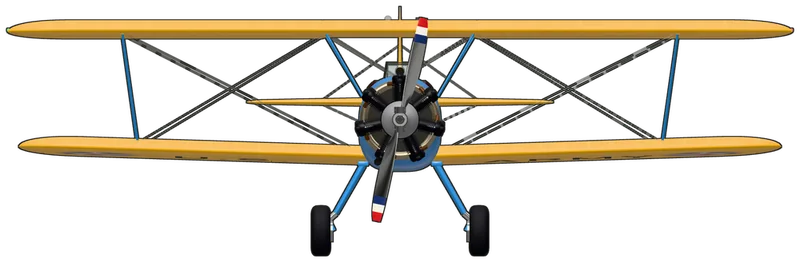
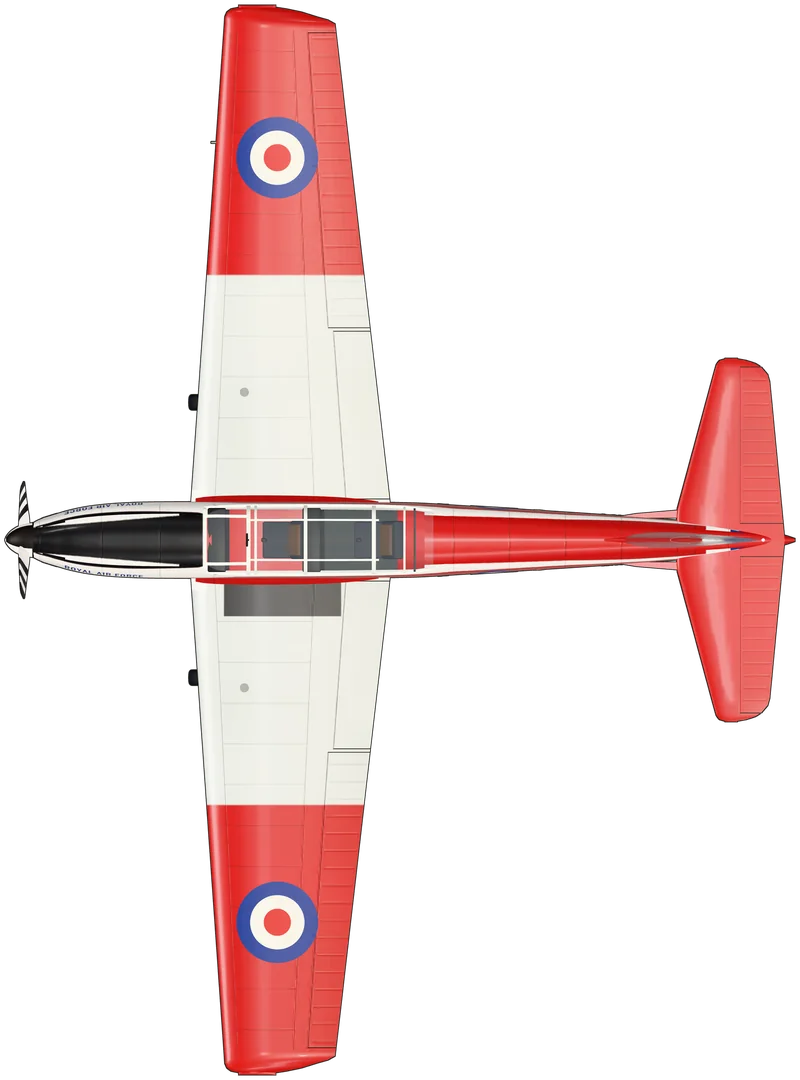
Each aircraft drawn from its 3D model, painted as one real airframe, with its specification.

de Havilland Tiger Moth

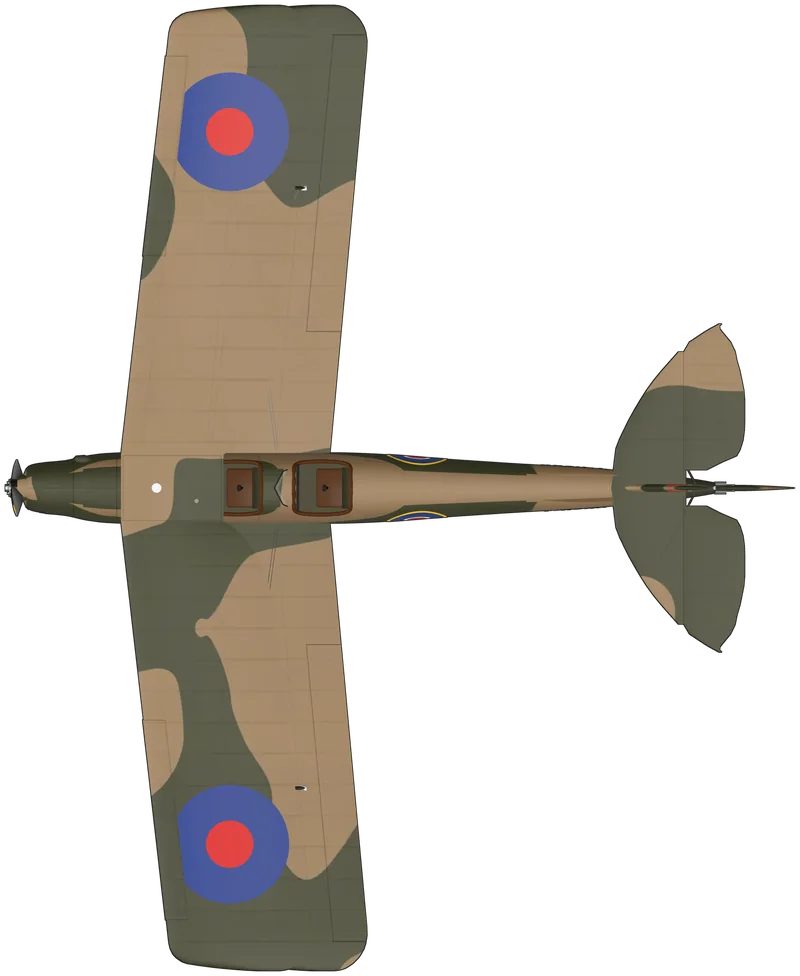
01 · Elementary trainer · Tiger Moth II T6296
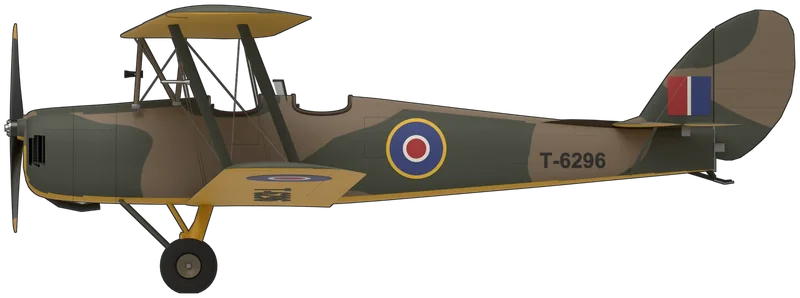
Side view of the de Havilland Tiger Moth, Tiger Moth II T6296
Port side
Top view of the de Havilland Tiger Moth, Tiger Moth II T6296
Plan, from above
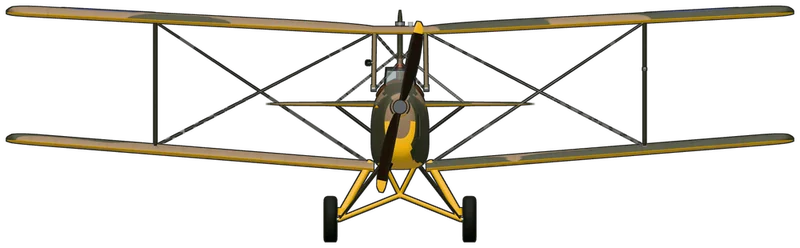
Front view of the de Havilland Tiger Moth, Tiger Moth II T6296
Head-on

The Tiger Moth grew out of de Havilland’s DH.60 Moth. To let the instructor in the front seat bail out wearing a parachute, the upper wing’s centre section was moved forward, clear of the front cockpit, and the wings were swept back slightly to keep the balance right. The first DH.82 flew at Stag Lane on 26 October 1931, and the RAF ordered it as an elementary trainer the following year.

The swept-back wings were not for speed: they balanced the aircraft after the upper centre section was moved forward so the front-seat occupant could escape by parachute.

T6296 was built by Morris Motors at Cowley in 1941 and taught RAF pupils at No. 1 Elementary Flying Training School at Hatfield and No. 7 EFTS at Desford.

First flight
26 October 1931
Role
Elementary trainer
Maker
de Havilland, Britain
Engine
de Havilland Gipsy Major I four-cylinder inverted inline, 130 hp
Crew
2
Wingspan
8.94 m (29 ft 4 in)
Length
7.29 m (23 ft 11 in)
Height
2.68 m (8 ft 10 in)
Top speed
109 mph
Built
8,868
In service
1932–1955 (Royal Navy to 1972)
Miles Magister

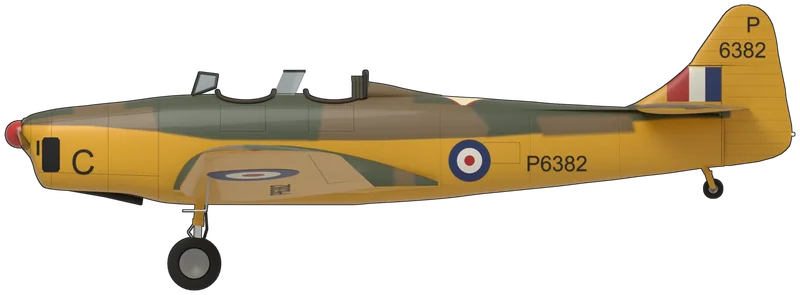
02 · Elementary trainer · Magister I P6382 (G-AJRS)
Side view of the Miles Magister, Magister I P6382 (G-AJRS)
Port side
Top view of the Miles Magister, Magister I P6382 (G-AJRS)
Plan, from above
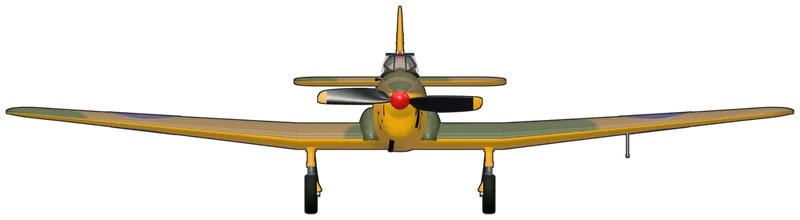
Front view of the Miles Magister, Magister I P6382 (G-AJRS)
Head-on

In the mid-1930s the RAF taught its pilots on biplanes, while the fighters they would go on to fly were becoming monoplanes. F. G. Miles of Phillips & Powis at Woodley, near Reading, had already built the Hawk Trainer, a two-seat version of his light Hawk monoplane, and the Air Ministry wrote specification T.40/36 around a militarised version of it. The prototype M.14, flown by Miles on 20 March 1937, was a low-wing monoplane built of spruce and plywood, with tandem open cockpits, flaps, a fixed undercarriage and a 130 hp de Havilland Gipsy Major I. It gave pupils the feel of a monoplane, flaps and all, before they moved on to the Harvard, the Master and then the Hurricane and Spitfire.

The Magister was the RAF’s first monoplane trainer, but it was built almost entirely of wood: a spruce and plywood airframe in an age that was turning to metal.

P6382 was built by Phillips & Powis at Woodley in 1939 and served with the RAF as an elementary trainer.

First flight
20 March 1937
Role
Elementary trainer
Maker
Phillips & Powis Aircraft (Miles), Britain
Engine
de Havilland Gipsy Major I four-cylinder inverted inline, 130 hp
Crew
2
Wingspan
10.31 m (33 ft 10 in)
Length
7.51 m (24 ft 8 in)
Height
2.03 m (6 ft 8 in)
Top speed
132 mph
Built
1,303
In service
1937–1940s

Boeing-Stearman Kaydet

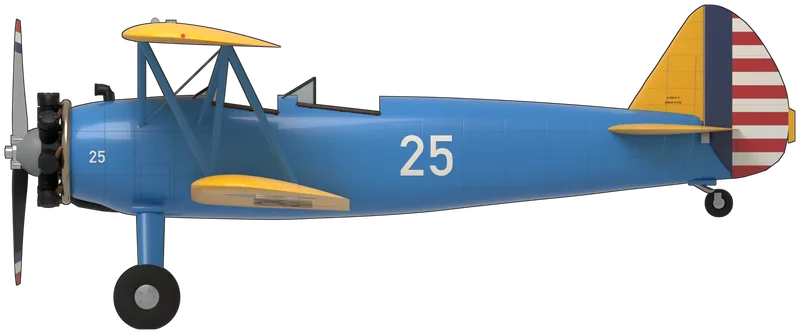
03 · Primary trainer · PT-17 Kaydet “42-17786”
Side view of the Boeing-Stearman Kaydet, PT-17 Kaydet “42-17786”
Port side
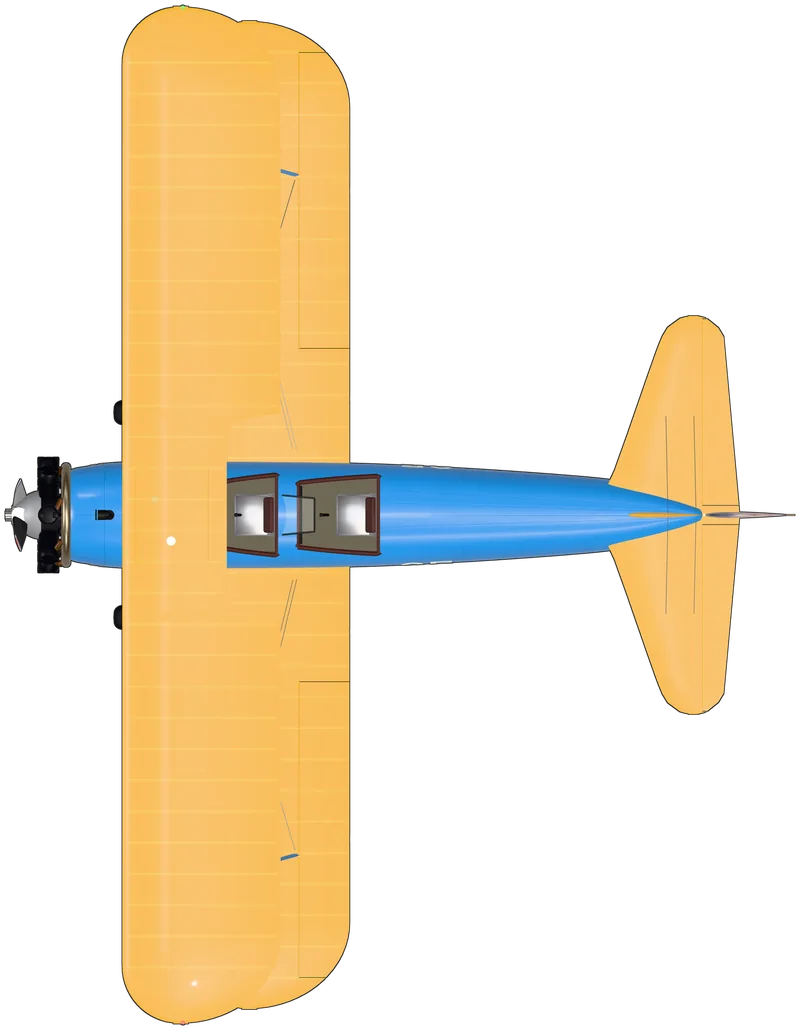
Top view of the Boeing-Stearman Kaydet, PT-17 Kaydet “42-17786”
Plan, from above
Front view of the Boeing-Stearman Kaydet, PT-17 Kaydet “42-17786”
Head-on

Stearman Aircraft of Wichita, Kansas, was already a subsidiary of Boeing when its engineers built the Model 70 as a private venture in 1933: a sturdy two-seat biplane trainer with open tandem cockpits, a welded steel-tube fuselage, fabric-covered wooden wings and a wide-track undercarriage that forgave a student’s heavy landings. The prototype first flew on 1 January 1934. The US Navy ordered 61 as the NS-1 that year, and the US Army Air Corps followed in 1936 with the PT-13, powered by a Lycoming R-680 radial.

The name Kaydet is a play on “cadet”, the young trainee pilots who flew it, and was first given to the type by the Royal Canadian Air Force.

The Imperial War Museum’s Kaydet hangs from the roof of the American Air Museum at Duxford.

First flight
1 January 1934
Role
Primary trainer
Maker
Stearman Aircraft (Boeing Wichita Division), United States
Engine
one Continental R-670-5 seven-cylinder radial, 220 hp
Crew
2
Wingspan
9.8 m (32 ft 2 in)
Length
7.54 m (24 ft 9 in)
Height
2.95 m (9 ft 8 in)
Top speed
124 mph
Built
~10,600
In service
1934–1940s

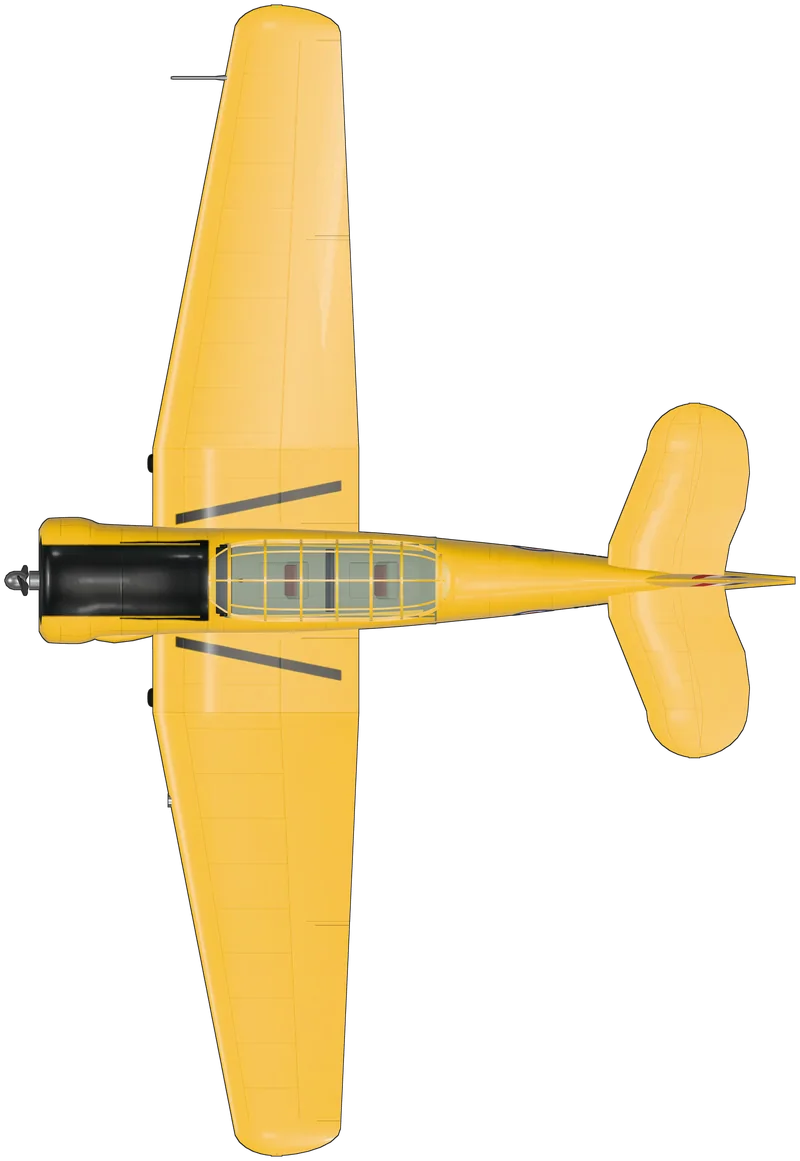
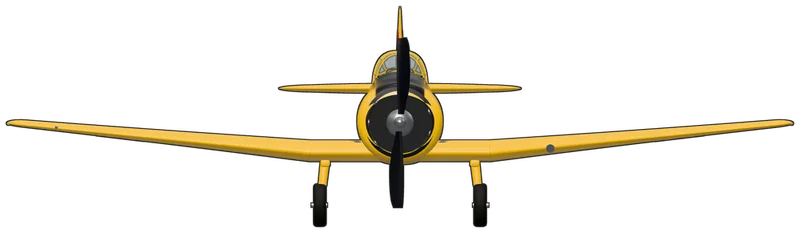
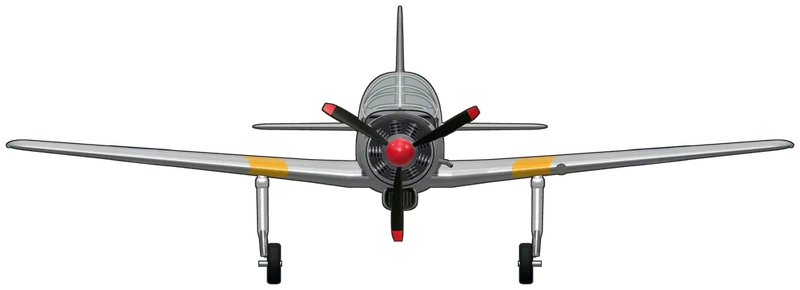
North American Harvard

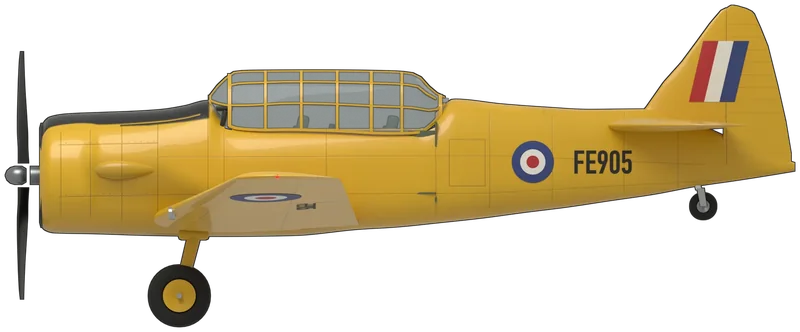
04 · Advanced trainer · Harvard IIB FE905
Side view of the North American Harvard, Harvard IIB FE905
Port side
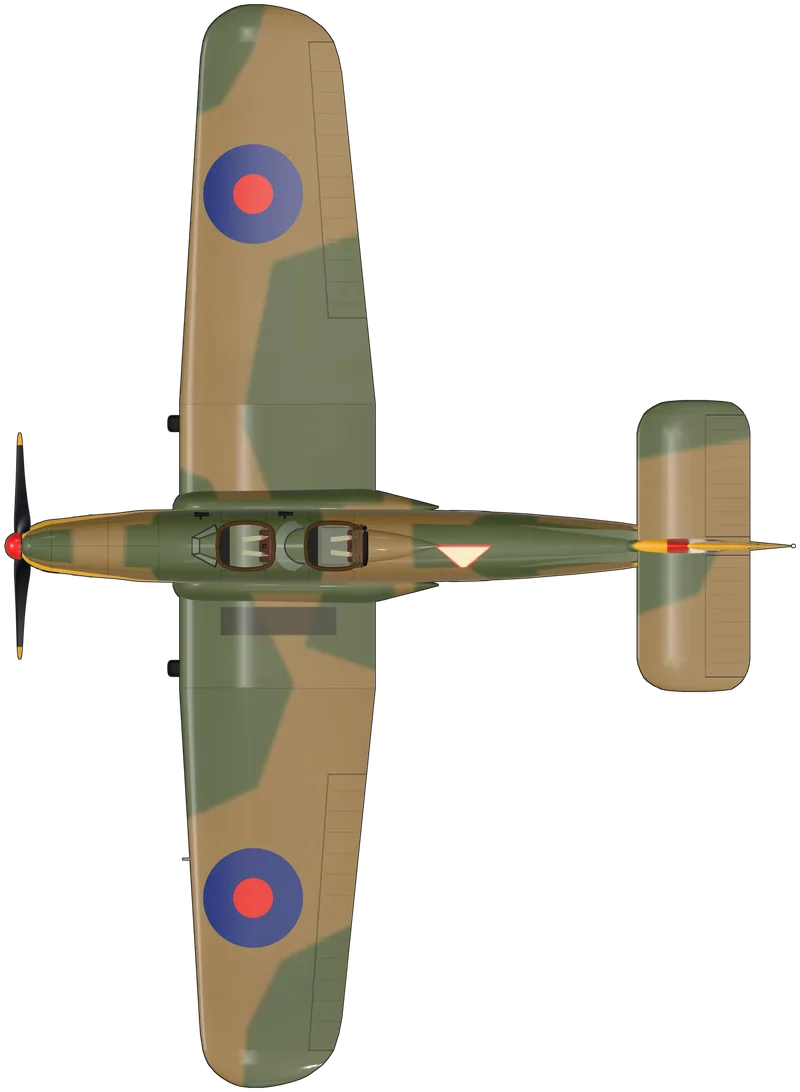
Top view of the North American Harvard, Harvard IIB FE905
Plan, from above
Front view of the North American Harvard, Harvard IIB FE905
Head-on

North American Aviation’s NA-16 first flew on 1 April 1935 and became the pattern for a long line of advanced trainers. A low-wing monoplane with a Wasp radial, a framed greenhouse canopy over two tandem cockpits and a retractable undercarriage, it taught pupils the habits of a fast, heavy fighter before they ever flew one. The RAF ordered it as the Harvard and the first arrived in 1938.

The Harvard’s propeller tips can reach supersonic speed in a dive or at full power, which is what gives the aircraft its distinctive snarl.

FE905 was built by Noorduyn in Montreal in 1943 as a Harvard IIB for the Royal Canadian Air Force.

First flight
1 April 1935
Role
Advanced trainer
Maker
North American Aviation (Noorduyn in Canada), United States
Engine
one Pratt & Whitney R-1340 Wasp nine-cylinder radial, 600 hp
Crew
2
Wingspan
12.81 m (42 ft 0 in)
Length
8.84 m (29 ft 0 in)
Height
3.57 m (11 ft 9 in)
Top speed
208 mph
Built
~20,000 (family)
In service
1938–1950s

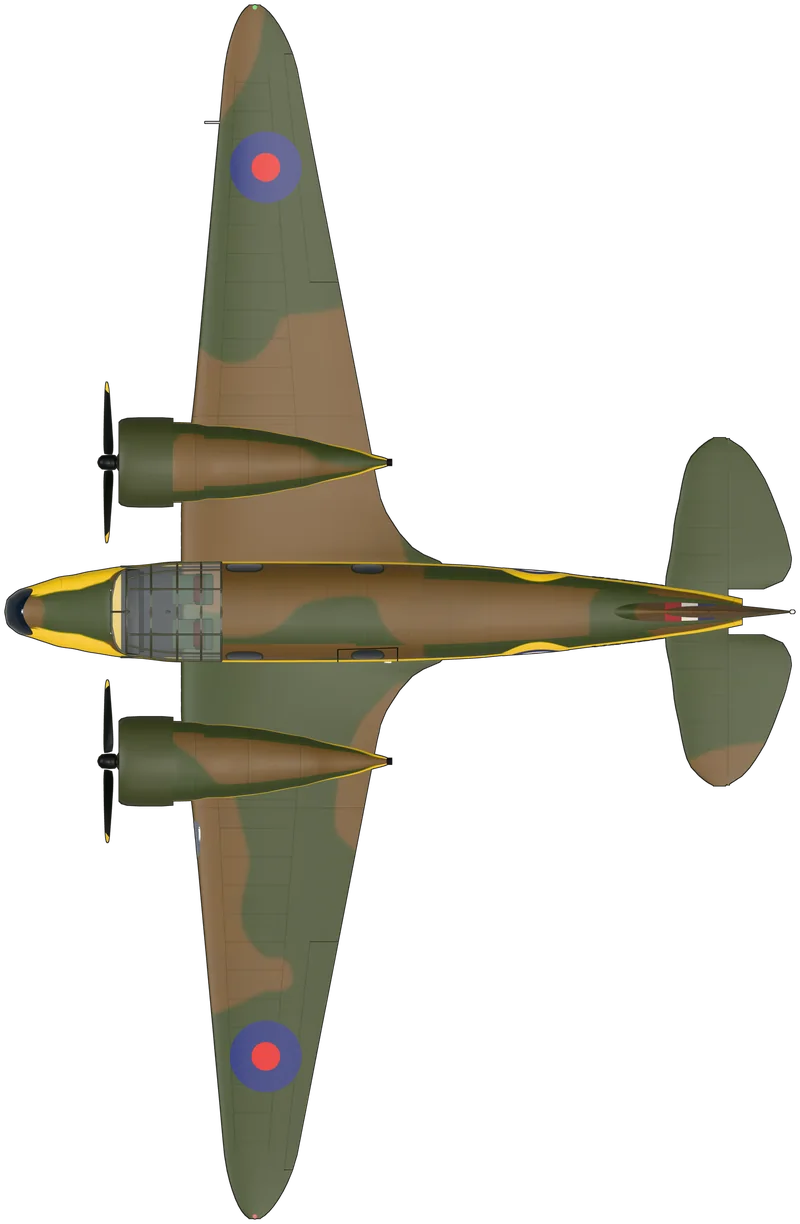
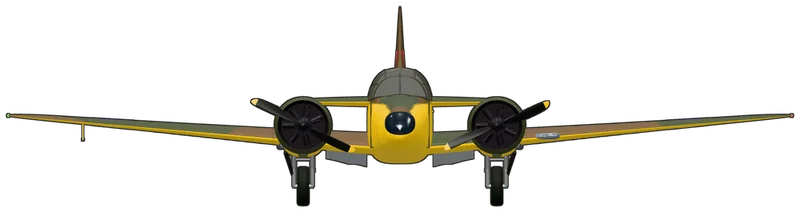
Airspeed Oxford

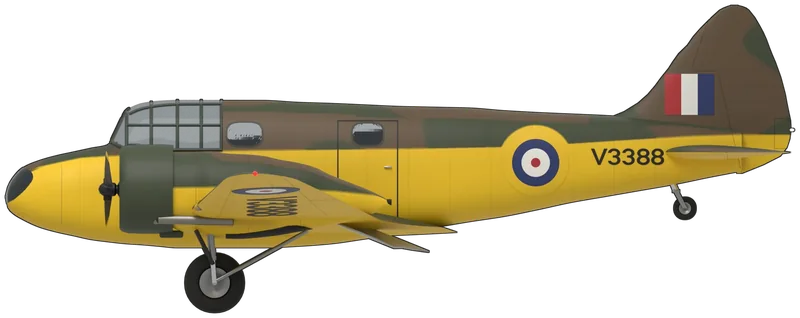
05 · Multi-engine trainer · Oxford I V3388
Side view of the Airspeed Oxford, Oxford I V3388
Port side
Top view of the Airspeed Oxford, Oxford I V3388
Plan, from above
Front view of the Airspeed Oxford, Oxford I V3388
Head-on

Airspeed based the Oxford on its Envoy, a small twin-engined airliner, to meet an Air Ministry specification for a multi-engined trainer. It was a low-winged wooden monoplane with a retractable undercarriage, flaps and a cabin for a pilot, a navigator or bomb aimer and a wireless operator or gunner. The prototype, L4534, first flew at Portsmouth on 19 June 1937, and the Central Flying School received the first Oxfords that November.

Amy Johnson was killed in an Oxford in January 1941, while ferrying one for the Air Transport Auxiliary; it came down in the Thames Estuary.

V3388 was built by de Havilland in 1940 and, after a spell in storage, had an uneventful wartime career.

First flight
19 June 1937
Role
Multi-engine trainer
Maker
Airspeed, Britain
Engine
2 × Armstrong Siddeley Cheetah X seven-cylinder radials, 375 hp each
Crew
3
Wingspan
16.26 m (53 ft 4 in)
Length
10.52 m (34 ft 6 in)
Height
3.38 m (11 ft 1 in)
Top speed
192 mph
Built
8,586
In service
1937–1956

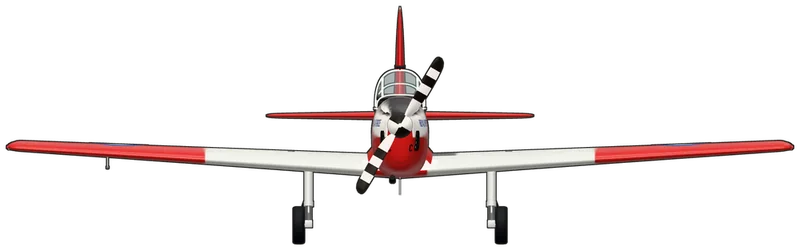
de Havilland Canada Chipmunk

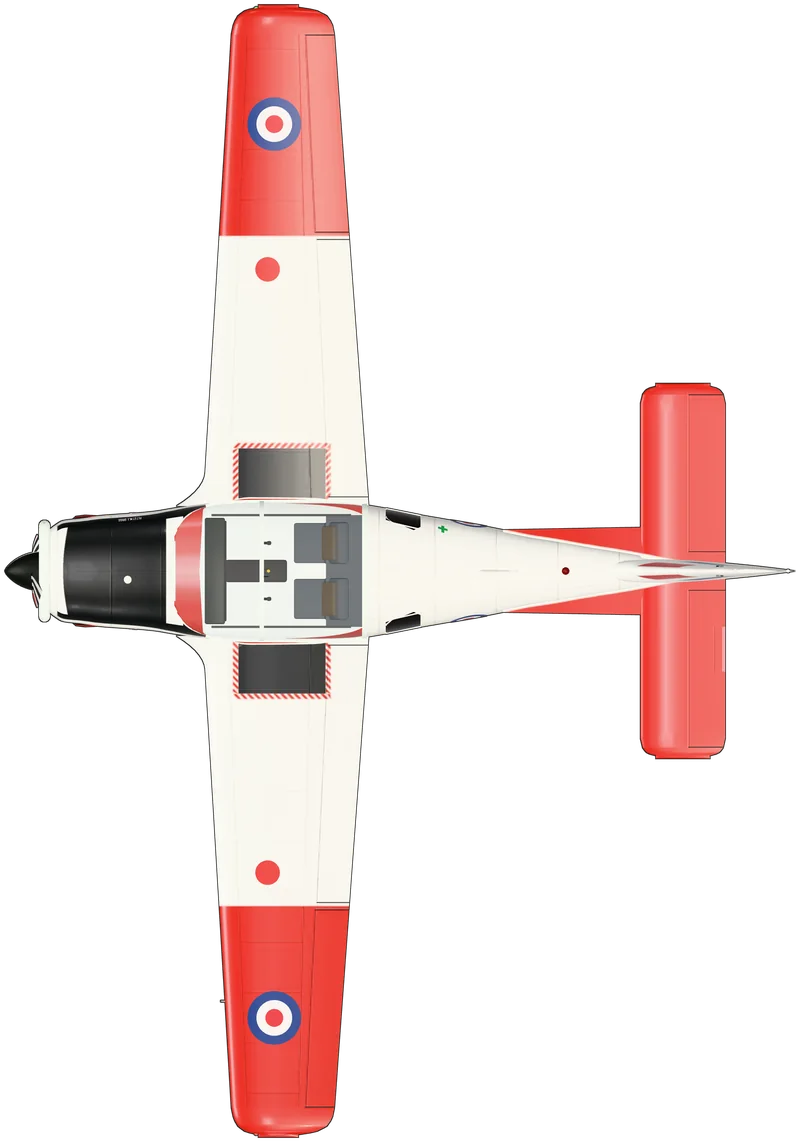
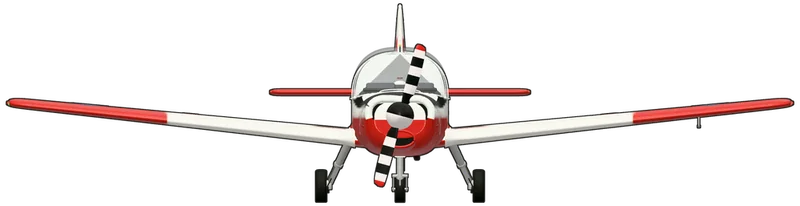
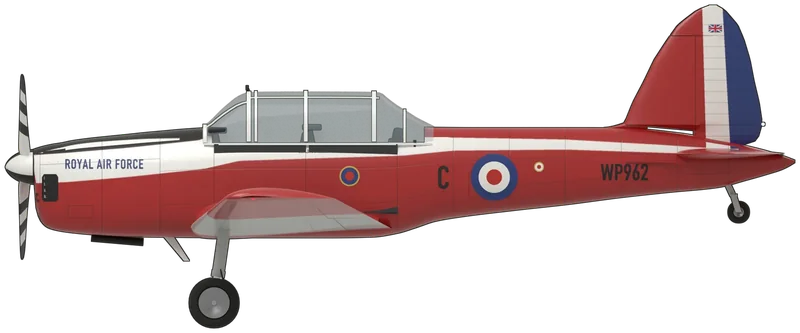
06 · Primary trainer · T.10 WP962
Side view of the de Havilland Canada Chipmunk, T.10 WP962
Port side
Top view of the de Havilland Canada Chipmunk, T.10 WP962
Plan, from above
Front view of the de Havilland Canada Chipmunk, T.10 WP962
Head-on

The Chipmunk was the first aircraft designed by de Havilland’s Canadian company. Its chief designer, the Polish engineer Wsiewołod Jakimiuk, drew a neat all-metal, low-winged two-seater with a tailwheel and a sliding canopy to replace the Tiger Moth, and the prototype first flew at Downsview, Toronto, on 22 May 1946.

The RAF took delivery of 740 Chipmunk T.10s in just four years, between November 1949 and October 1953.

WP962 was built at Broughton in 1952 and stood in the line of training aircraft at the Coronation Review at Odiham in July 1953.

First flight
22 May 1946
Role
Primary trainer
Maker
de Havilland Canada, Canada
Engine
de Havilland Gipsy Major 8 four-cylinder inverted inline, 145 hp
Crew
2
Wingspan
10.46 m (34 ft 4 in)
Length
7.75 m (25 ft 5 in)
Height
2.13 m (7 ft 0 in)
Top speed
138 mph
Built
1,283
In service
1950–1997

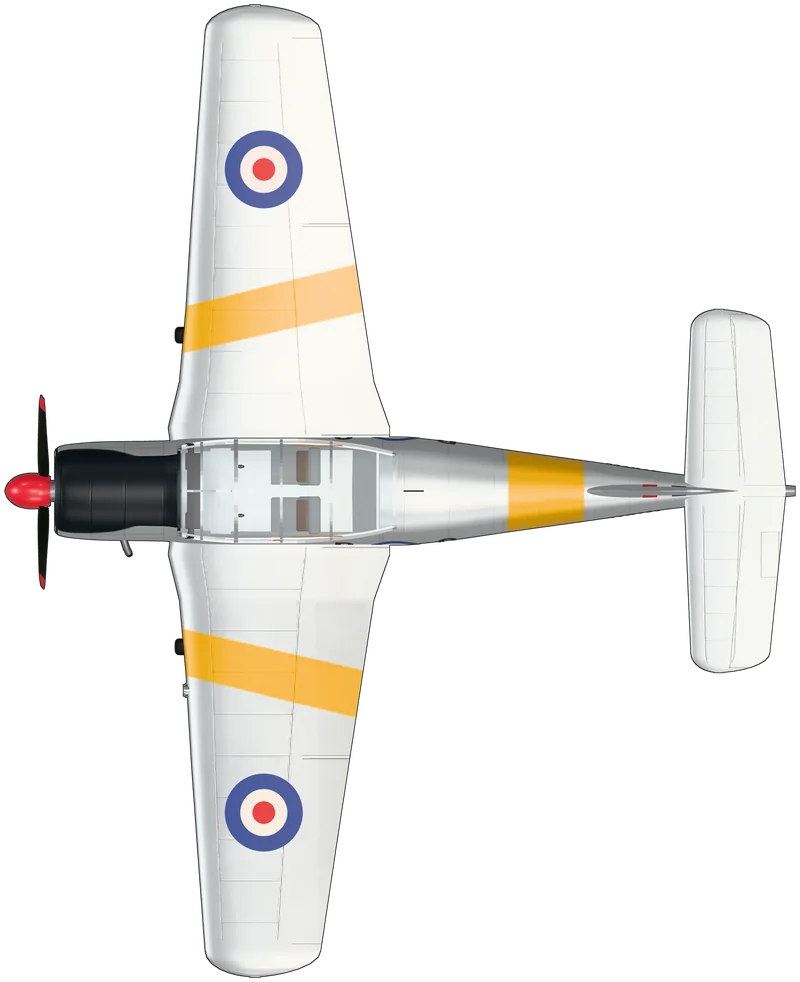
Percival Provost

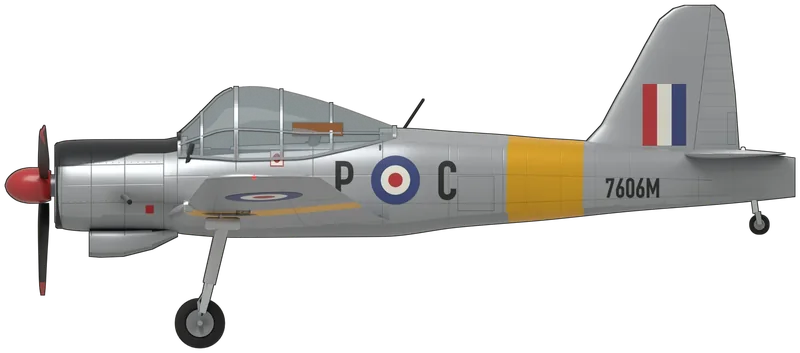
07 · Basic trainer · T.1 WV562
Side view of the Percival Provost, T.1 WV562
Port side
Top view of the Percival Provost, T.1 WV562
Plan, from above
Front view of the Percival Provost, T.1 WV562
Head-on

After the war the RAF wanted a basic trainer that behaved more like the fast aircraft its pupils would go on to fly than the old Tiger Moth did. Percival’s P.56 Provost, which first flew on 24 February 1950, was a stout low-wing monoplane with a large radial engine, a tailwheel undercarriage and a roomy cockpit where pupil and instructor sat side by side.

The Provost’s cockpit canopy and glass are so wide because pupil and instructor sit side by side, which let the instructor watch the pupil’s hands as well as the view ahead.

WV562 is a Provost T.1 that served with No. 22 Flying Training School, wearing the code “P-C”, and was later kept as an instructional airframe with the maintenance serial 7606M.

First flight
24 February 1950
Role
Basic trainer
Maker
Percival Aircraft (Hunting Percival), Britain
Engine
one Alvis Leonides 126 nine-cylinder radial, 550 hp
Crew
2
Wingspan
10.72 m (35 ft 2 in)
Length
8.74 m (28 ft 8 in)
Height
3.72 m (12 ft 2 in)
Top speed
200 mph
Built
461
In service
1953–1960s

Folland Gnat

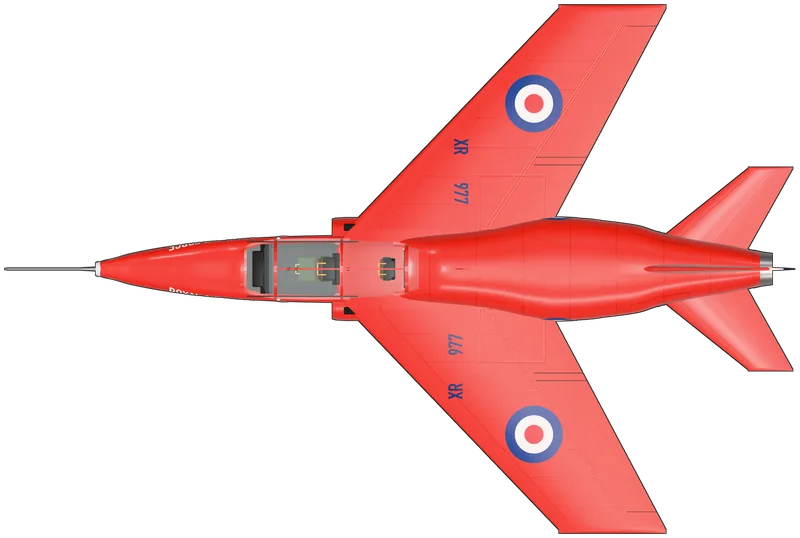
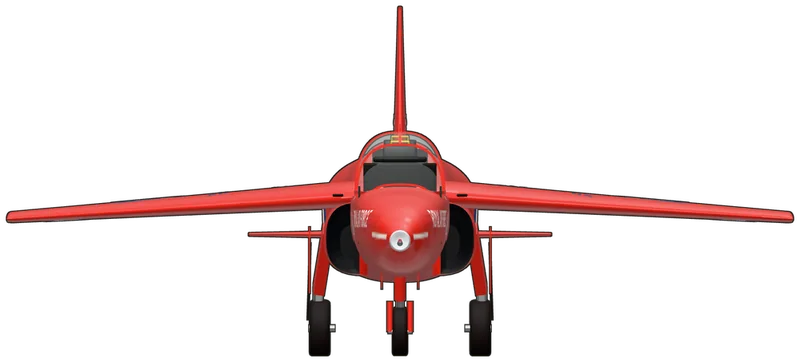
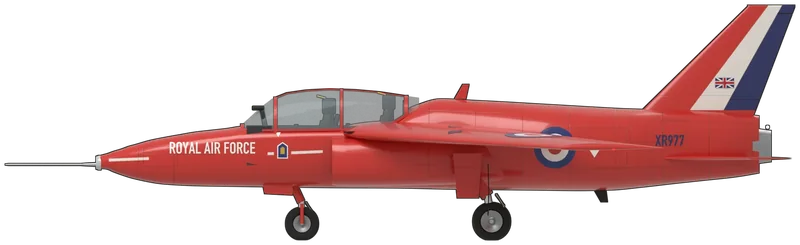
08 · Advanced jet trainer · T.1 XR977
Side view of the Folland Gnat, T.1 XR977
Port side
Top view of the Folland Gnat, T.1 XR977
Plan, from above
Front view of the Folland Gnat, T.1 XR977
Head-on

W. E. W. Petter designed the Gnat at Folland as a small, cheap lightweight fighter around the Bristol Saturn engine. When that engine was cancelled, the Gnat flew on 18 July 1955 with the smaller Bristol Orpheus. The RAF did not want it as a fighter, but India bought it, and Indian Gnats earned the nickname ‘Sabre Slayer’ against Pakistan’s F-86s.

The Gnat T.1 was small enough that the Red Arrows flew it in tight formation with a span of only 7.3 metres, and the whole team was painted red to stand out against the sky.

XR977 is a Gnat T.1 on show at the Royal Air Force Museum in London.

First flight
18 July 1955
Role
Advanced jet trainer
Maker
Folland Aircraft, Britain
Engine
one Bristol Siddeley Orpheus 101 turbojet
Crew
2
Wingspan
7.32 m (24 ft 0 in)
Length
9.68 m (31 ft 9 in)
Height
3.25 m (10 ft 8 in)
Top speed
695 mph
Built
449
In service
1959–1979 (Red Arrows 1965–1979)

Scottish Aviation Bulldog T.1

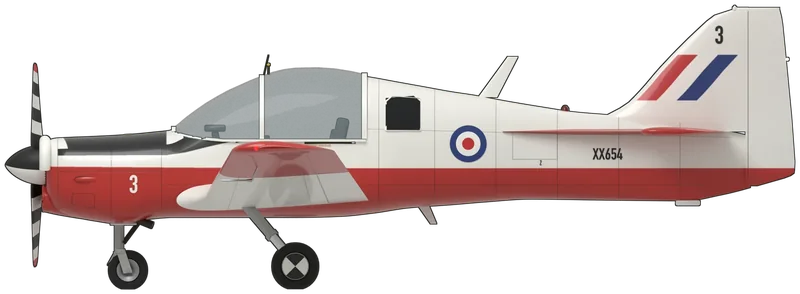
09 · Primary trainer · Bulldog T.1 XX654
Side view of the Scottish Aviation Bulldog T.1, Bulldog T.1 XX654
Port side
Top view of the Scottish Aviation Bulldog T.1, Bulldog T.1 XX654
Plan, from above
Front view of the Scottish Aviation Bulldog T.1, Bulldog T.1 XX654
Head-on

The Bulldog began at Beagle Aircraft at Shoreham as the B.125, a military trainer developed from the company’s Pup light aircraft. Beagle kept the Pup’s general layout, a low wing and a fixed tricycle undercarriage, but gave the trainer a stronger, fully aerobatic airframe, a 200 hp Lycoming flat-four, a wider cabin seating instructor and pupil side by side under a sliding bubble canopy, and hardpoints under the wings. The prototype first flew on 19 May 1969, and Sweden became the first customer, for its air force and army.

Unlike the Chipmunk it replaced, the Bulldog sat instructor and pupil side by side, so the instructor could watch the student’s hands and instruments directly.

XX654, construction number 312, was built by Scottish Aviation at Prestwick in 1974 as one of the RAF’s Bulldog Series 120s and delivered to Church Fenton on 1 November that year.

First flight
19 May 1969
Role
Primary trainer
Maker
Scottish Aviation (Beagle design), Britain
Engine
Lycoming IO-360-A1B6 four-cylinder horizontally opposed, 200 hp
Crew
2
Wingspan
10.06 m (33 ft 0 in)
Length
7.09 m (23 ft 3 in)
Height
2.28 m (7 ft 6 in)
Top speed
480 mph
Built
~470
In service
1973–2001

Hawker Siddeley Dominie

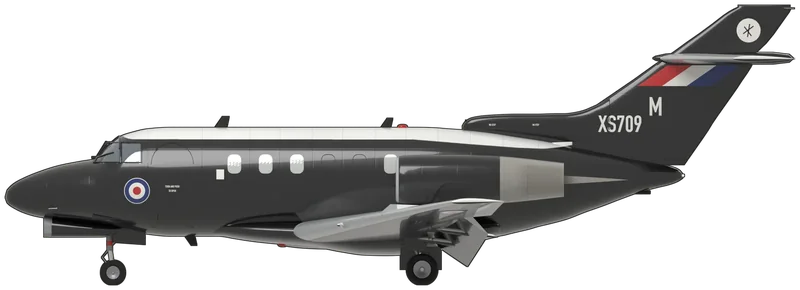
10 · Navigation trainer · Dominie T.1 XS709
Side view of the Hawker Siddeley Dominie, Dominie T.1 XS709
Port side
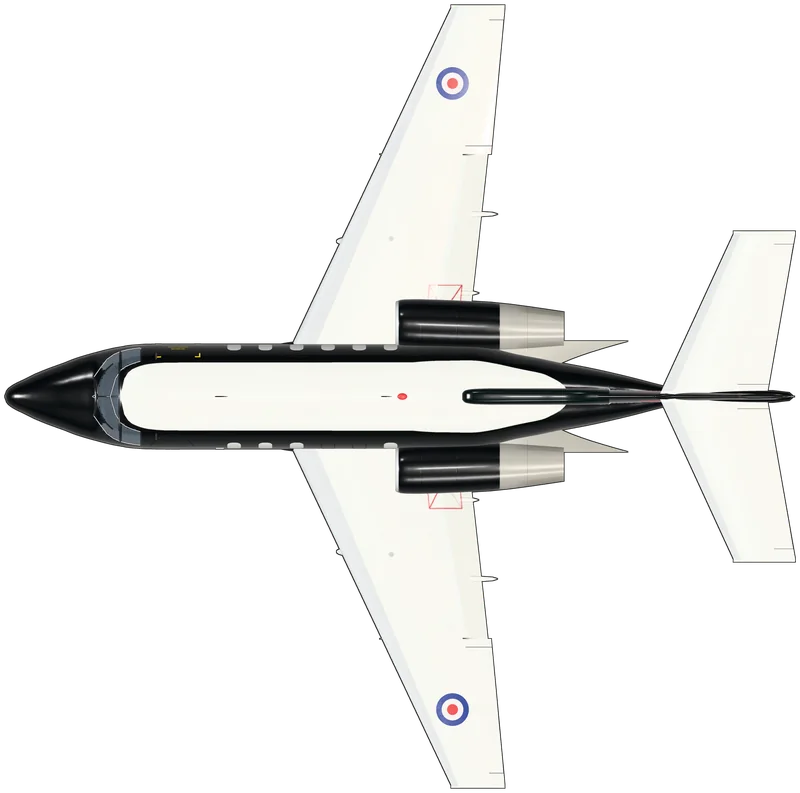
Top view of the Hawker Siddeley Dominie, Dominie T.1 XS709
Plan, from above
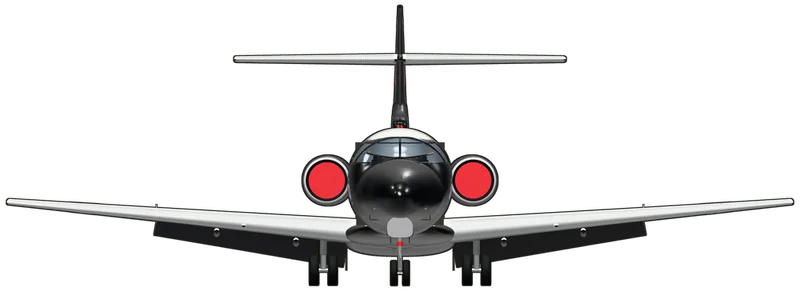
Front view of the Hawker Siddeley Dominie, Dominie T.1 XS709
Head-on

The 125 was the last de Havilland type to fly. The company drew it up at Hatfield as the DH.125 Jet Dragon, a small business jet with a low swept wing, a cabin for six to eight passengers and two Bristol Siddeley Viper turbojets mounted on the rear fuselage, clear of the cabin and the wing. The prototype, G-ARYA, first flew from Hatfield on 13 August 1962.

The Dominie took its name from the Second World War navigation trainer version of the de Havilland Dragon Rapide, so the RAF taught navigators in two de Havilland Dominies a quarter of a century apart.

XS709 was built at Hawarden, near Chester, and on 30 December 1964 it became the first Dominie to fly; on 30 March 1965 it became the first to be delivered to the RAF.

First flight
13 August 1962
Role
Navigation trainer
Maker
Hawker Siddeley (de Havilland design), Britain
Engine
2 × Bristol Siddeley Viper 301 turbojets, about 3,000 lbf each
Crew
1 pilot, with up to five students and instructors
Wingspan
14.33 m (47 ft 0 in)
Length
14.45 m (47 ft 5 in)
Height
5.03 m (16 ft 6 in)
Top speed
510 mph
Built
~1,700
In service
1965–2011

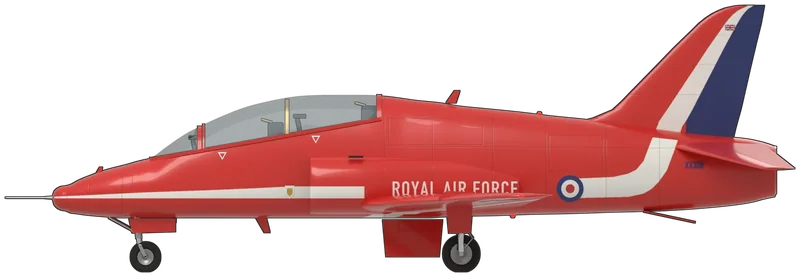
BAe Hawk T.1A

11 · Advanced jet trainer · Hawk T.1A XX308
Side view of the BAe Hawk T.1A, Hawk T.1A XX308
Port side
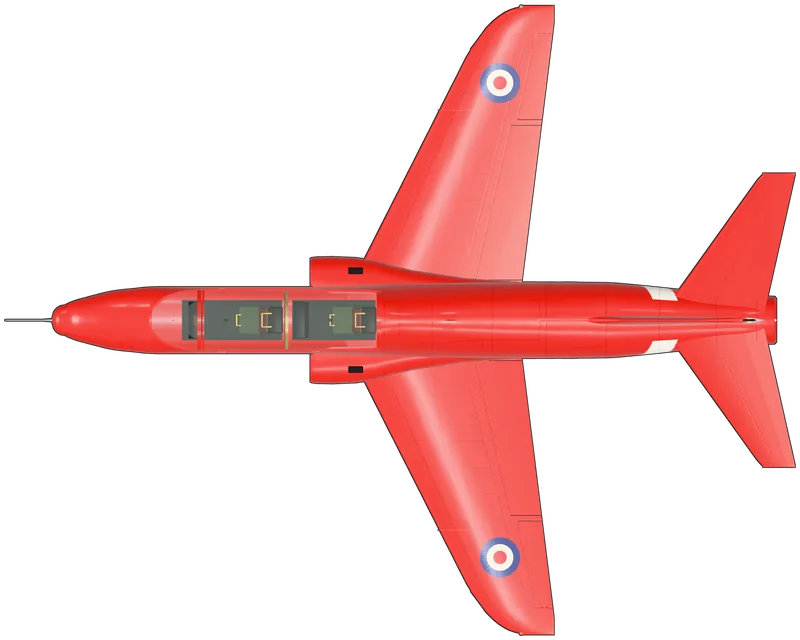
Top view of the BAe Hawk T.1A, Hawk T.1A XX308
Plan, from above
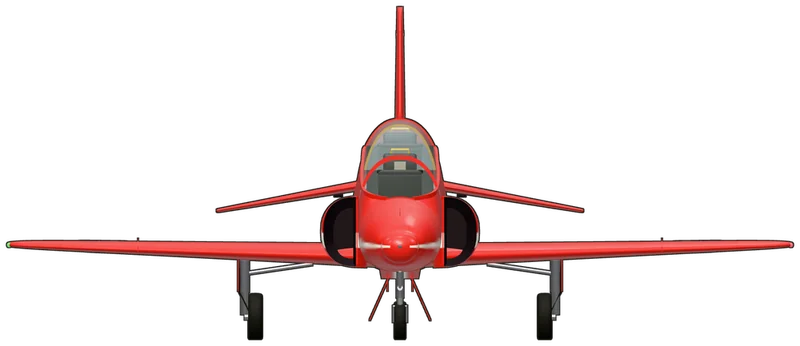
Front view of the BAe Hawk T.1A, Hawk T.1A XX308
Head-on

In the late 1960s the RAF needed one aircraft to replace both the Gnat, its advanced trainer, and the Hunter, on which pilots learned weapons and tactics. Hawker Siddeley at Kingston answered with the HS.1182: a low-wing, tandem-seat jet with a single Rolls-Royce Turbomeca Adour turbofan, the engine of the Jaguar, and the instructor’s seat raised behind the pupil’s so that both had a clear view ahead. In 1971 the RAF ordered 175 off the drawing board, with no prototype, and the first aircraft, XX154, first flew from Dunsfold on 21 August 1974 with Duncan Simpson at the controls.

The RAF bought the Hawk without a prototype: the first aircraft to fly, XX154, was ordered as a production machine and used for development flying, and it is preserved at Boscombe Down.

XX308, construction number 143/312133, was delivered to the RAF on 23 April 1980 and later modified to T.1A standard.

First flight
21 August 1974
Role
Advanced jet trainer
Maker
Hawker Siddeley (British Aerospace from 1977), Britain
Engine
Rolls-Royce Turbomeca Adour Mk 151 turbofan, 5,200 lbf
Crew
2
Wingspan
9.39 m (30 ft 10 in)
Length
11.17 m (36 ft 8 in)
Height
3.99 m (13 ft 1 in)
Top speed
638 mph
Built
~1,000
In service
1976–present (Red Arrows from 1980)

Compared

Specifications at a glance

Span, length, speed and production for every aircraft on this page.

Specifications compared
AircraftFirst flewRoleSpanLengthTop speedBuiltUK museums
de Havilland Tiger Moth1931Elementary trainer8.94 m7.29 m109 mph8,8687
Miles Magister1937Elementary trainer10.31 m7.51 m132 mph1,3033
Boeing-Stearman Kaydet1934Primary trainer9.8 m7.54 m124 mph~10,6002
North American Harvard1935Advanced trainer12.81 m8.84 m208 mph~20,000 (family)6
Airspeed Oxford1937Multi-engine trainer16.26 m10.52 m192 mph8,5862
de Havilland Canada Chipmunk1946Primary trainer10.46 m7.75 m138 mph1,28314
Percival Provost1950Basic trainer10.72 m8.74 m200 mph4618
Folland Gnat1955Advanced jet trainer7.32 m9.68 m695 mph4498
Scottish Aviation Bulldog T.11969Primary trainer10.06 m7.09 m480 mph~4705
Hawker Siddeley Dominie1962Navigation trainer14.33 m14.45 m510 mph~1,7006
BAe Hawk T.1A1974Advanced jet trainer9.39 m11.17 m638 mph~1,0008

Questions

Asked and answered

What was the RAF’s first all-through jet trainer?

The Hunting Jet Provost. From the late 1950s pupils learned to fly on it from their first lesson, and it served until 1993.

What did the Red Arrows fly before the Hawk?

The Folland Gnat, from the team’s formation in 1965 until 1979. The Hawk has flown with the team since 1980.

What was the standard RAF elementary trainer?

The Tiger Moth from 1932, the Chipmunk from 1950, the Bulldog from 1973, then the Tutor and today the Prefect.

More dioramas

Other collections

The models and drawings are procedural interpretations built from published dimensions, three-view drawings and photographs of each airframe, and the airfield is a compressed impression of its period, not a plan of a real station. Treat the museum aircraft as the reference.