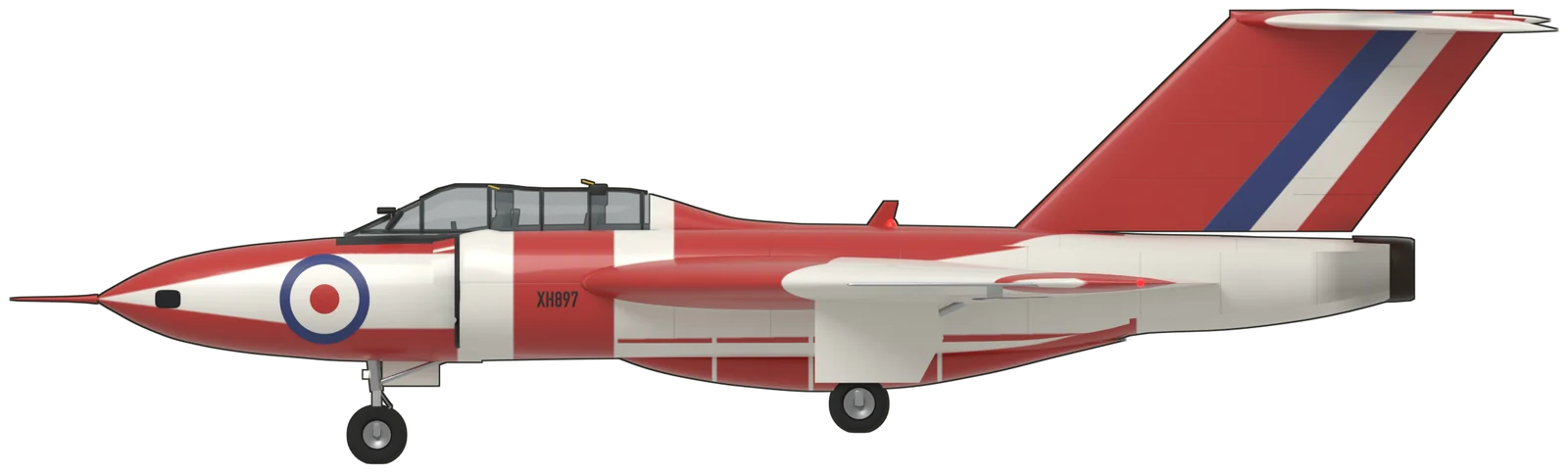
3D model
Turn it over
A procedural model built in Blender from published dimensions, drawings and photographs, painted as XH897 in the gloss white and signal red trials scheme it wears at IWM Duxford, with the long nose boom and open intakes. Drag to orbit, scroll or pinch to zoom · download .glb (865 KB)
History
The Javelin FAW.9
The Javelin was designed to the Air Ministry’s demand for a two-seat night and all-weather fighter, one that could find bombers in the dark and cloud by radar. Gloster gave it a large delta wing, a high tailplane on a tall fin and two Sapphire turbojets, and the prototype flew on 26 November 1951.
The RAF received its first Javelins in 1956. The FAW.9 was the last of the fighter marks, with reheat for more thrust and a longer nose boom to carry its instruments. Javelins flew with squadrons in Britain and in Germany, and with the Far East Air Force, where they served during the Indonesian Confrontation in Borneo.
Gloster and Armstrong Whitworth built 436 Javelins. Supersonic missile-armed fighters such as the Lightning replaced them in the 1960s, and the RAF withdrew the last in 1968.
This airframe
FAW.9 XH897
XH897 is a Javelin FAW.9 that is kept at IWM Duxford in Cambridgeshire. The model shows it in gloss white with signal red bands on the nose, intake sections, wing tips, fin and the tops of the engine nacelles, with Type D roundels, the serial in black on the red band and a long red nose boom.
Where to see one
In the gazetteer
The gazetteer records the Javelin FAW.9 in 6 UK collections. The airframe modelled here is marked.