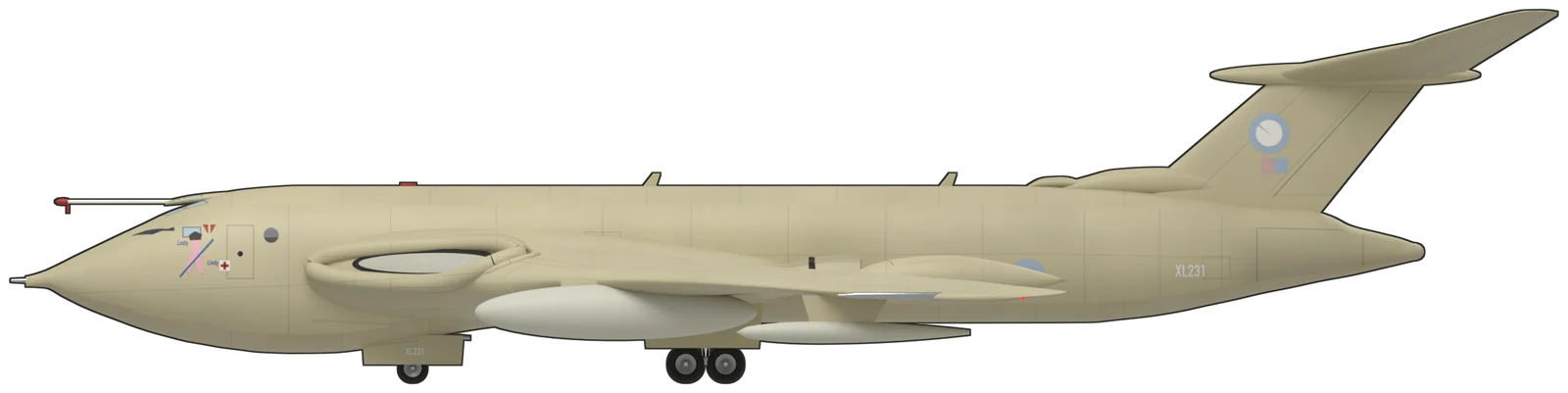
3D model
Turn it over
A procedural model built in Blender from published dimensions, drawings and photographs, painted as XL231 'Lusty Lindy' in the pale stone tanker scheme with low-visibility markings that it wears at the Yorkshire Air Museum, Elvington. Drag to orbit, scroll or pinch to zoom · download .glb (986 KB)
History
The Victor
Handley Page’s Victor was the third of the V-bombers, and the strangest to look at: a crescent wing, thick at the root and thinning towards the tip so that it stayed efficient at high speed, with a T-tail and a nose like a bulbous glasshouse. The prototype first flew on Christmas Eve 1952, and the type entered service in 1958.
It was the fastest of the three and could carry the biggest bomb load, but it was overtaken as a bomber when the RAF turned to low-level attack. The Victor was reborn as a tanker. The K.2 conversions had their wings shortened and carried a refuelling hose from each wing and from the fuselage, and they became the RAF’s main air-to-air tankers.
In 1982 Victor tankers made the Black Buck Vulcan raids on Port Stanley possible, a relay of aircraft handing fuel to one another over the South Atlantic. They flew again in the Gulf War of 1991 and were retired in October 1993. Only 86 Victors were built, and six of the gazetteer’s collections hold one.
This airframe
K.2 XL231 “Lusty Lindy”
XL231 was built as a B.2 bomber and converted to a K.2 tanker. It flew in the Gulf War, where its nose carried the name “Lusty Lindy”, and it now stands at the Yorkshire Air Museum at Elvington, painted in a pale stone scheme with low-visibility markings.
Where to see one
In the gazetteer
The gazetteer records the Victor in 6 UK collections. The airframe modelled here is marked.