3D model
Turn it over
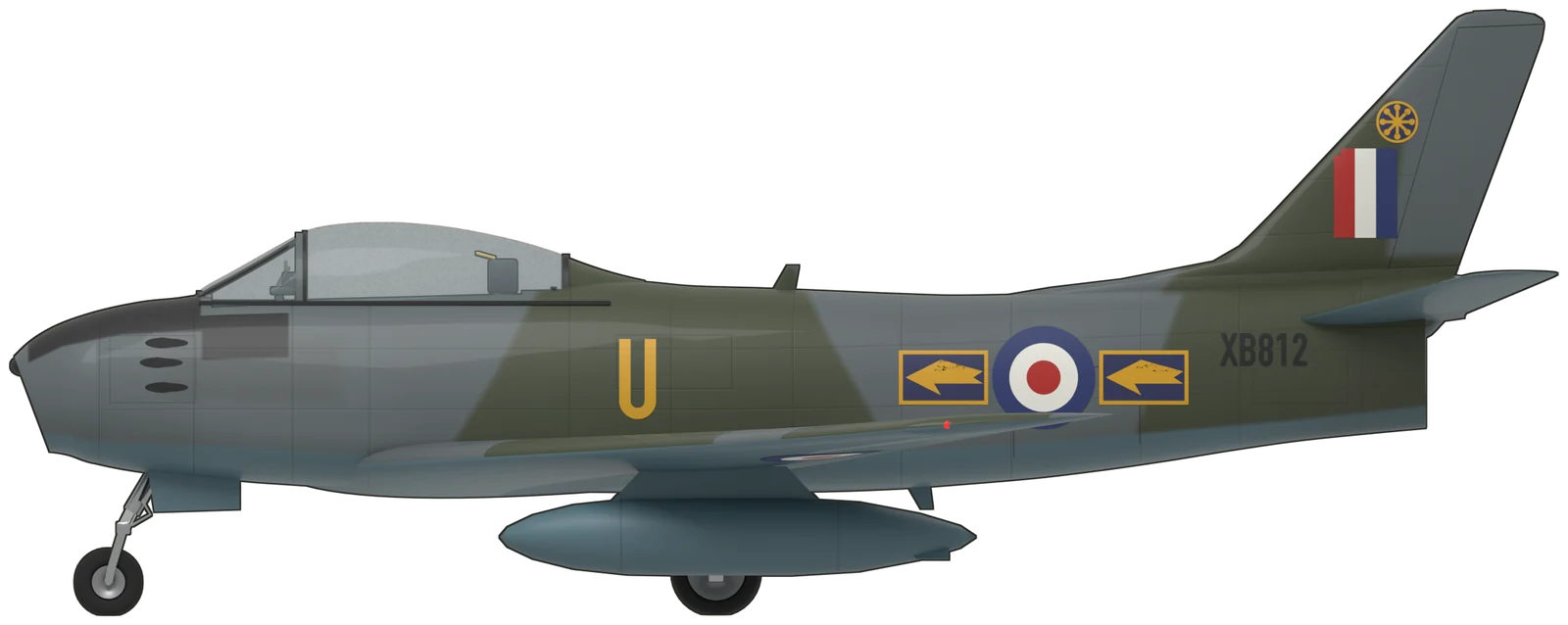
A procedural model built in Blender from published dimensions, drawings and photographs, painted as XB812 ‘U’ of No. 93 Squadron at Jever, a Canadair-built Sabre F.4 in Dark Green and Dark Sea Grey over PRU Blue undersides, with Type D roundels, the squadron’s blue and yellow arrowhead bars and its escarbuncle badge on the fin, as it is preserved by the Royal Air Force Museum at Cosford. Drag to orbit, scroll or pinch to zoom · download .glb (1.0 MB)
History
The Sabre F.4
North American began the Sabre as a straight-winged jet for the US Army Air Forces, then swept its wing back 35 degrees after studying German wartime research. The XP-86 first flew on 1 October 1947 with George Welch at the controls, and in September 1948 an F-86A set a world speed record of 671 mph. It had leading-edge slats that opened at low speed, a nose intake and a bubble canopy that gave the pilot a clear view all round.
Sabres reached Korea in December 1950 to meet the Soviet-built MiG-15 over the Yalu river, the stretch of sky the pilots called MiG Alley. The F-86E, which added an all-moving tailplane for better control at high speed, followed in 1951. Canadair built the Sabre under licence in Montreal, 1,815 of them in all, and with the American, Australian, Italian and Japanese production nearly 9,900 were made. Bolivia flew the last in front-line service until 1994.
The RAF had no swept-wing fighter ready in the early 1950s, so the United States paid for 430 Canadair Sabres under the Mutual Defense Aid Programme: 60 F.2s and 370 F.4s, the RAF name for the Canadair Mk 4, a licence-built F-86E. They were ferried across the Atlantic by way of Greenland and Iceland from December 1952 and equipped ten squadrons of the 2nd Tactical Air Force in Germany and two of Fighter Command. When the Hunter arrived in 1956 the Sabres were withdrawn, refurbished and passed on to Italy and Yugoslavia.
This airframe
Sabre F.4 XB812
XB812 was built by Canadair at Cartierville and first flew on 16 April 1953. It joined No. 112 Squadron at Brüggen in January 1954 and moved to No. 93 Squadron at Jever that May, coded ‘U’. It went into store in June 1955, was later refurbished and passed to the Italian Air Force as MM19666, and ended its days there as an instructional airframe in Rome. It came to the RAF Museum in an exchange in 1993, and after restoration by The Fighter Collection at Duxford it stood at Hendon until 2006; it now hangs inverted in the National Cold War Exhibition at Cosford. The model shows it on its wheels as it stood at Hendon, in 93 Squadron markings: Dark Green and Dark Sea Grey over PRU Blue undersides, Type D roundels, the squadron’s blue bars with yellow arrowheads, a yellow ‘U’, the escarbuncle badge on the fin and two blue drop tanks. Its wing has fixed leading edges in place of the slats.
Where to see one
In the gazetteer
The gazetteer records the Sabre F.4 in 5 UK collections. The airframe modelled here is marked.