AP 118 · No. 10 Section II · Aircraft Collection 06 / 12

Aircraft/Collections/Early jet age

Jet fighter station · 1944–55

The early jet age

Straight wings give way to swept ones in a decade: the first jet fighters and bombers, from the Meteor that chased flying bombs to the Hunter that broke the world speed record.

10
Aircraft
1944–55
Period
25
UK museums hold them

The diorama

Diorama · 1944–55

Loading the airfield…

An RAF fighter station of the early 1950s: a single long concrete runway, a parallel taxiway, a busy apron, a control tower with a glass visual control room and dispersal pans across the airfield. Piston trainers still share the circuit with the jets.

Drag to look around · ctrl + scroll to zoom · pick an aircraft to follow it

The Gloster Meteor entered RAF service in July 1944 and was soon chasing V-1 flying bombs over Kent. It was the only Allied jet to see combat in the Second World War, and with the de Havilland Vampire it made Britain, briefly, the leading jet power in the world.

The lead did not last. Captured German research on swept wings went into the American F-86 Sabre and the Soviet MiG-15, which met over Korea in 1950, and the RAF flew Canadian-built Sabres as a stopgap while its own swept-wing fighters were put right. The Supermarine Swift never was, and found its niche in low-level reconnaissance; the Hawker Hunter became one of the great fighters, and in 1953 took the world air speed record at 727 mph.

The English Electric Canberra, Britain’s first jet bomber, flew in 1949 and could outfly most fighters at height. Training changed too: the Chipmunk and the piston Provost took over from the Tiger Moth and Harvard, ready to pass pupils on to jet trainers.

To scale

The collection side by side

Every aircraft drawn at the same scale, so a Canberra and a Chipmunk can be compared at a glance.

  • Gloster Meteor side profile, to scaleMeteor · 13.59 m
  • de Havilland Vampire side profile, to scaleVampire · 9.37 m
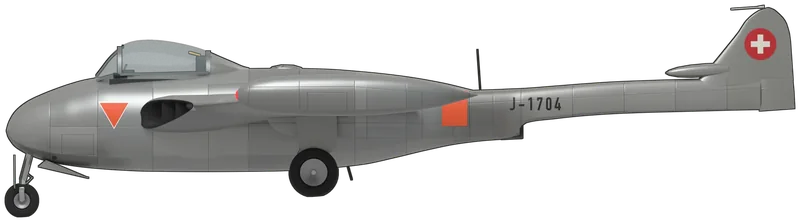
  • de Havilland Venom side profile, to scaleVenom FB.4 · 10.06 m
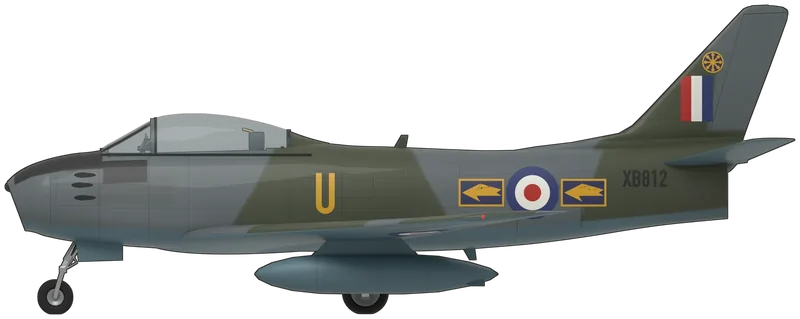
  • Canadair Sabre side profile, to scaleSabre F.4 · 11.43 m
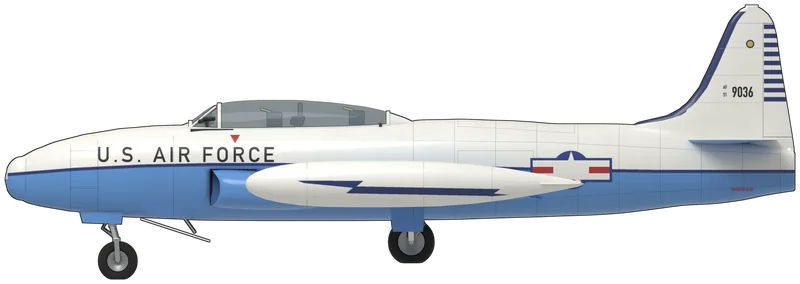
  • Lockheed T-33 Shooting Star side profile, to scaleT-33A · 11.51 m
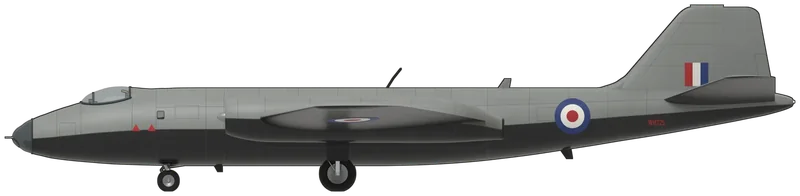
  • English Electric Canberra side profile, to scaleCanberra · 19.96 m
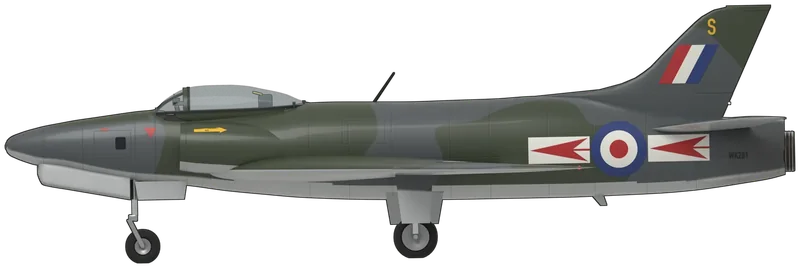
  • Supermarine Swift side profile, to scaleSwift · 12.88 m
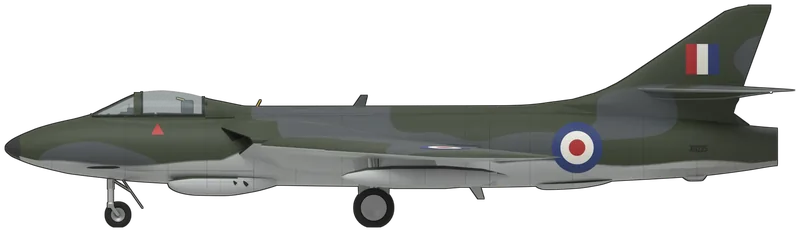
  • Hawker Hunter side profile, to scaleHunter · 13.98 m
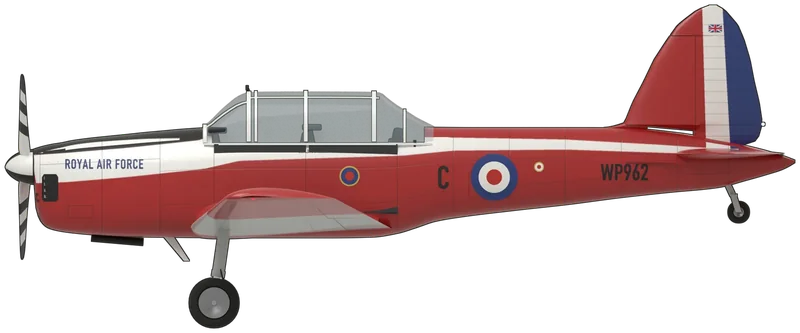
  • de Havilland Canada Chipmunk side profile, to scaleChipmunk · 7.75 m
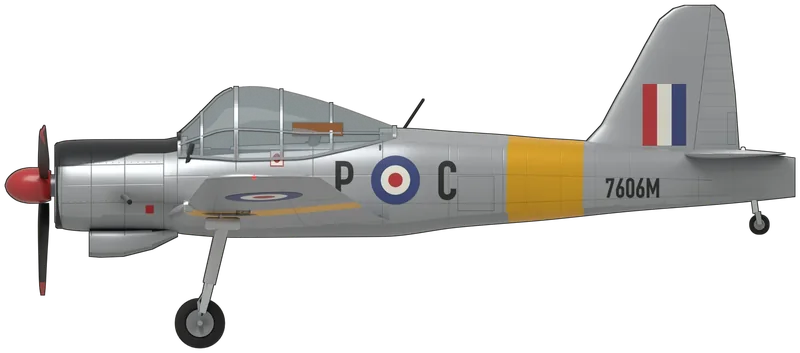
  • Percival Provost side profile, to scaleProvost · 8.74 m

10 m

Profiles

Side, top and front

Each aircraft drawn from its 3D model, painted as one real airframe, with its specification.

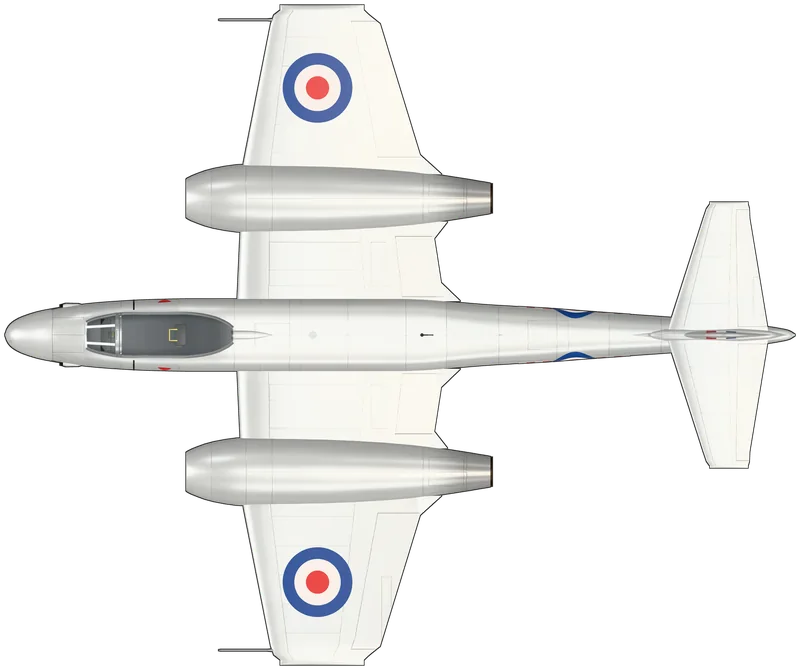
Gloster Meteor

01 · Jet fighter · F.8 WK991
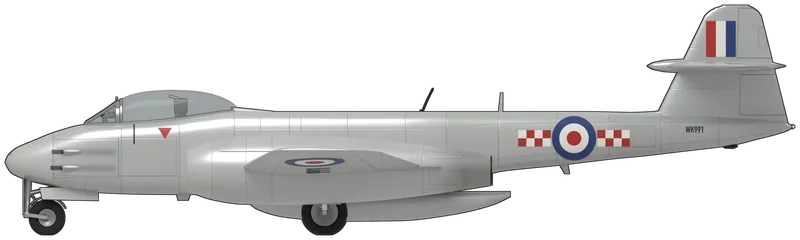
Side view of the Gloster Meteor, F.8 WK991
Port side
Top view of the Gloster Meteor, F.8 WK991
Plan, from above
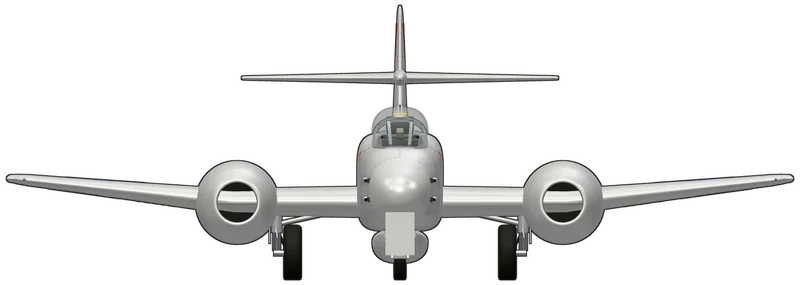
Front view of the Gloster Meteor, F.8 WK991
Head-on

Gloster’s Meteor was the only Allied jet fighter to see operational service in the Second World War. Frank Whittle’s early engines were too weak for one to do the job, so George Carter’s design used two, slung in the wings. The first Meteor flew in March 1943, and in July 1944 No. 616 Squadron took it into action against V-1 flying bombs.

Meteors of No. 616 Squadron were the RAF’s first jets in action, chasing V-1 flying bombs in the summer of 1944.

WK991 is preserved at IWM Duxford in the High Speed Silver of a 1950s Fighter Command day fighter, with the red-and-white chequers of No. 56 Squadron and the ventral tank it is displayed with.

First flight
5 March 1943
Role
Jet fighter
Maker
Gloster, Britain
Engine
2 × Rolls-Royce Derwent 8 turbojets, 3,500 lbf each
Crew
1
Wingspan
11.32 m (37 ft 2 in)
Length
13.59 m (44 ft 7 in)
Height
3.96 m (13 ft 0 in)
Top speed
600 mph
Built
3,947
In service
1944–1980s

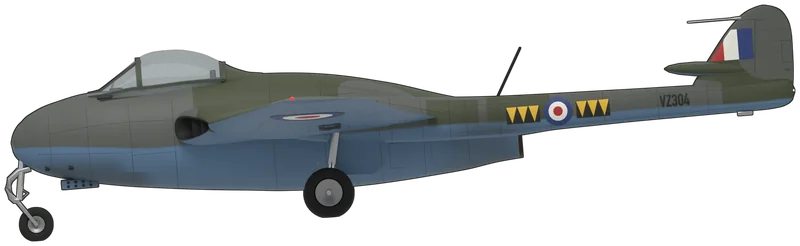
de Havilland Vampire

02 · Jet fighter-bomber · FB.5 VZ304
Side view of the de Havilland Vampire, FB.5 VZ304
Port side
Top view of the de Havilland Vampire, FB.5 VZ304
Plan, from above
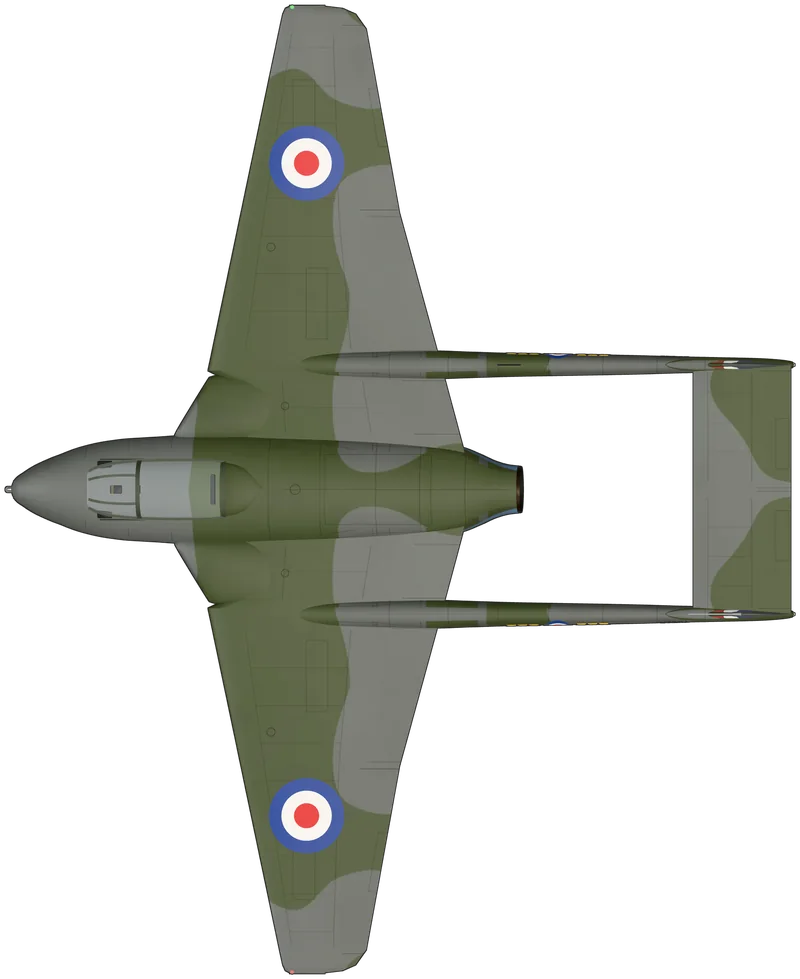
Front view of the de Havilland Vampire, FB.5 VZ304
Head-on

Early jet engines were so feeble that every foot of tailpipe wasted precious thrust. de Havilland’s answer was to put the Goblin in a short central nacelle and carry the tail on two slim booms, which kept the jet pipe short and gave the Vampire its unmistakable shape. The prototype flew in September 1943, too late for the war, and the Vampire became the RAF’s second jet fighter.

A Vampire was the first jet to land on and take off from an aircraft carrier, in December 1945.

The model wears the early-1950s day-fighter scheme of VZ304 as it was photographed preserved at Duxford in 1983: Dark Green and Dark Sea Grey over PRU Blue, with bright Type D roundels and yellow-and-black unit bars either side of the boom roundels.

First flight
20 September 1943
Role
Jet fighter-bomber
Maker
de Havilland, Britain
Engine
de Havilland Goblin 2 turbojet, 3,100 lbf
Crew
1
Wingspan
11.58 m (38 ft 0 in)
Length
9.37 m (30 ft 9 in)
Height
2.13 m (7 ft 0 in)
Top speed
548 mph
Built
~4,400
In service
1946–1967

de Havilland Venom

03 · Jet fighter-bomber · FB.4 J-1704
Side view of the de Havilland Venom, FB.4 J-1704
Port side
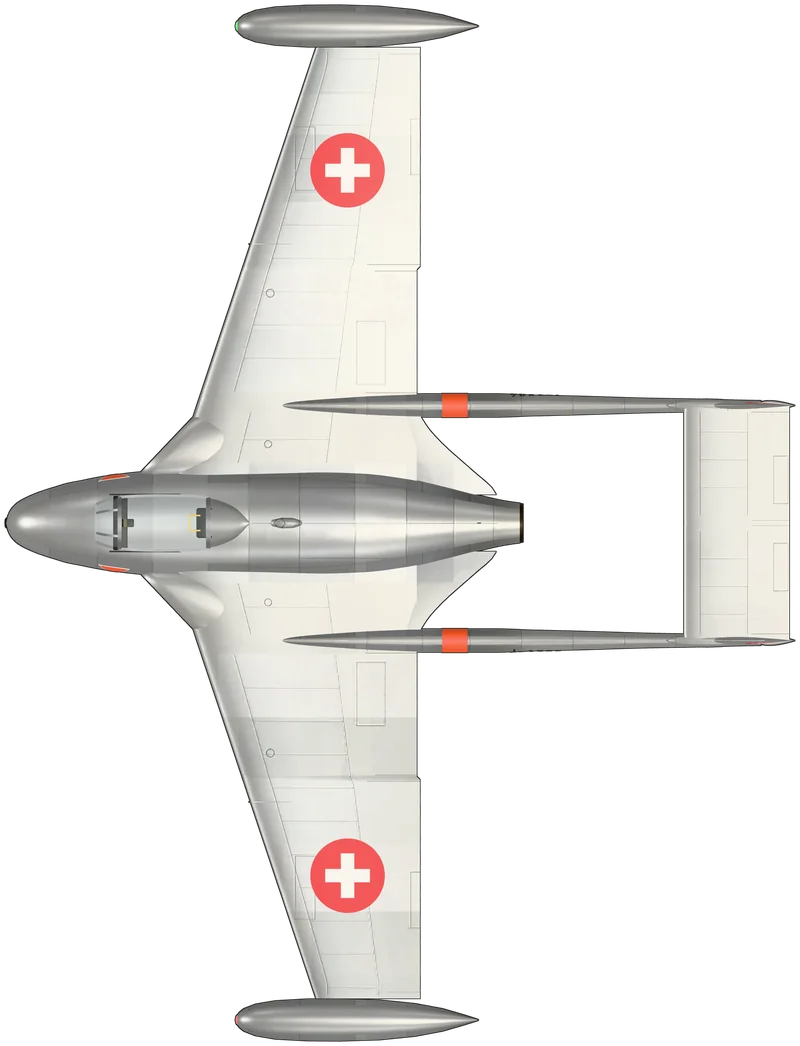
Top view of the de Havilland Venom, FB.4 J-1704
Plan, from above
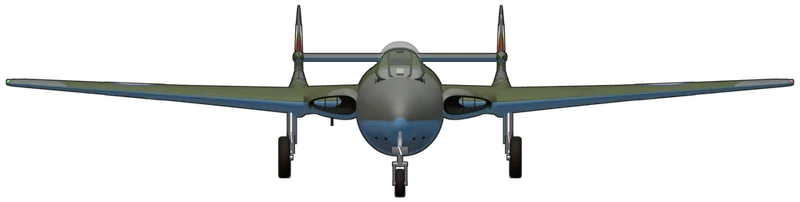
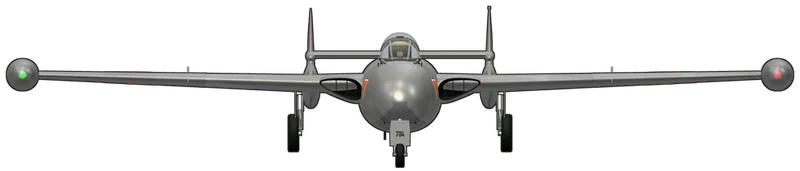
Front view of the de Havilland Venom, FB.4 J-1704
Head-on

The Venom began as a Vampire with a bigger engine. de Havilland fitted the twin-boom layout with the more powerful Ghost and a new, thinner wing swept back along its leading edge, and at first called it the Vampire FB.8. By the time John Derry flew the prototype at Hatfield on 2 September 1949 it had become the DH.112 Venom, and it was a good deal faster and higher-flying than the aircraft it grew from.

Switzerland’s licence-built Venoms outlasted the RAF’s by more than twenty years: the last were retired in 1984.

J-1704 is one of 100 Venom FB.4s, J-1701 to J-1800, built for the Swiss Air Force by a consortium of Swiss firms; it was assembled by the Federal Aircraft Factory at Emmen, made its acceptance flights on 6 September 1956 and was delivered in March 1957.

First flight
2 September 1949
Role
Jet fighter-bomber
Maker
de Havilland (and a Swiss consortium under licence), Britain
Engine
de Havilland Ghost 103 turbojet, 4,850 lbf
Crew
1
Wingspan
12.7 m (41 ft 8 in)
Length
10.06 m (33 ft 0 in)
Height
1.88 m (6 ft 2 in)
Top speed
640 mph
Built
~1,400
In service
1952–1984

Canadair Sabre

04 · Swept-wing day fighter · Sabre F.4 XB812
Side view of the Canadair Sabre, Sabre F.4 XB812
Port side
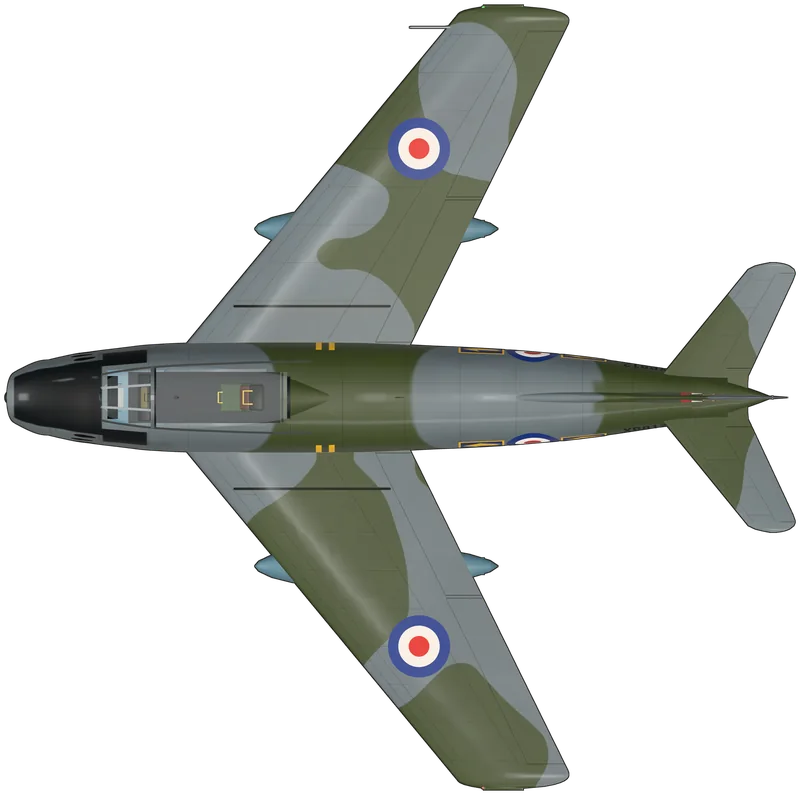
Top view of the Canadair Sabre, Sabre F.4 XB812
Plan, from above
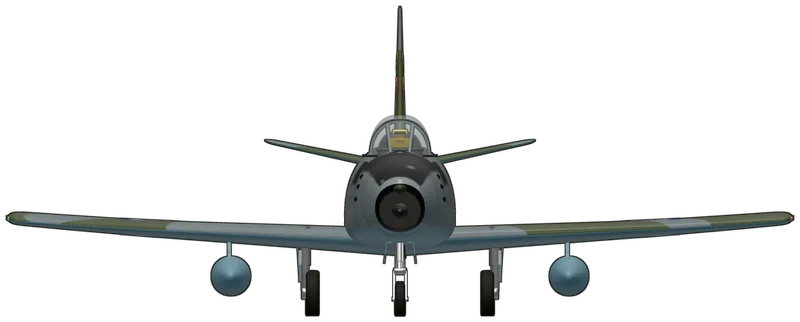
Front view of the Canadair Sabre, Sabre F.4 XB812
Head-on

North American began the Sabre as a straight-winged jet for the US Army Air Forces, then swept its wing back 35 degrees after studying German wartime research. The XP-86 first flew on 1 October 1947 with George Welch at the controls, and in September 1948 an F-86A set a world speed record of 671 mph. It had leading-edge slats that opened at low speed, a nose intake and a bubble canopy that gave the pilot a clear view all round.

On 18 May 1953 the American pilot Jacqueline Cochran flew a Canadair Sabre faster than sound in a dive, the first woman to do so.

XB812 was built by Canadair at Cartierville and first flew on 16 April 1953.

First flight
1 October 1947
Role
Swept-wing day fighter
Maker
North American Aviation (Canadair in Canada), United States
Engine
General Electric J47-GE-13 turbojet, 5,200 lbf thrust
Crew
1
Wingspan
11.31 m (37 ft 1 in)
Length
11.43 m (37 ft 6 in)
Height
4.48 m (14 ft 8 in)
Top speed
687 mph
Built
~9,860
In service
1949–1994 (RAF 1953–1956)

Lockheed T-33 Shooting Star

05 · Jet trainer · T-33A 51-9036
Side view of the Lockheed T-33 Shooting Star, T-33A 51-9036
Port side
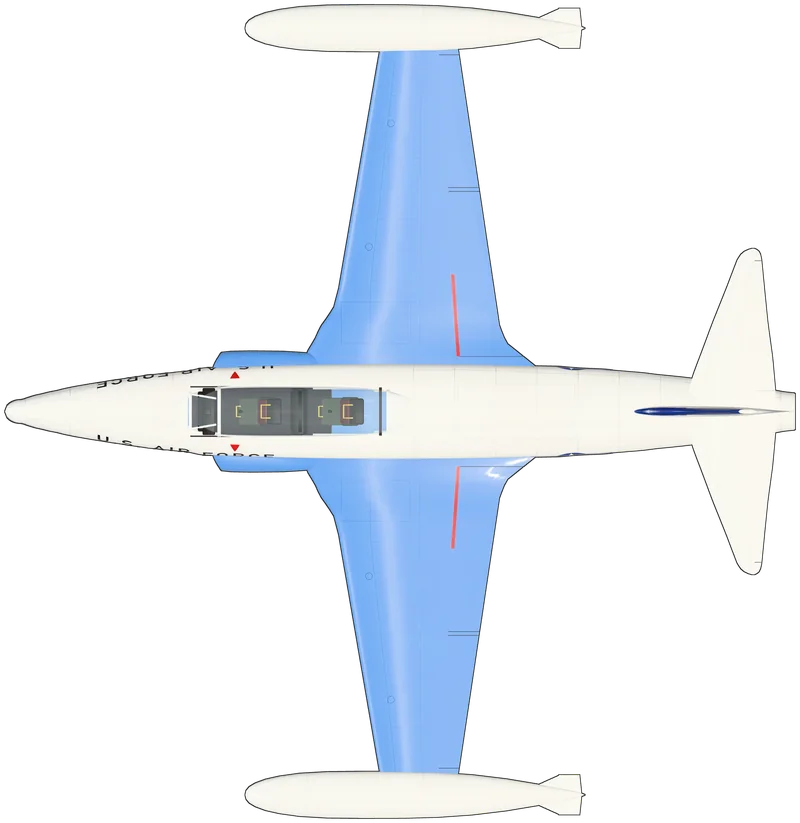
Top view of the Lockheed T-33 Shooting Star, T-33A 51-9036
Plan, from above
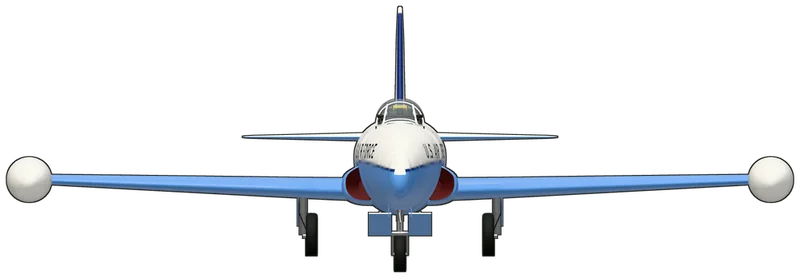
Front view of the Lockheed T-33 Shooting Star, T-33A 51-9036
Head-on

Lockheed built the T-33 by stretching its P-80 Shooting Star, the first American jet fighter to enter squadron service, so that a second cockpit would fit behind the first. The fuselage gained about a metre, the instructor sat in tandem behind the student under one long sliding canopy, and some of the fuel went from the fuselage into the wing and the big tanks on its tips. Tony LeVier flew the prototype, then called the TP-80C, on 22 March 1948.

Canada’s licence-built CT-133 Silver Star swapped the American Allison engine for a Rolls-Royce Nene, and Canadian crews were still flying it in 2005.

Lockheed built 51-9036 as a T-33A-1-LO for the US Air Force, which passed it to the French Air Force, where it flew as 19036.

First flight
22 March 1948
Role
Jet trainer
Maker
Lockheed (Canadair and Kawasaki under licence), United States
Engine
Allison J33-A-35 centrifugal-flow turbojet, 5,400 lbf thrust with water injection
Crew
2
Wingspan
11.85 m (38 ft 11 in)
Length
11.51 m (37 ft 9 in)
Height
3.56 m (11 ft 8 in)
Top speed
600 mph
Built
6,557
In service
1948–2017

English Electric Canberra

06 · Jet bomber · B.2 WH725
Side view of the English Electric Canberra, B.2 WH725
Port side
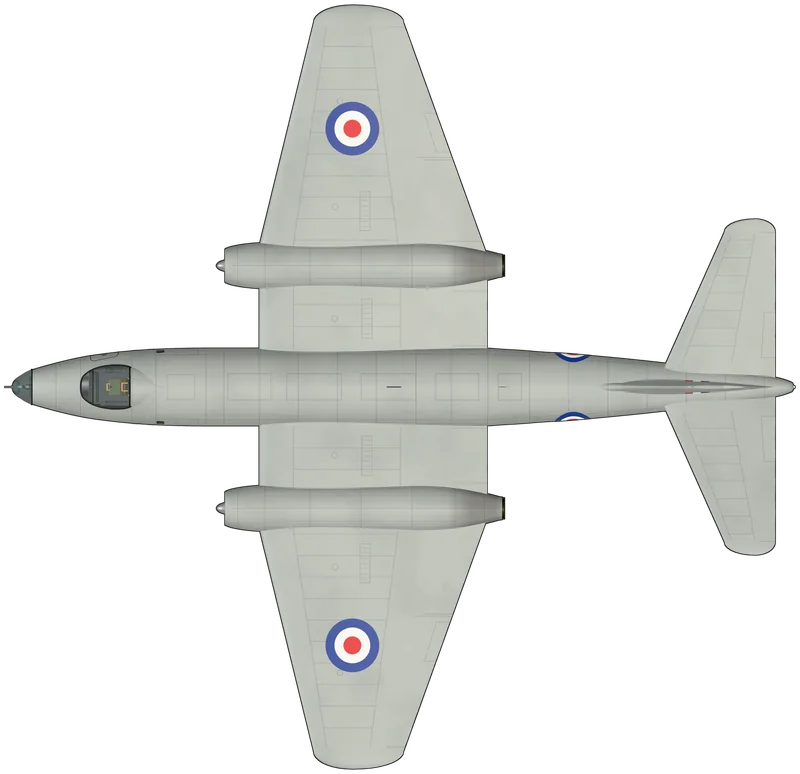
Top view of the English Electric Canberra, B.2 WH725
Plan, from above
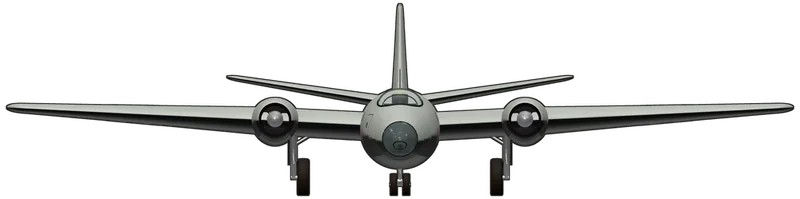
Front view of the English Electric Canberra, B.2 WH725
Head-on

Britain’s first jet bomber came from English Electric, a company better known for trams and power stations, and from its chief designer W.E.W. “Teddy” Petter. Roland Beamont first flew the prototype in May 1949, and its broad, nearly unswept wing let it fly higher than the fighters of its day.

In 1957 a rocket-boosted Canberra set a world altitude record of 70,310 ft.

WH725 is shown as delivered to No. 50 Squadron in 1953, in Medium Sea Grey over gloss black with Type D roundels and a red serial.

First flight
13 May 1949
Role
Jet bomber
Maker
English Electric, Britain
Engine
2 × Rolls-Royce Avon 101 turbojets, 6,500 lbf each
Crew
3
Wingspan
19.51 m (64 ft 0 in)
Length
19.96 m (65 ft 6 in)
Height
4.75 m (15 ft 7 in)
Top speed
580 mph
Built
1,352 + 403 licence
In service
1951–2006

Supermarine Swift

07 · Fighter-reconnaissance jet · Swift FR.5 WK281
Side view of the Supermarine Swift, Swift FR.5 WK281
Port side
Top view of the Supermarine Swift, Swift FR.5 WK281
Plan, from above
Front view of the Supermarine Swift, Swift FR.5 WK281
Head-on

The Swift began as an insurance policy. In 1948 Supermarine gave its straight-winged Attacker a swept wing and tail to make the Type 510, the first British aircraft to fly with both swept back, and when the Korean War made the RAF anxious for a fighter to match the MiG-15, the Air Ministry ordered a developed version off the drawing board as a back-up to the Hawker Hunter. The Type 541 had a new fuselage around a Rolls-Royce Avon axial-flow engine, fed by intakes on either side of the cockpit, and kept the 510’s wing, swept back at its leading edge and slightly drooped.

For eight days in the autumn of 1953 a Swift was the fastest aircraft in the world: Mike Lithgow’s record of 735.7 mph, set in the heat over Libya, beat Neville Duke’s Hunter record of earlier that month and was then lost to Douglas’s F4D Skyray.

WK281 was built by Supermarine as an FR.5 and served with No. 79 Squadron in RAF Germany as ‘S’, flying low-level camera sorties over the north German plain until the squadron gave up its Swifts in 1961.

First flight
1 August 1951
Role
Fighter-reconnaissance jet
Maker
Supermarine (Vickers-Armstrongs), Britain
Engine
Rolls-Royce Avon 114 turbojet with reheat, 7,175 lbf dry
Crew
1
Wingspan
9.86 m (32 ft 4 in)
Length
12.88 m (42 ft 3 in)
Height
4.01 m (13 ft 2 in)
Top speed
713 mph
Built
197
In service
1954–1961

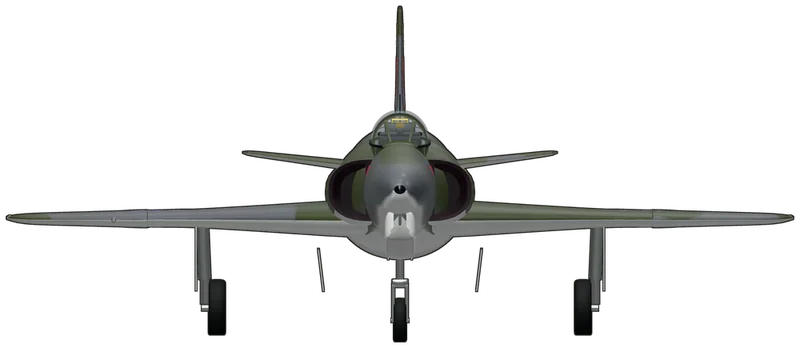
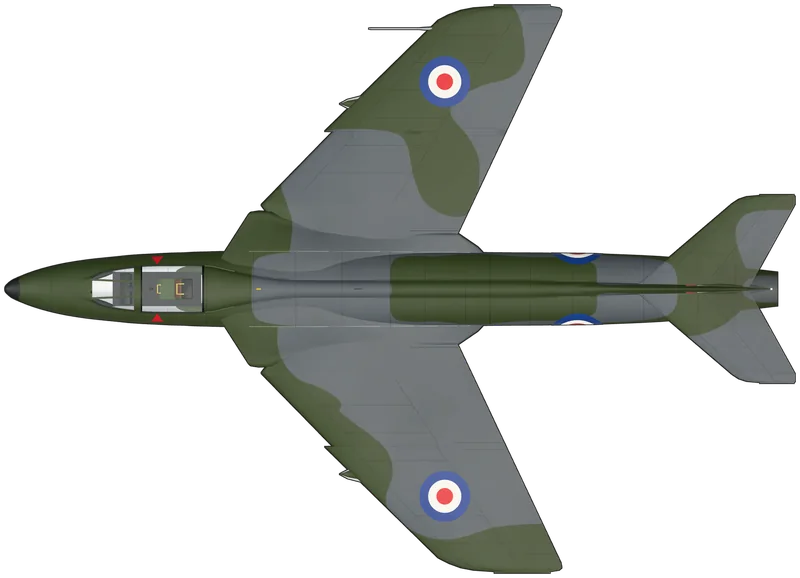
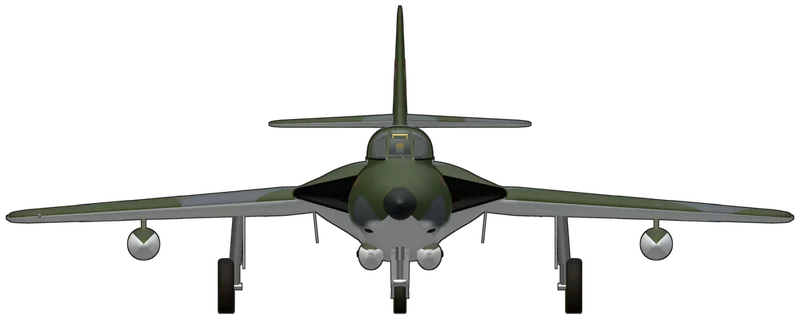
Hawker Hunter

08 · Day fighter · F.6 XG225
Side view of the Hawker Hunter, F.6 XG225
Port side
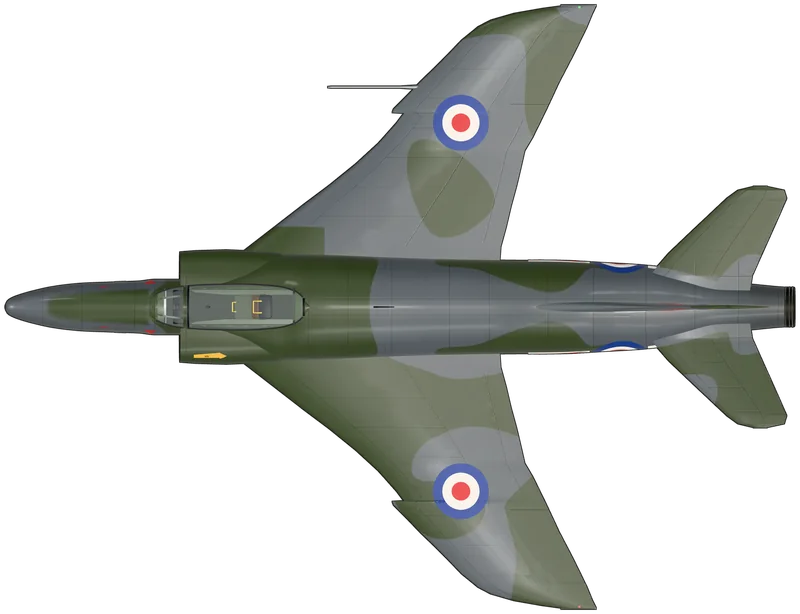
Top view of the Hawker Hunter, F.6 XG225
Plan, from above
Front view of the Hawker Hunter, F.6 XG225
Head-on

Sydney Camm’s Hunter is often called the most beautiful jet fighter Britain ever built. The prototype first flew in July 1951 with Neville Duke at the controls, and in September 1953 Duke took a modified Hunter, WB188, to a world air speed record of 727.6 mph.

The Hunter’s gun pack, with all four Aden cannon and their ammunition, could be swapped as a single unit to turn a jet round quickly.

The model wears the 1950s RAF day-fighter finish of F.6 XG225: Dark Green and Dark Sea Grey disruptive camouflage over High Speed Silver, with Type D roundels.

First flight
20 July 1951
Role
Day fighter
Maker
Hawker, Britain
Engine
Rolls-Royce Avon 203 turbojet, 10,000 lbf
Crew
1
Wingspan
10.26 m (33 ft 8 in)
Length
13.98 m (45 ft 10 in)
Height
4.01 m (13 ft 2 in)
Top speed
715 mph
Built
1,972
In service
1954–1994

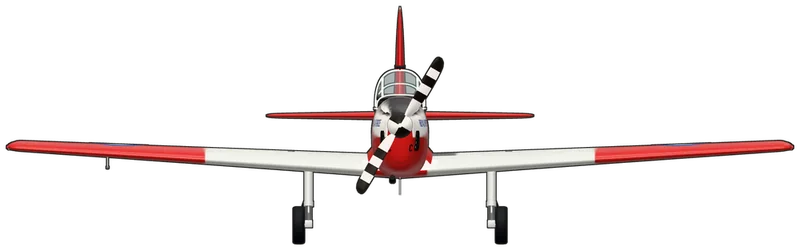
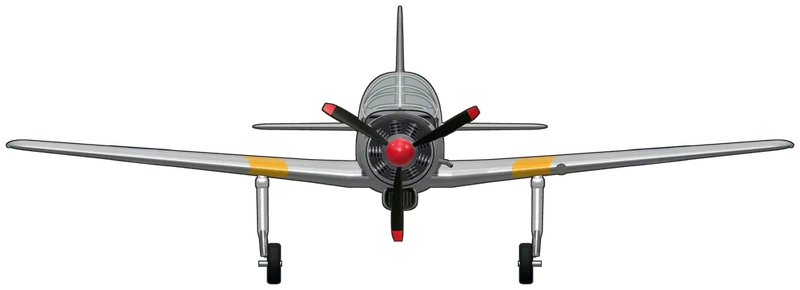
de Havilland Canada Chipmunk

09 · Primary trainer · T.10 WP962
Side view of the de Havilland Canada Chipmunk, T.10 WP962
Port side
Top view of the de Havilland Canada Chipmunk, T.10 WP962
Plan, from above
Front view of the de Havilland Canada Chipmunk, T.10 WP962
Head-on

The Chipmunk was the first aircraft designed by de Havilland’s Canadian company. Its chief designer, the Polish engineer Wsiewołod Jakimiuk, drew a neat all-metal, low-winged two-seater with a tailwheel and a sliding canopy to replace the Tiger Moth, and the prototype first flew at Downsview, Toronto, on 22 May 1946.

The RAF took delivery of 740 Chipmunk T.10s in just four years, between November 1949 and October 1953.

WP962 was built at Broughton in 1952 and stood in the line of training aircraft at the Coronation Review at Odiham in July 1953.

First flight
22 May 1946
Role
Primary trainer
Maker
de Havilland Canada, Canada
Engine
de Havilland Gipsy Major 8 four-cylinder inverted inline, 145 hp
Crew
2
Wingspan
10.46 m (34 ft 4 in)
Length
7.75 m (25 ft 5 in)
Height
2.13 m (7 ft 0 in)
Top speed
138 mph
Built
1,283
In service
1950–1997

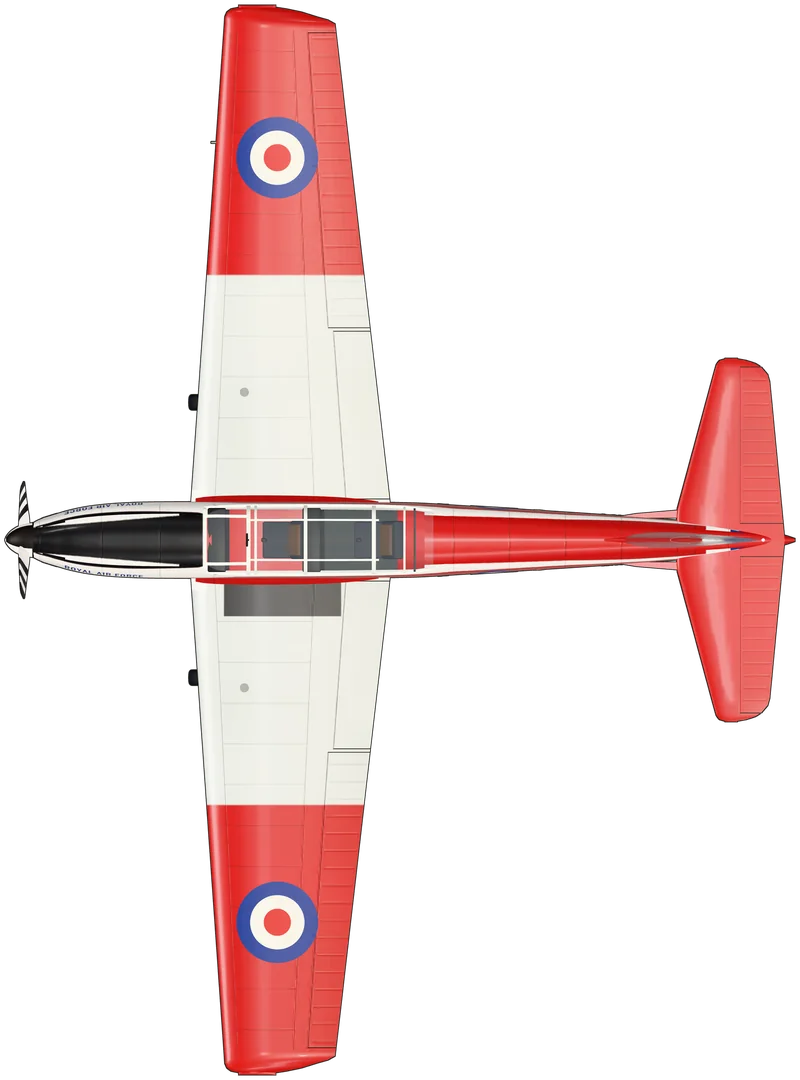
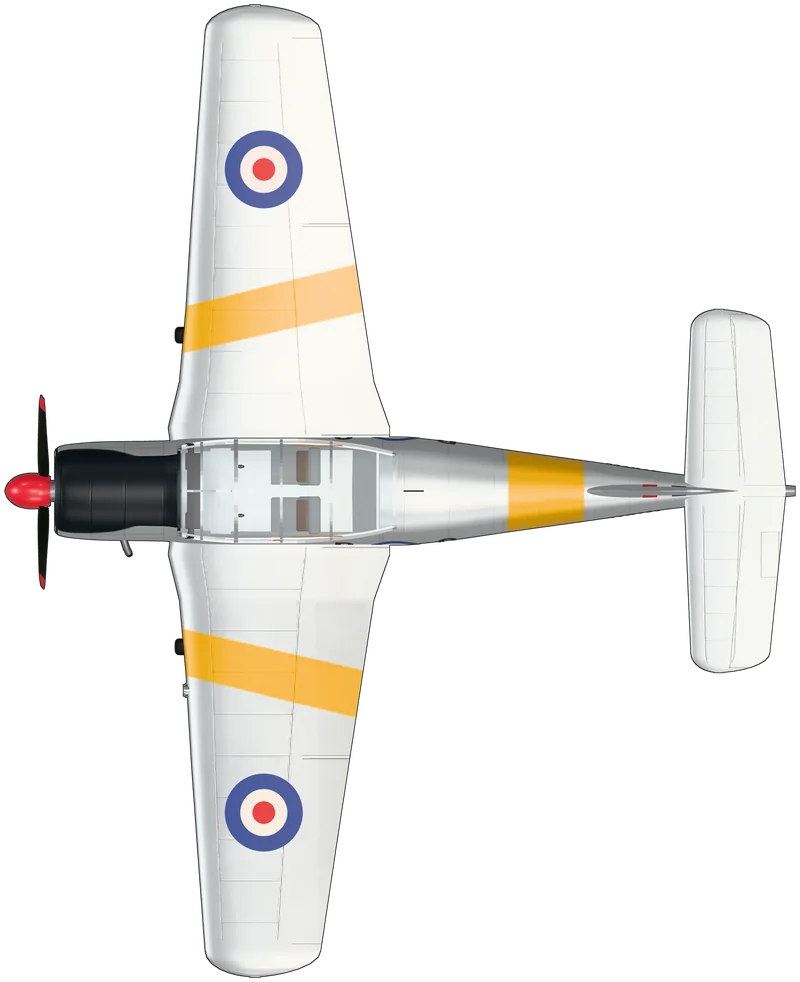
Percival Provost

10 · Basic trainer · T.1 WV562
Side view of the Percival Provost, T.1 WV562
Port side
Top view of the Percival Provost, T.1 WV562
Plan, from above
Front view of the Percival Provost, T.1 WV562
Head-on

After the war the RAF wanted a basic trainer that behaved more like the fast aircraft its pupils would go on to fly than the old Tiger Moth did. Percival’s P.56 Provost, which first flew on 24 February 1950, was a stout low-wing monoplane with a large radial engine, a tailwheel undercarriage and a roomy cockpit where pupil and instructor sat side by side.

The Provost’s cockpit canopy and glass are so wide because pupil and instructor sit side by side, which let the instructor watch the pupil’s hands as well as the view ahead.

WV562 is a Provost T.1 that served with No. 22 Flying Training School, wearing the code “P-C”, and was later kept as an instructional airframe with the maintenance serial 7606M.

First flight
24 February 1950
Role
Basic trainer
Maker
Percival Aircraft (Hunting Percival), Britain
Engine
one Alvis Leonides 126 nine-cylinder radial, 550 hp
Crew
2
Wingspan
10.72 m (35 ft 2 in)
Length
8.74 m (28 ft 8 in)
Height
3.72 m (12 ft 2 in)
Top speed
200 mph
Built
461
In service
1953–1960s

Compared

Specifications at a glance

Span, length, speed and production for every aircraft on this page.

Specifications compared
AircraftFirst flewRoleSpanLengthTop speedBuiltUK museums
Gloster Meteor1943Jet fighter11.32 m13.59 m600 mph3,94718
de Havilland Vampire1943Jet fighter-bomber11.58 m9.37 m548 mph~4,40016
de Havilland Venom1949Jet fighter-bomber12.7 m10.06 m640 mph~1,4007
Canadair Sabre1947Swept-wing day fighter11.31 m11.43 m687 mph~9,8602
Lockheed T-33 Shooting Star1948Jet trainer11.85 m11.51 m600 mph6,5575
English Electric Canberra1949Jet bomber19.51 m19.96 m580 mph1,352 + 403 licence17
Supermarine Swift1951Fighter-reconnaissance jet9.86 m12.88 m713 mph1975
Hawker Hunter1951Day fighter10.26 m13.98 m715 mph1,97218
de Havilland Canada Chipmunk1946Primary trainer10.46 m7.75 m138 mph1,28314
Percival Provost1950Basic trainer10.72 m8.74 m200 mph4618

Questions

Asked and answered

What was the first RAF jet fighter?

The Gloster Meteor, which entered service with No. 616 Squadron in July 1944.

When did the Hunter set the world speed record?

On 7 September 1953 Neville Duke flew a modified Hunter at 727.63 mph off the Sussex coast.

Did the RAF fly the F-86 Sabre?

Yes. Canadian-built Sabres equipped RAF squadrons, mostly in Germany, from 1953 to 1956 until Hunters were available in numbers.

More dioramas

Other collections

The models and drawings are procedural interpretations built from published dimensions, three-view drawings and photographs of each airframe, and the airfield is a compressed impression of its period, not a plan of a real station. Treat the museum aircraft as the reference.