3D model
Turn it over
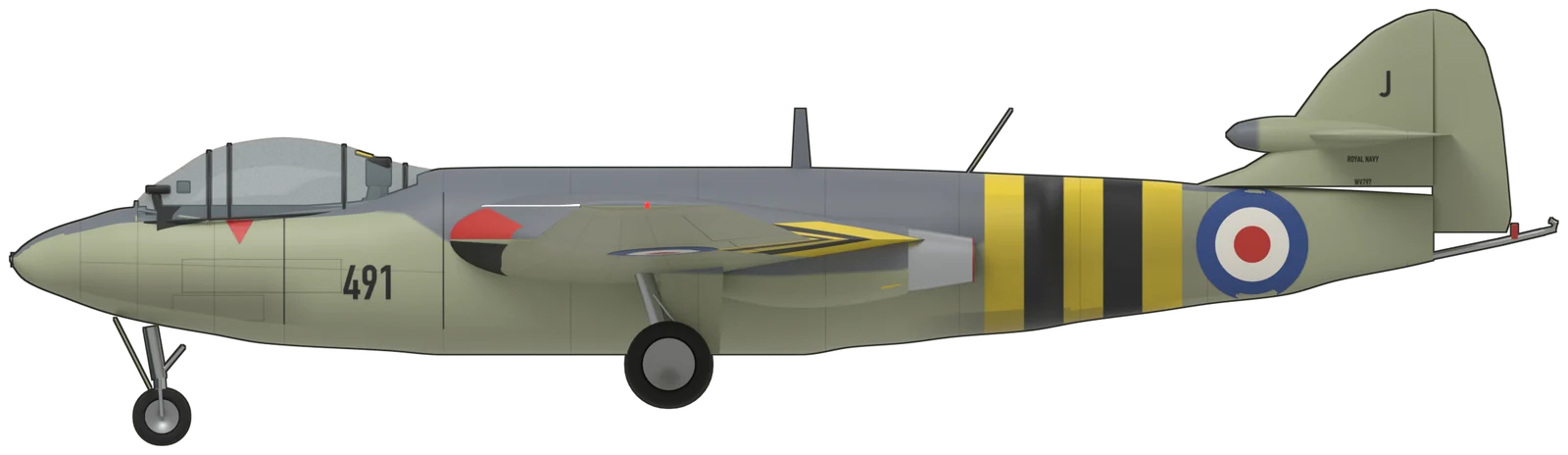
A procedural model built in Blender from published dimensions, drawings and photographs, painted as WV797 '491' in the Extra Dark Sea Grey and Sky Suez-stripe scheme it wears at the Midland Air Museum, Coventry. Drag to orbit, scroll or pinch to zoom · download .glb (800 KB)
History
The Sea Hawk FGA.6
The Sea Hawk began as Hawker’s P.1040, a straight-winged jet fighter built round the Rolls-Royce Nene engine, which first flew on 2 September 1947. Sydney Camm’s team gave it a short fuselage by splitting the jet pipe in two and venting it through slots in the trailing edges of the wing roots, so that the engine could sit well back without a long tailpipe, and the air intakes were set in the wing roots as well.
The Royal Navy ordered it as a carrier fighter and the production aircraft, many of them built by Armstrong Whitworth at Coventry, joined the Fleet Air Arm from 1953. The FGA.6 added hardpoints under the wings for rockets and bombs, a more powerful engine and powered ailerons, and it was the mark most widely used. The Sea Hawk flew from the carriers HMS Albion, Eagle and Bulwark.
In November 1956 Sea Hawks from these carriers attacked Egyptian airfields during the Suez operation, wearing black and yellow identification stripes round the rear fuselage and wings. The type left front-line Royal Navy service in the early 1960s, and a number were sold on to the navies of Germany, the Netherlands and India.
This airframe
FGA.6 WV797 (J-491)
WV797 is a Sea Hawk FGA.6 built by Armstrong Whitworth and flown by the Royal Navy. It is displayed at the Midland Air Museum in Coventry, close to where the type was built, painted as a Sea Hawk of the Suez operation of 1956 with the code “491”, a “J” on the fin and the black and yellow stripes round the rear fuselage and wings. The model shows it in Extra Dark Sea Grey over Sky, as it appears there.
Where to see one
In the gazetteer
The gazetteer records the Sea Hawk FGA.6 in 6 UK collections. The airframe modelled here is marked.