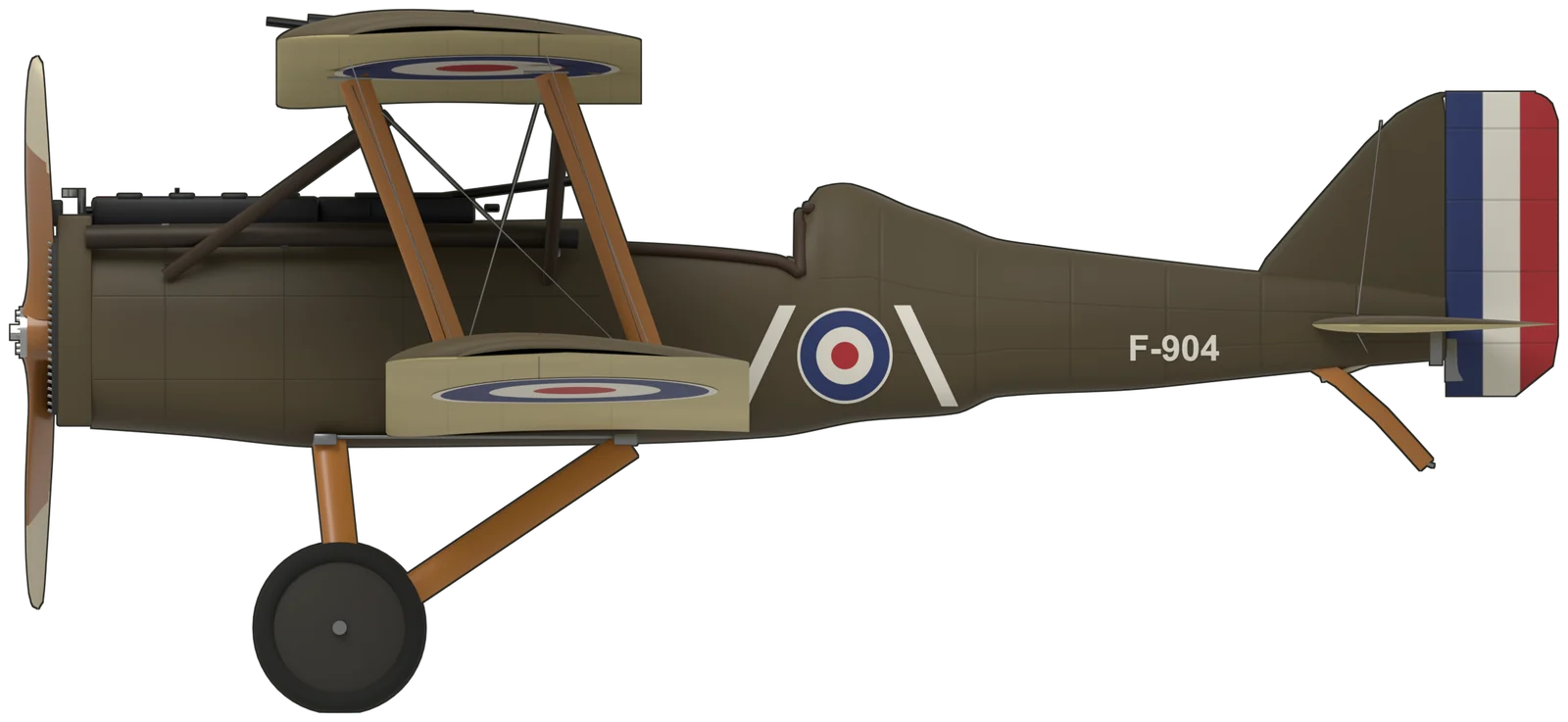
3D model
Turn it over
A procedural model built in Blender from published dimensions, drawings and photographs, painted as F904 (G-EBIA) as flown by The Shuttleworth Collection, in its Royal Flying Corps scheme. Drag to orbit, scroll or pinch to zoom · download .glb (878 KB)
History
The S.E.5a
The S.E.5 was designed at the Royal Aircraft Factory at Farnborough by Henry Folland, John Kenworthy and Frank Goodden, and first flew in November 1916. Built round a geared Hispano-Suiza V-8, it was strong, stable and fast in a dive, and it made a steady gun platform.
The S.E.5a, with the more powerful 200 hp engine, reached the squadrons in 1917 and was soon wanted everywhere. Engine supply was the bottleneck: Wolseley built the Viper, a high-compression Hispano-Suiza copy, and many airframes waited for engines. In all 5,205 S.E.5s were built, many by contractors such as Austin, Vickers and Wolseley.
Pilots liked it: James McCudden, Edward Mannock and Albert Ball, among others, scored heavily in it. Its Vickers gun fired through the propeller and a Lewis gun on a Foster mount slid along a rail above the centre section.
This airframe
S.E.5a F904 (G-EBIA)
F904 is one of the few genuine S.E.5as left and is kept in flying condition by The Shuttleworth Collection at Old Warden, Bedfordshire, with a Wolseley Viper engine. The model shows it as flown and displayed in recent years: khaki-brown top surfaces, clear-doped linen undersides, roundels on the fuselage and both wings, a red, white and blue rudder, and the serial “F-904” on the rear fuselage.
Where to see one
In the gazetteer
The gazetteer records the S.E.5a in 6 UK collections. The airframe modelled here is marked.