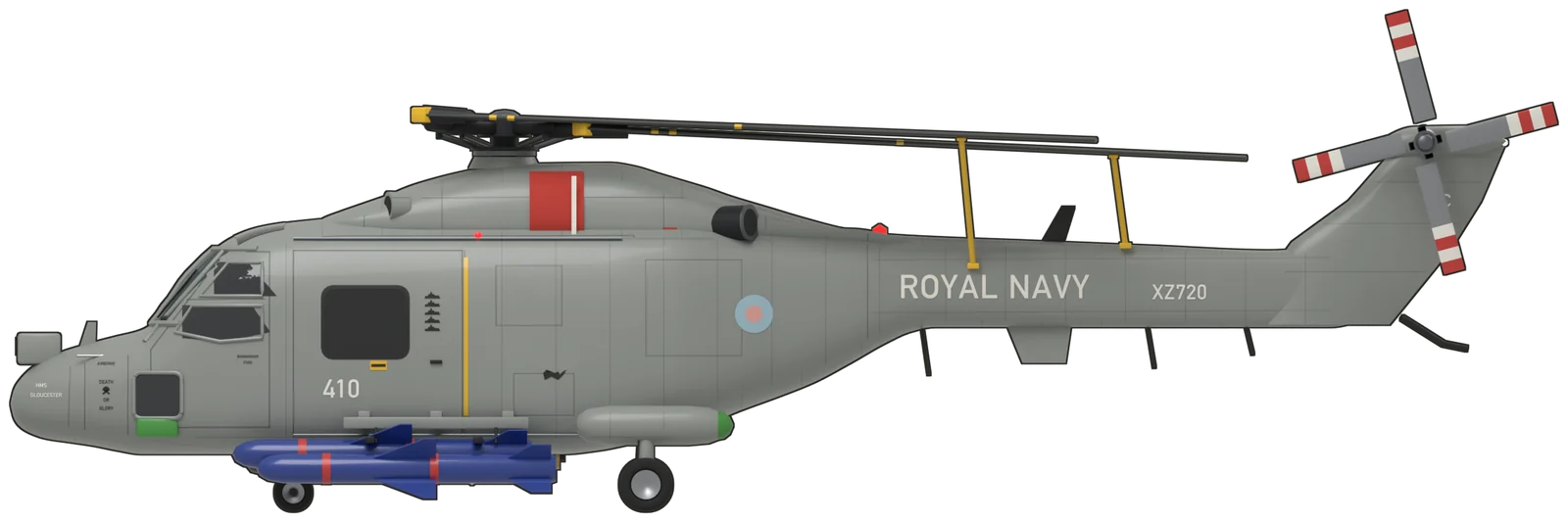
3D model
Turn it over
A procedural model built in Blender from published dimensions, drawings and photographs, painted as XZ720 ‘410’ of HMS Gloucester’s Flight in its 1991 Gulf War markings: overall medium sea grey with low-visibility roundels, ‘ROYAL NAVY’ and ‘GC’ on the tail, five black ship kill marks below the cockpit, ‘DEATH OR GLORY’ with skull and crossbones and ‘HMS GLOUCESTER’ on the nose, blue Sea Skua drill rounds to port and a Stingray torpedo to starboard, its main rotor blades folded aft on support poles as it is displayed at the Fleet Air Arm Museum, Yeovilton. Drag to orbit, scroll or pinch to zoom · download .glb (1.0 MB)
History
The Lynx HAS.3
The Lynx was the British-designed member of the three helicopters that Britain and France agreed to develop together in 1967, alongside the Puma and the Gazelle. Westland drew it up as the WG.13, a fast twin-turbine utility helicopter with a semi-rigid main rotor hub machined from a single titanium forging, which made it unusually agile, and two Rolls-Royce Gem engines. Aérospatiale took a share of the production work. The first prototype flew at Yeovil on 21 March 1971.
Two families grew from the design. The Army’s AH.1 sat on skids and carried troops or TOW anti-tank missiles. The Navy’s HAS.2 had a wheeled tricycle undercarriage, a harpoon that locked it to a deck grid, folding main rotor blades, flotation gear and a Ferranti Seaspray radar in the nose, and it was armed with homing torpedoes, depth charges and Sea Skua anti-ship missiles. It entered service with 700L Naval Air Squadron at Yeovilton in September 1976 and replaced the Wasp aboard the Navy’s frigates and destroyers. The HAS.3 followed from 1982 with uprated engines, and the HMA.8 in the 1990s with a chin radar and a thermal imager on the nose.
Lynx flights went to war in the Falklands in 1982, when a Lynx made the first Sea Skua attacks, and in the Gulf in 1991, when Royal Navy Lynx sank or crippled much of the Iraqi navy. More than 400 were built, for Britain, France, Germany, the Netherlands, Denmark, Norway, Brazil, South Korea and others, and the design lives on in the AW159 Wildcat. The Royal Navy retired its last Lynx in March 2017, after 41 years in service.
This airframe
Lynx HAS.3 (GMS) XZ720
XZ720 was built at Yeovil as a HAS.2 and later brought up to HAS.3 standard. In the Falklands War of 1982 it flew from the frigate HMS Alacrity, and a machine-gun round from an Argentine patrol vessel came through the windscreen, narrowly missing its pilot. After flights in HMS Coventry, Brazen and Battleaxe it joined the destroyer HMS Gloucester in July 1990, and in the opening weeks of 1991 its crew, led by Lt Cdr David Livingstone with observer Lt Cdr ‘Florry’ Ford, used Sea Skua missiles to sink or damage five Iraqi vessels. After almost thirty years at sea it retired from front-line flying, and it was presented to the Fleet Air Arm Museum at Yeovilton on 26 April 2012, restored by the Lynx Operational Support Team as a memorial to all who flew and maintained the type. The model shows it as displayed there, in its Gulf War markings as ‘410’ of Gloucester’s Flight: overall medium sea grey with low-visibility roundels, ‘ROYAL NAVY’ and ‘XZ720’ on the boom, ‘GC’ on the tail, five black ship kill marks below the cockpit, ‘DEATH OR GLORY’ with skull and crossbones and ‘HMS GLOUCESTER’ on the nose, and Sea Skua drill rounds and a Stingray torpedo on its weapon carriers. Its main rotor blades are folded aft on support poles.
Where to see one
In the gazetteer
The gazetteer records the Lynx HAS.3 in 5 UK collections. The airframe modelled here is marked.