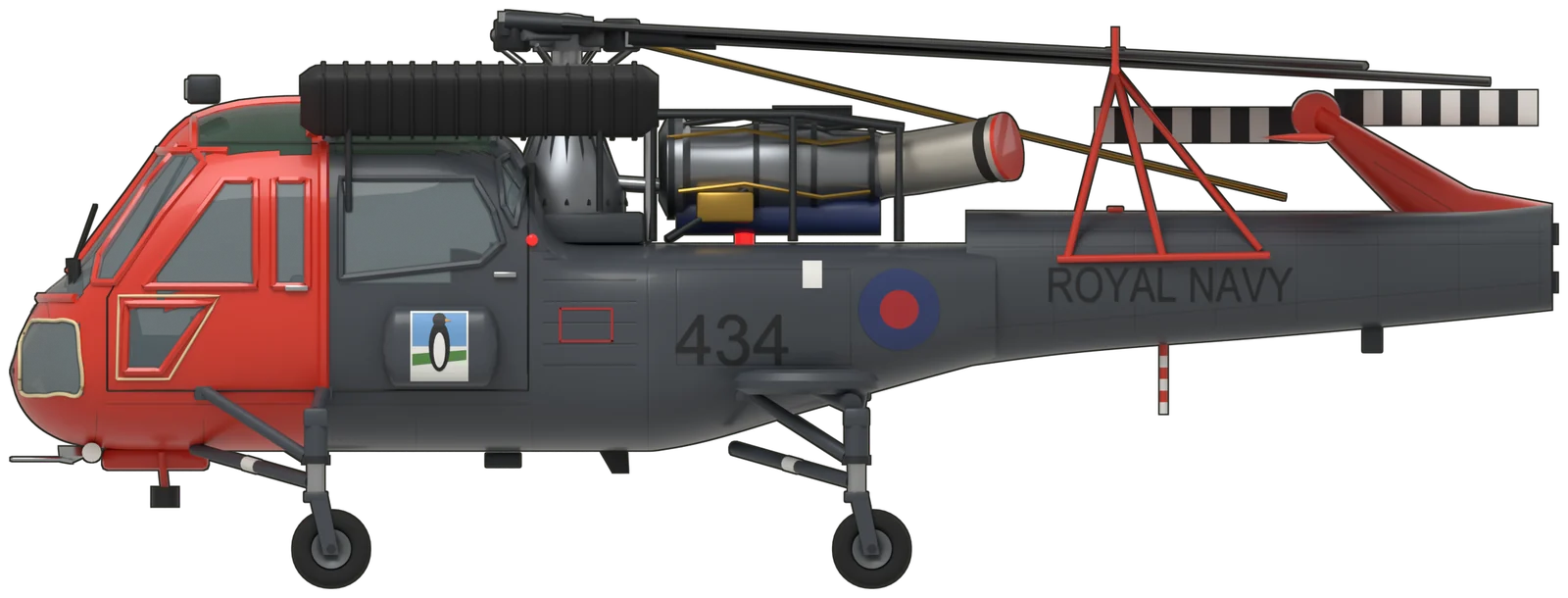
3D model
Turn it over
A procedural model built in Blender from published dimensions, drawings and photographs, painted as XS567 ‘434’ of HMS Endurance’s Flight, in dark blue-grey with the ice patrol ship’s red cab and folding tail, ‘HMS ENDURANCE’ on the nose, low-visibility roundels, the Endurance penguin badge and black flotation packs above the cabin, with its rotor and tail folded as it is displayed at IWM Duxford. Drag to orbit, scroll or pinch to zoom · download .glb (943 KB)
History
The Wasp HAS.1
The Wasp grew out of the Saunders-Roe P.531, a small turbine helicopter developed from the Skeeter that first flew on 20 July 1958. Westland took over Saunders-Roe in 1959 and developed the design two ways: as the Scout for the Army and as the Wasp for the Royal Navy. The first pre-production Wasps flew on 28 October 1962.
The Navy wanted a helicopter that could carry a homing torpedo out to a submarine contact found by a frigate’s sonar, well beyond the ship’s own weapons, and land back on a deck too small for anything larger. The Wasp met that need with a folding rotor and tail and a four-wheel castoring undercarriage that held it on a rolling deck. It went to sea from 1964 on the Tribal, Leander and Rothesay class frigates and the ice patrol ship HMS Endurance, armed with two torpedoes, depth charges or AS.12 wire-guided missiles.
The Royal Navy took 98 Wasps, and 133 were built in all, with export customers including Brazil, Indonesia, Malaysia, the Netherlands, New Zealand and South Africa. The Lynx began to replace it in the late 1970s, and the Navy’s last Wasps left service in 1988 as the last Type 12 frigates were paid off.
This airframe
HAS.1 XS567
XS567 was delivered to the Royal Navy in June 1964 and flew with 829 Naval Air Squadron’s ship’s flights, first in HMS Gurkha and then in HMS Apollo, with which it took part in the first Armilla patrol in the Gulf in 1981. By 1984 it had joined HMS Endurance’s Flight as ‘434’, and it was withdrawn from service in June 1986. It has been at IWM Duxford since 1992. The model shows it as displayed there: dark blue-grey with Endurance’s red cab and folding tail, ‘HMS ENDURANCE’ above the nose code, the ship’s penguin badge on the cabin lockers and black flotation packs above the cabin, with the main rotor folded back along the boom and the tail folded forward.
Where to see one
In the gazetteer
The gazetteer records the Wasp HAS.1 in 5 UK collections. The airframe modelled here is marked.