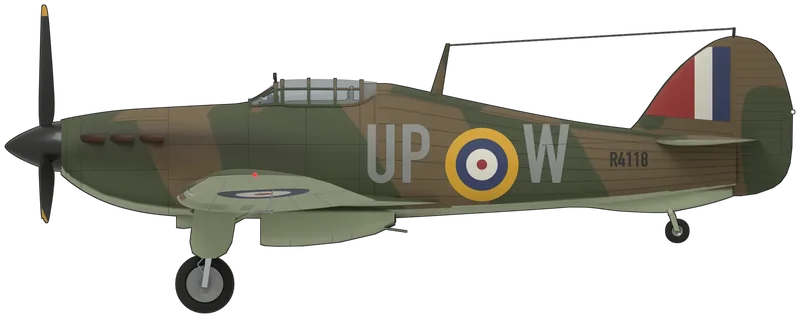
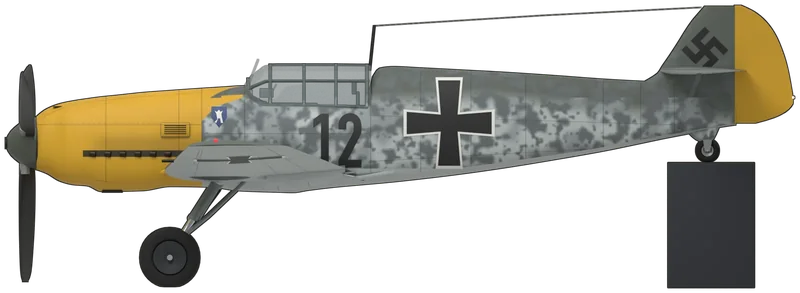
Specifications compared


| Variant compared | Hurricane Mk I | Bf 109 E-3 |
|---|---|---|
| First flight | 6 Nov 1935 | 29 May 1935 |
| Entered service | Dec 1937 | Feb 1937 (type) |
| Max speed | 316–340 mph (509–547 km/h), by propeller and fuel | 354 mph (570 km/h) at 16,400 ft (5,000 m) |
| Engine | Rolls-Royce Merlin II or III, c. 1,030 hp | Daimler-Benz DB 601A, 1,100 PS (1,085 hp) |
| Armament | 8 × .303 in Browning machine guns | 2 × 7.92 mm MG 17 and 2 × 20 mm MG FF cannon |
| Number built | 14,487 (UK and Canada, all marks) | c. 34,000 (all versions, 1936–45) |
| Crew | 1 | 1 |
Design
The Hurricane flew on 6 November 1935, and the Bf 109 on 29 May 1935. They were near contemporaries, but built very differently.
Hawker used a steel-tube frame with wooden formers and doped linen covering. It was easy to repair in the field. Messerschmitt built a small, light, all-metal stressed-skin fighter.
The 1940 trials
In May 1940 a captured Bf 109E-3 was flown against a Hurricane by British pilots. The Messerschmitt was faster and could out-climb and out-dive the Hurricane. It could not out-turn it.
In turning fights the Hurricane got onto the 109's tail within four turns. The trials stopped below 15,000 ft, because no oxygen equipment was available. Higher up, the 109's advantages grew.
How they were used
Fighter Command sent Hurricanes after the bombers wherever possible. The escorting Bf 109s and Bf 110s were there to stop them. Hurricane pilots were taught to break hard into an attacker rather than dive away.
The Bf 109E carried two 20 mm cannon as well as machine guns. The Hurricane I had eight .303 in machine guns. The 109's short range limited its time over England.
The Hurricane's fabric rear fuselage let some cannon shells pass straight through, and many badly damaged aircraft got home. The same construction burned readily once alight.
The record and a myth
14,487 Hurricanes were built in Britain and Canada, against about 34,000 Bf 109s. Both stayed in service throughout the war.
The Hurricane is sometimes called obsolete by 1940. Yet Fighter Command credited it with 55% of German losses in the Battle of Britain. It was slower than its rival, not outclassed.
Later Hurricanes moved towards ground attack. The Mk IIC carried four 20 mm cannon and bombs, while the Bf 109F and G pushed past 400 mph as fighters.
Published figures do not all agree. A 1967 calculation gave the Bf 109E a tighter turning radius than the Hurricane at 10,000 ft. The 1940 flight trials found the opposite.
Where to see a Hurricane and a Bf 109
IWM Duxford and the Royal Air Force Museum London each show a Hurricane I near a genuine Bf 109E. The Royal Air Force Museum Midlands pairs a Hurricane IIc with its desert Bf 109G-2.
| Museum | Adult entry | Airframes | Headline exhibit |
|---|---|---|---|
| Biggin Hill Heritage HangarWesterham, Greater London | £49 | 17 | A rotating dozen-ish airworthy and in-rebuild Spitfires plus a Hurricane and Buchón; the 'Sit in a Spitfire' add-on is the affordable… |
| IWM DuxfordCambridge, Cambridgeshire | £29 | 146 | Concorde 101 (G-AXDN), the pre-production development aircraft and the fastest Concorde of them all at Mach 2.23 — plus an SR-71A… |
| Royal Air Force Museum LondonLondon, Greater London | Free | 88 | Avro Lancaster R5868 'S-Sugar' — 137 operations, the RAF's highest-scoring surviving heavy — under the same roof as a Vulcan, a… |
| Royal Air Force Museum MidlandsShifnal, Shropshire | Free | 78 | TSR-2 XR220, one of two survivors of the most gifted aircraft Britain ever cancelled, sharing floor space with the stainless-steel… |
| Spitfire Visitor Centre, Hangar 42, BlackpoolBlackpool, Lancashire | £12 | 6 | The Ops Room recreation and the £5 sit-in-a-Spitfire photography session — the cheapest Spitfire seat time in the country. |
| Yorkshire Air MuseumYork, North Yorkshire | £17 | 54 | Halifax 'Friday the 13th' — the world's only complete Halifax reconstruction, honouring the type that flew from this very field —… |
Frequently asked
Could a Hurricane out-turn a Bf 109?
Yes. In 1940 trials with a captured Bf 109E-3, the Hurricane got onto the Messerschmitt's tail within four turns. The 109 was faster, climbed better and could dive away.
Was the Hurricane obsolete in 1940?
It was slower than the Bf 109E but far from useless. Fighter Command credited Hurricanes with 55% of German aircraft destroyed in the Battle of Britain.
Where can I see a Hurricane and a Bf 109 together?
IWM Duxford, the Royal Air Force Museum London and the Royal Air Force Museum Midlands all hold genuine examples of both.