Specifications compared


| Variant compared | Spitfire Mk I | Hurricane Mk I |
|---|---|---|
| First flight | 5 Mar 1936 | 6 Nov 1935 |
| Entered service | 4 Aug 1938 | Dec 1937 |
| Max speed | 362 mph (583 km/h) at 18,500 ft | 316–340 mph (509–547 km/h), by propeller and fuel |
| Engine | Rolls-Royce Merlin II, 1,030 hp | Rolls-Royce Merlin II or III, c. 1,030 hp |
| Armament | 8 × .303 in Browning machine guns | 8 × .303 in Browning machine guns |
| Number built | 20,351+ (all marks) | 14,487 (UK and Canada, all marks) |
| Crew | 1 | 1 |
Old methods and new
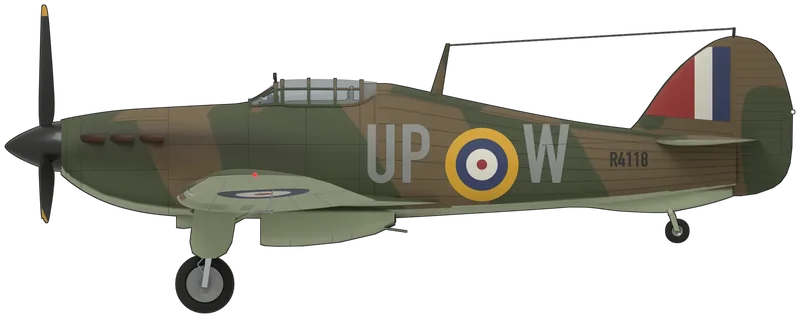
Sydney Camm's Hurricane flew first, on 6 November 1935. It used Hawker's established method: a steel-tube frame with wooden formers and a doped linen skin. Early wings were fabric-covered too, with metal wings arriving in 1939.
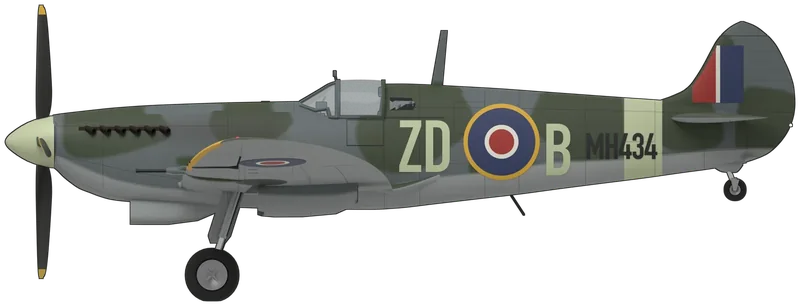
R. J. Mitchell's Spitfire followed on 5 March 1936. It had a stressed-skin metal structure and a thin wing. It was slower to build, but it could take far more power later.
Performance and how they were used
Both carried a Rolls-Royce Merlin and eight .303 in Browning guns. A production Spitfire I reached 362 mph at 18,500 ft. The Hurricane I was roughly 40 mph slower.
The Hurricane turned tighter and was a steady gun platform. A Fighter Command report found it could out-turn a Spitfire in a simple tail chase. Where possible, Hurricanes were sent after the bombers while Spitfires took on the Bf 109 escorts.
Later marks pulled further apart. The Hurricane IIC reached 340 mph with four 20 mm cannon, while contemporary Spitfires were faster still. The Spitfire also had the airframe to accept the bigger Griffon engine.
The record
The Hurricane reached No. 111 Squadron at Northolt in December 1937. The Spitfire joined No. 19 Squadron at Duxford on 4 August 1938.
After the Battle of Britain the Spitfire replaced the Hurricane as Fighter Command's main fighter. It stayed in production until 1948, and more than 20,351 were built. The Hurricane went on to ground attack, carrier work and every major theatre; 14,487 were built in Britain and Canada.
The Hurricane's simple structure paid off in 1940. Damaged airframes could be patched in the field and sent back to their squadrons quickly.
The myth: the Spitfire won the Battle of Britain
Fighter Command's figures credit Hurricanes with 55% of the 2,739 German aircraft lost in the Battle, and Spitfires with 42%. There were simply more Hurricanes, and they flew more sorties.
The Spitfire's case rests elsewhere. Its squadrons lost fewer aircraft and scored more victories for each loss. Both statements are true, and the Battle needed both types.
Where to see a Spitfire and a Hurricane
IWM Duxford shows several Spitfire Is and Hurricane Is, and the Royal Air Force Museum London has a Mk I of each. The Battle Of Britain Memorial Flight Visitors Centre and the Spitfire & Hurricane Memorial Museum, Manston also show both types.
| Museum | Adult entry | Airframes | Headline exhibit |
|---|---|---|---|
| Battle of Britain BunkerUxbridge, Greater London | £12.50 | 2 | The actual 11 Group operations bunker at Uxbridge, 77 steps down, restored to its Battle of Britain configuration — Churchill watched the… |
| Battle Of Britain Memorial Flight Visitors CentreLincoln, Lincolnshire | £12.50 | 11 | Lancaster PA474 — one of only two airworthy Lancasters on Earth — when she's home (she periodically visits Duxford for deep maintenance,… |
| Biggin Hill Heritage HangarWesterham, Greater London | £49 | 17 | A rotating dozen-ish airworthy and in-rebuild Spitfires plus a Hurricane and Buchón; the 'Sit in a Spitfire' add-on is the affordable… |
| Hooton Park HangarsEllesmere Port, Cheshire | £9 | 45 | Hooton Park's 1917 Belfast-truss hangars — among the finest WWI aviation buildings surviving — hold aircraft, buses and a printing museum… |
| IWM DuxfordCambridge, Cambridgeshire | £29 | 146 | Concorde 101 (G-AXDN), the pre-production development aircraft and the fastest Concorde of them all at Mach 2.23 — plus an SR-71A… |
| Norfolk and Suffolk Aviation MuseumBungay, Suffolk | £10 | 65 | Depends who you ask — the joy is the oddities. Come for the Bloodhound missiles and decoy rarities; stay for volunteer flight-simulator… |
| North East Land, Sea and Air MuseumsSunderland, Tyne and Wear | £7.50 | 46 | NELSAM in Sunderland mixes Vulcan XL319 (flew in when the airport still existed), a Pucará from the Falklands, trams, buses and a… |
| Royal Air Force Museum LondonLondon, Greater London | Free | 88 | Avro Lancaster R5868 'S-Sugar' — 137 operations, the RAF's highest-scoring surviving heavy — under the same roof as a Vulcan, a… |
| Royal Air Force Museum MidlandsShifnal, Shropshire | Free | 78 | TSR-2 XR220, one of two survivors of the most gifted aircraft Britain ever cancelled, sharing floor space with the stainless-steel… |
| Spitfire & Hurricane Memorial Museum, ManstonRamsgate, Kent | Free | 3 | Free-entry memorial museum holding Spitfire TB752 and Hurricane LF751 plus a dense Manston story — the emergency runway where crippled… |
| Spitfire Visitor Centre, Hangar 42, BlackpoolBlackpool, Lancashire | £12 | 6 | The Ops Room recreation and the £5 sit-in-a-Spitfire photography session — the cheapest Spitfire seat time in the country. |
| Tangmere Military Aviation MuseumChichester, West Sussex | £15 | 23 | Hawker Hunter WB188 in one-off scarlet, in which Neville Duke took the world air speed record to 727.63 mph off this coast in 1953;… |
| The Shuttleworth CollectionBiggleswade, Bedfordshire | £19.50 | 55 | The 1934 DH.88 Comet 'Grosvenor House', winner of the MacRobertson England–Australia air race, restored to fly; and the Edwardians —… |
| Yorkshire Air MuseumYork, North Yorkshire | £17 | 54 | Halifax 'Friday the 13th' — the world's only complete Halifax reconstruction, honouring the type that flew from this very field —… |
Frequently asked
Which was faster, the Spitfire or the Hurricane?
The Spitfire. A production Spitfire I reached 362 mph at 18,500 ft; the Hurricane I managed between about 316 and 340 mph, depending on its propeller and fuel. The gap stayed as both were developed.
Did the Hurricane shoot down more aircraft than the Spitfire in 1940?
Yes. Fighter Command credited Hurricanes with 55% of German losses in the Battle of Britain and Spitfires with 42%. Spitfire squadrons, however, lost fewer aircraft for each victory.
Where can I see a Spitfire and a Hurricane together?
IWM Duxford, the Royal Air Force Museum London and the Royal Air Force Museum Midlands all hold both. The Battle Of Britain Memorial Flight Visitors Centre shows airworthy examples of each.