3D model
Turn it over
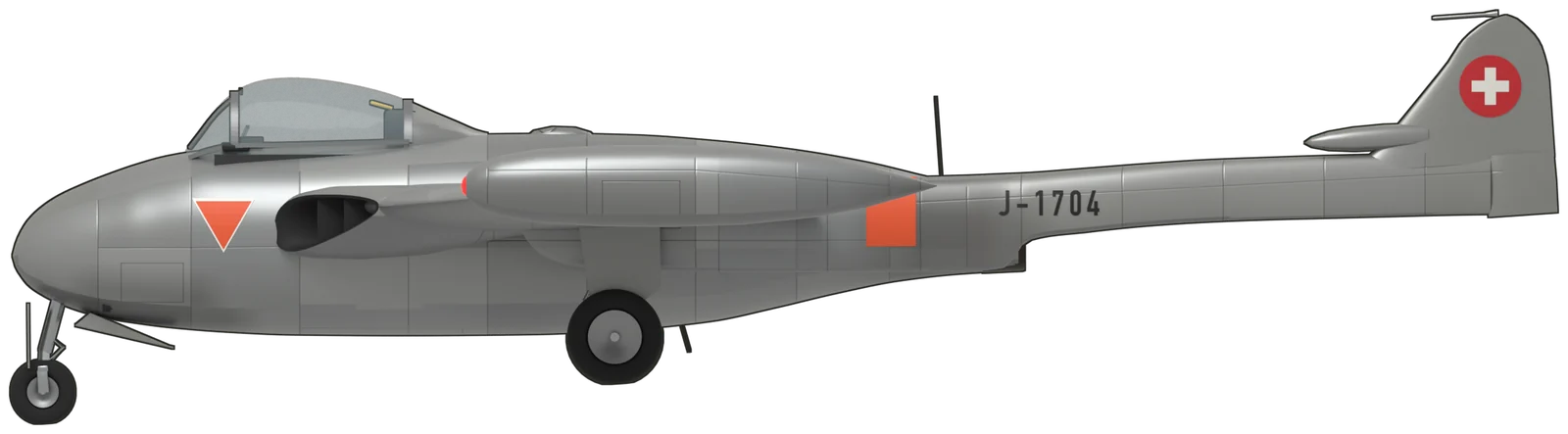
A procedural model built in Blender from published dimensions, drawings and photographs, painted as J-1704, a single-seat Venom FB.4 built under licence by the Swiss Federal Aircraft Factory at Emmen and accepted by the Swiss Air Force in September 1956: bare natural metal with weathered panel tones and tip tanks, a day-glo orange band round each boom with black ‘J-1704’ behind it, the Swiss white cross on a red disc on the fins (and, following other Swiss Venoms, the wings), an orange rescue triangle below the windscreen and ‘704’ on the nose-gear door, as photographed at RAF Museum Midlands, Cosford. Drag to orbit, scroll or pinch to zoom · download .glb (925 KB)
History
The Venom FB.4
The Venom began as a Vampire with a bigger engine. de Havilland fitted the twin-boom layout with the more powerful Ghost and a new, thinner wing swept back along its leading edge, and at first called it the Vampire FB.8. By the time John Derry flew the prototype at Hatfield on 2 September 1949 it had become the DH.112 Venom, and it was a good deal faster and higher-flying than the aircraft it grew from.
The FB.1 joined No. 11 Squadron in Germany in 1952 as a stopgap fighter-bomber until swept-wing jets arrived. The FB.4 followed with an ejection seat, powered ailerons and redesigned fins and rudders. In November 1956 Venoms of Nos 6, 8 and 249 Squadrons flew from Akrotiri in Cyprus against Egyptian airfields during the Suez crisis, and RAF Venoms also fought in Aden, Oman and Malaya before Hunters replaced the last of them in the early 1960s.
Two-seat night fighters served the RAF, and the Sea Venom flew from Royal Navy carriers. Switzerland built 250 Venoms under licence, 150 to FB.1 standard and 100 to FB.4 standard, and flew them from Alpine airfields until 1984. Most of the Venoms preserved in Britain today came home from Swiss service.
This airframe
FB.4 J-1704
J-1704 is one of 100 Venom FB.4s, J-1701 to J-1800, built for the Swiss Air Force by a consortium of Swiss firms; it was assembled by the Federal Aircraft Factory at Emmen, made its acceptance flights on 6 September 1956 and was delivered in March 1957. It came to Britain in 1979 for the RAF Museum and is now at Cosford. The model shows it as photographed there between 2013 and 2019: bare natural metal with weathered panel tones and tip tanks, a day-glo orange band round each boom with black “J-1704” behind it, the white Swiss cross on a red disc on its fins (and on its wings, painted from other Swiss Venoms because photos of J-1704 don’t show them), an orange rescue triangle below the windscreen and “704” on the nose-gear door.
Where to see one
In the gazetteer
The gazetteer records the Venom FB.4 in 4 UK collections. The airframe modelled here is marked.