AP 118 · No. 10 Section II · Aircraft Collection 09 / 12

Aircraft/Collections/Fleet Air Arm

Royal Naval Air Station · 1936–2006

The Fleet Air Arm

Biplane torpedo bombers, jet fighters with folding wings and the helicopters that hunted submarines: seventy years of the Royal Navy in the air.

11
Aircraft
1936–2006
Period
22
UK museums hold them

The diorama

Diorama · 1936–2006

Loading the airfield…

A Royal Naval Air Station ashore, in the manner of Yeovilton or Culdrose: a concrete runway and taxiway, an apron for the fixed-wing squadrons, hangars and a control tower. Helicopters take off from the apron while the jets use the runway.

Drag to look around · ctrl + scroll to zoom · pick an aircraft to follow it

The Fleet Air Arm took back control of the Navy’s aircraft from the RAF in 1939 and went to war with the Swordfish, a biplane that looked obsolete and achieved more than any other British naval aircraft: it crippled the Italian fleet at Taranto in November 1940 and the battleship Bismarck in May 1941.

After the war the Navy went to sea with jets, helped by British inventions that made carrier jet flying practical: the angled deck, the steam catapult and the mirror landing sight. The Sea Hawk and Sea Venom flew at Suez in 1956; the Sea Vixen and the Buccaneer followed, and when the big carriers went, the Sea Harrier made small ones useful, proving itself in the Falklands in 1982.

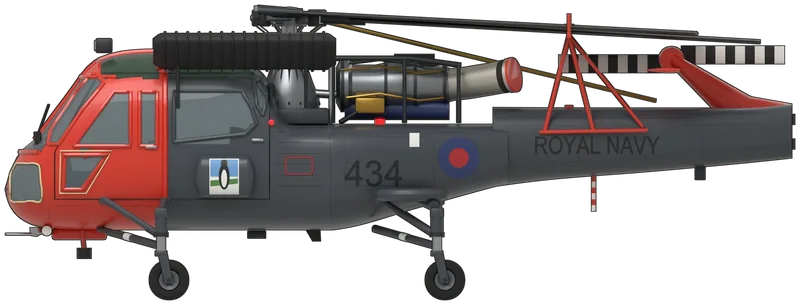
Helicopters became the Navy’s other air arm. From the Dragonfly and Whirlwind to the Wessex, Wasp, Sea King and Lynx they hunted submarines, carried commandos, rescued sailors and aircrew and flew from the decks of frigates and destroyers. The Fleet Air Arm Museum at Yeovilton holds the national collection.

To scale

The collection side by side

Every aircraft drawn at the same scale, so a Sea King HAR.3 and a Martlet I can be compared at a glance.

  • Fairey Swordfish side profile, to scaleSwordfish · 10.87 m
  • Supermarine Walrus side profile, to scaleWalrus · 11.45 m
  • Grumman Martlet side profile, to scaleMartlet I · 8.76 m
  • Fairey Firefly side profile, to scaleFirefly · 11.46 m
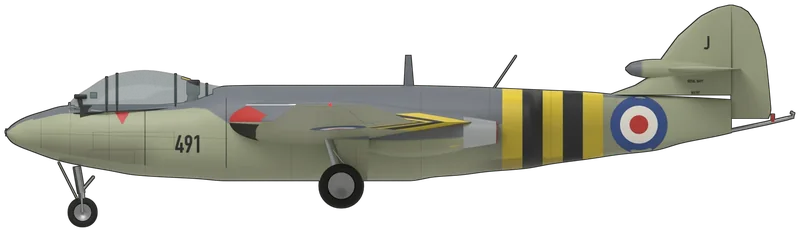
  • Hawker Sea Hawk side profile, to scaleSea Hawk FGA.6 · 12.09 m
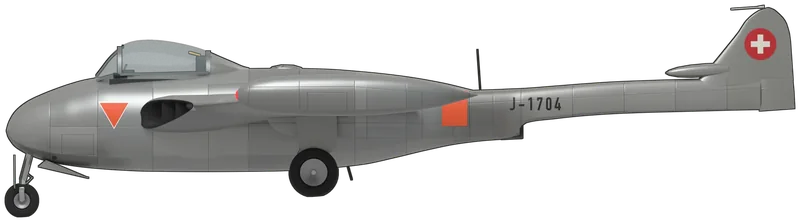
  • de Havilland Venom side profile, to scaleVenom FB.4 · 10.06 m
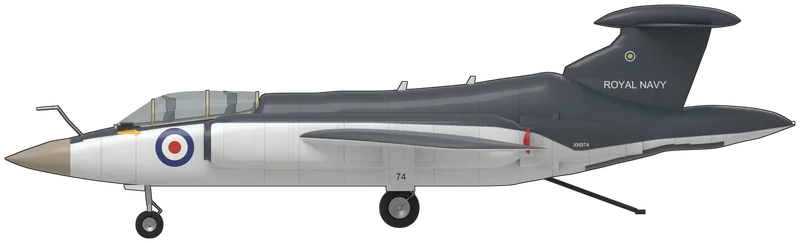
  • Blackburn Buccaneer side profile, to scaleBuccaneer · 19.33 m
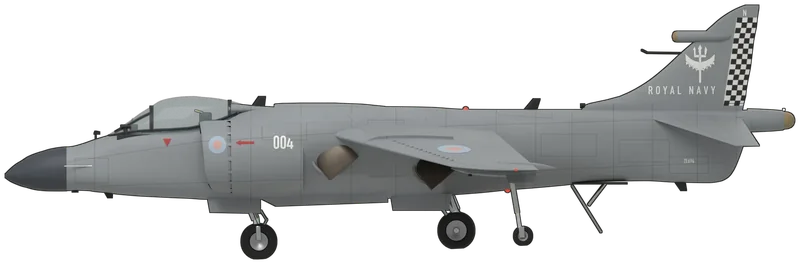
  • British Aerospace Sea Harrier side profile, to scaleSea Harrier FA.2 · 14.17 m
  • Westland Wasp side profile, to scaleWasp HAS.1 · 12.29 m
  • Westland Sea King side profile, to scaleSea King HAR.3 · 22.15 m
  • Westland Lynx side profile, to scaleLynx HAS.3 · 15.16 m

10 m

Profiles

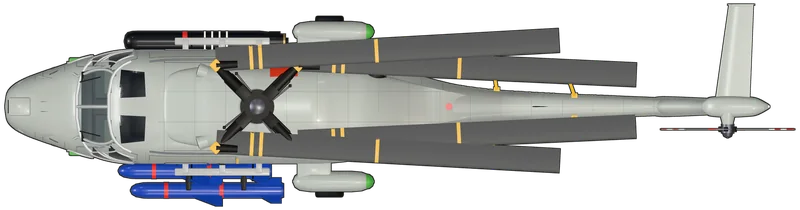
Side, top and front

Each aircraft drawn from its 3D model, painted as one real airframe, with its specification.

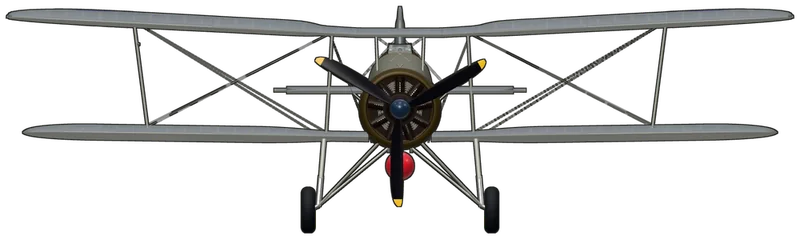
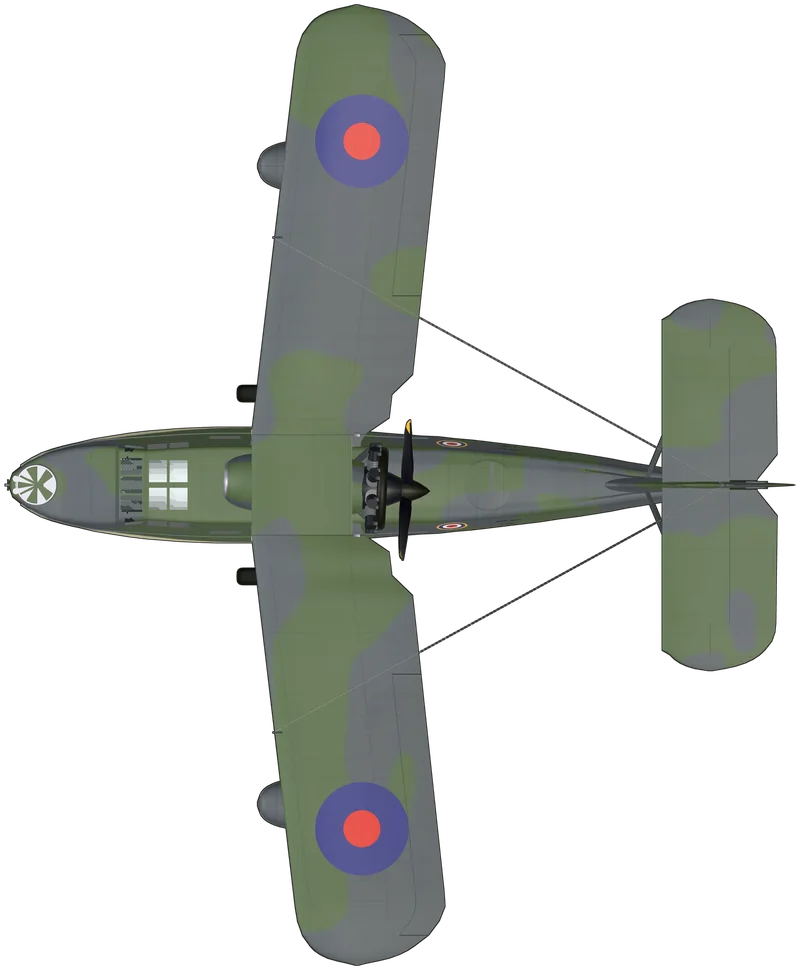
Fairey Swordfish

01 · Carrier torpedo bomber · Swordfish I W5856 (G-BMGC)
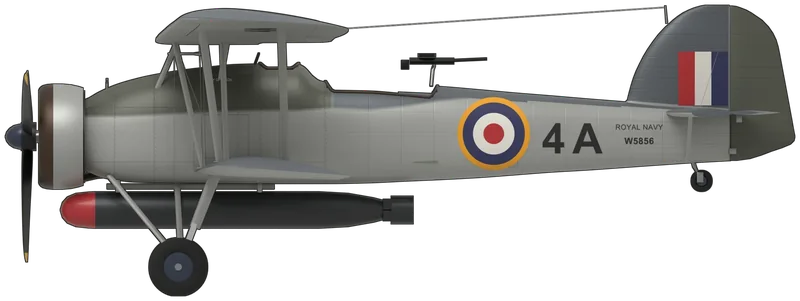
Side view of the Fairey Swordfish, Swordfish I W5856 (G-BMGC)
Port side
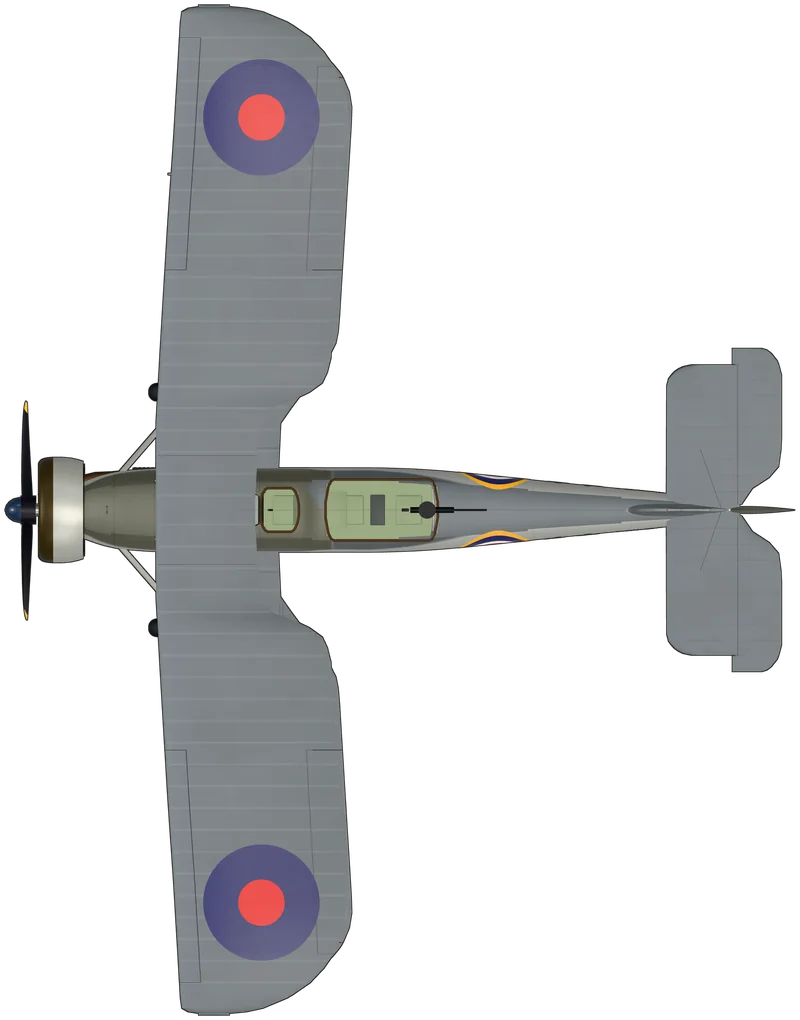
Top view of the Fairey Swordfish, Swordfish I W5856 (G-BMGC)
Plan, from above
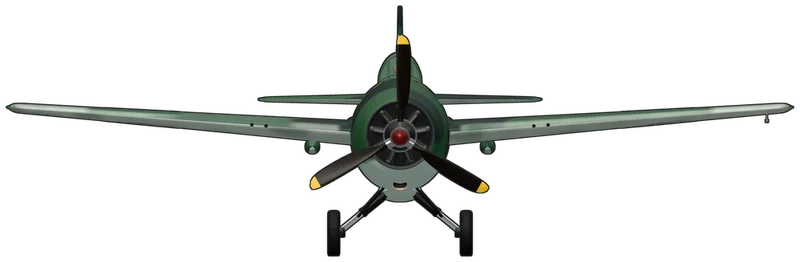
Front view of the Fairey Swordfish, Swordfish I W5856 (G-BMGC)
Head-on

Fairey built the Swordfish as a private venture, the TSR II, a torpedo, spotter and reconnaissance biplane for the Fleet Air Arm developed from an earlier design that had crashed in 1933. The prototype first flew on 17 April 1934, and the Admiralty ordered it into production as the Swordfish. It was a fabric-covered two-bay biplane of steel and light alloy with a Bristol Pegasus radial, open cockpits for a pilot, an observer and a telegraphist air gunner, and wings that folded back beside the fuselage for stowage aboard ship.

The Swordfish outlasted its intended replacement: the Fairey Albacore left front-line service before it did, and Swordfish were still flying operationally when the war in Europe ended.

W5856 was built by Blackburn at Sherburn-in-Elmet and first flew on 21 October 1941.

First flight
17 April 1934
Role
Carrier torpedo bomber
Maker
Fairey Aviation (Blackburn Aircraft under licence), Britain
Engine
Bristol Pegasus IIIM3 nine-cylinder radial, 690 hp
Crew
3
Wingspan
13.87 m (45 ft 6 in)
Length
10.87 m (35 ft 8 in)
Height
3.76 m (12 ft 4 in)
Top speed
139 mph
Built
2,391
In service
1936–1945

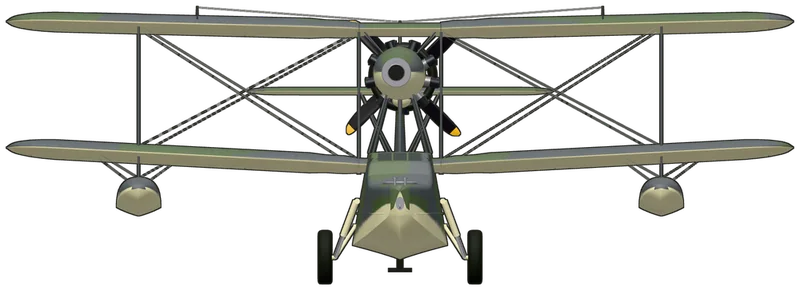
Supermarine Walrus

02 · Shipborne reconnaissance and air-sea rescue amphibian · Walrus I L2301
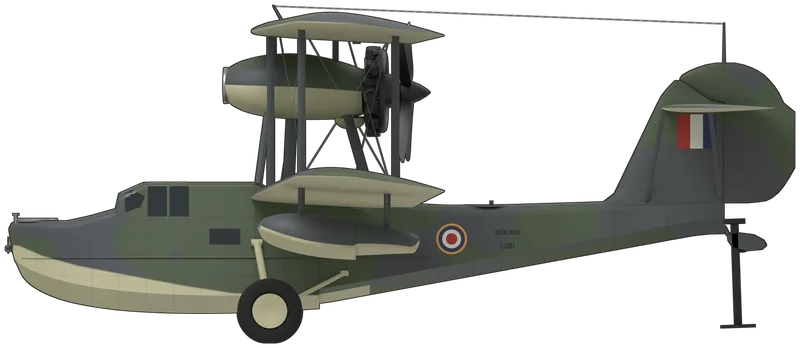
Side view of the Supermarine Walrus, Walrus I L2301
Port side
Top view of the Supermarine Walrus, Walrus I L2301
Plan, from above
Front view of the Supermarine Walrus, Walrus I L2301
Head-on

R. J. Mitchell designed the Walrus at Supermarine as a private venture, a small amphibian that warships could launch from a catapult to scout and spot for their guns. It grew out of the company’s earlier Seagull biplanes but had a single-step light-alloy hull, retractable main wheels and wings that folded back beside the hull. The Bristol Pegasus radial sat in a nacelle between the wings, driving a pusher propeller, and the whole aircraft was stressed to be catapulted with a full load.

The Walrus was the first British squadron aircraft with a retractable main undercarriage, completely enclosed crew accommodation and an all-metal fuselage, and the first amphibian to be catapulted from a ship with a full military load.

L2301 was built by Supermarine and delivered to the Irish Air Corps in March 1939 as N18, one of three Walruses used for coastal patrols during the Emergency; it suffered an engine failure and was damaged in a ditching on its delivery flight.

First flight
21 June 1933
Role
Shipborne reconnaissance and air-sea rescue amphibian
Maker
Supermarine (Saunders-Roe under licence), Britain
Engine
Bristol Pegasus VI nine-cylinder radial, 750 hp
Crew
3
Wingspan
13.97 m (45 ft 10 in)
Length
11.45 m (37 ft 7 in)
Height
4.65 m (15 ft 3 in)
Top speed
135 mph
Built
~740
In service
1936–1946

Grumman Martlet

03 · Carrier-borne fighter · Martlet I AL246
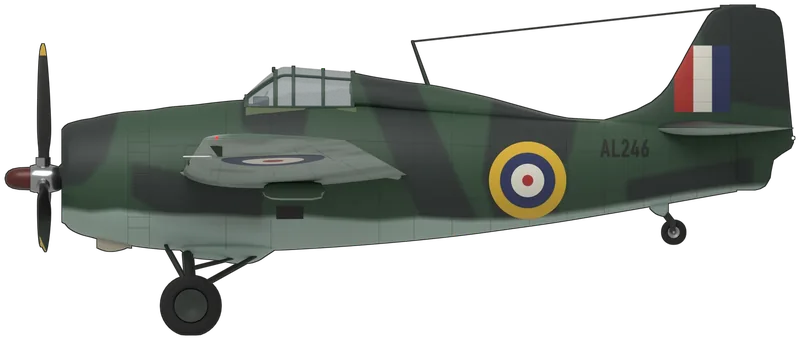
Side view of the Grumman Martlet, Martlet I AL246
Port side
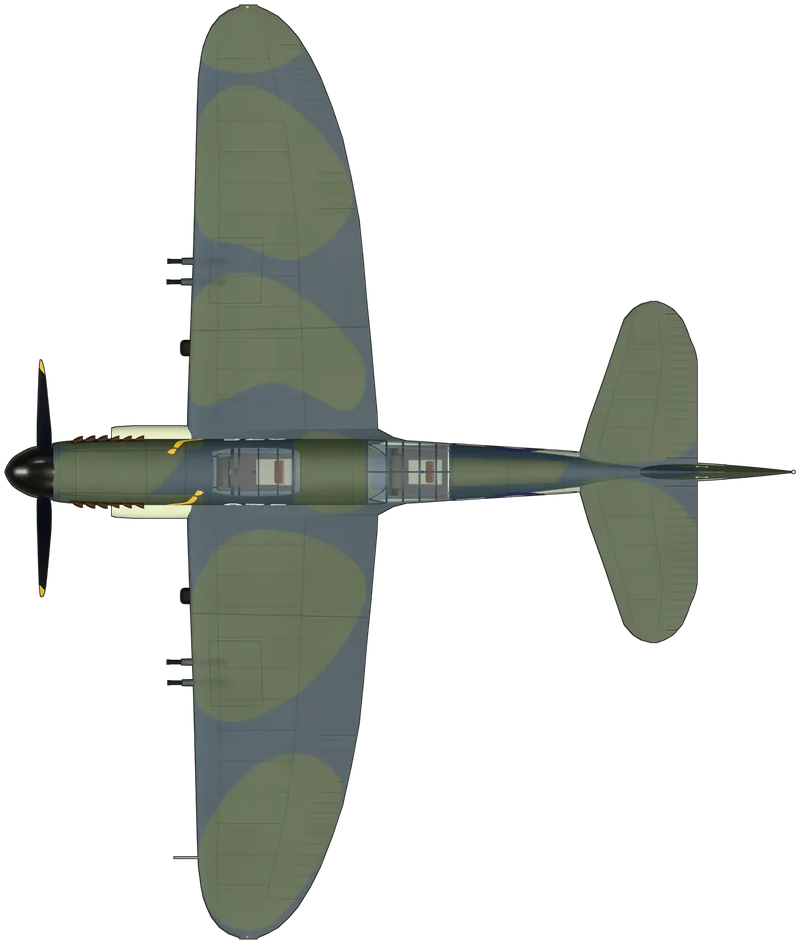
Top view of the Grumman Martlet, Martlet I AL246
Plan, from above
Front view of the Grumman Martlet, Martlet I AL246
Head-on

Grumman of Bethpage, Long Island, had supplied the US Navy with stubby biplane fighters through the 1930s. Its first monoplane fighter, the XF4F-2, flew on 2 September 1937 but lost the Navy’s 1938 competition to the Brewster Buffalo. Grumman rebuilt it with a two-stage supercharged Pratt & Whitney Twin Wasp, a larger wing and a squared-off tail, and in August 1939 the Navy ordered it as the F4F-3.

The Martlet I was ordered by France, and Britain inherited all 81 when France fell before any had been delivered.

AL246 was one of the G-36As built for the French Navy in 1940 and taken over by Britain after the fall of France.

First flight
2 September 1937
Role
Carrier-borne fighter
Maker
Grumman, United States
Engine
Wright R-1820-G205A Cyclone nine-cylinder air-cooled radial, 1,200 hp
Crew
1
Wingspan
11.58 m (38 ft 0 in)
Length
8.76 m (28 ft 9 in)
Height
3.61 m (11 ft 10 in)
Top speed
380 mph
Built
~32,000
In service
1940–1945

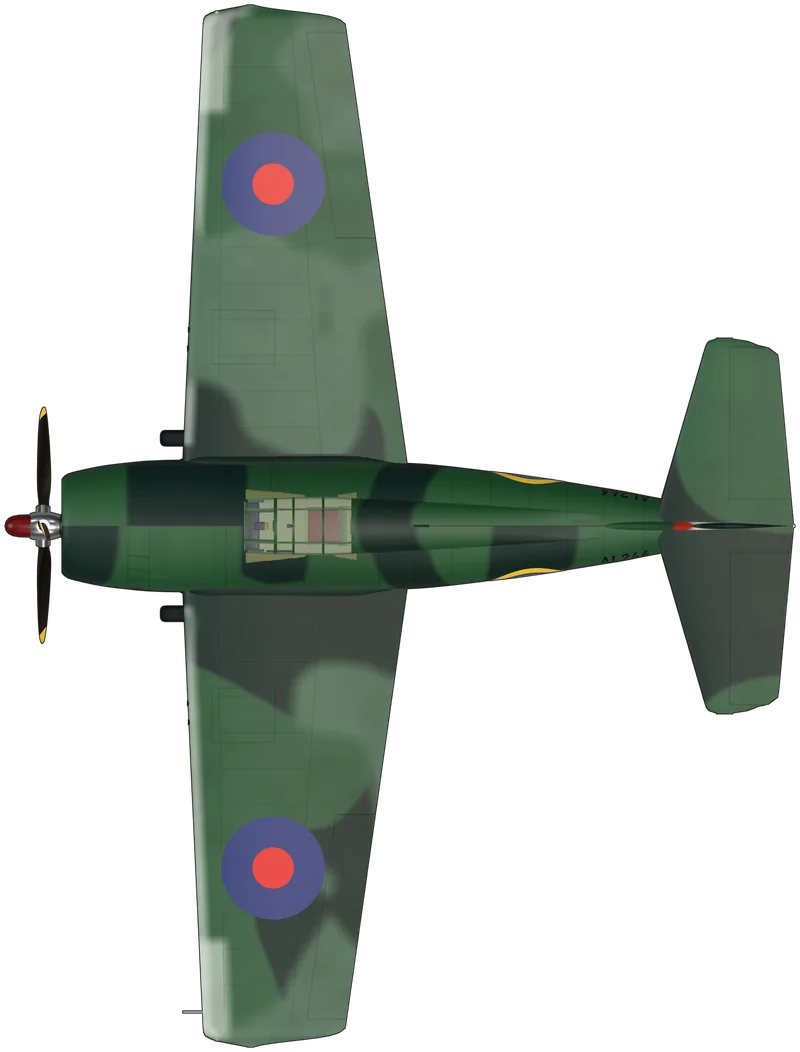
Fairey Firefly

04 · Two-seat carrier fighter and reconnaissance aircraft · Firefly I Z2033, painted as DK431 “275/N”
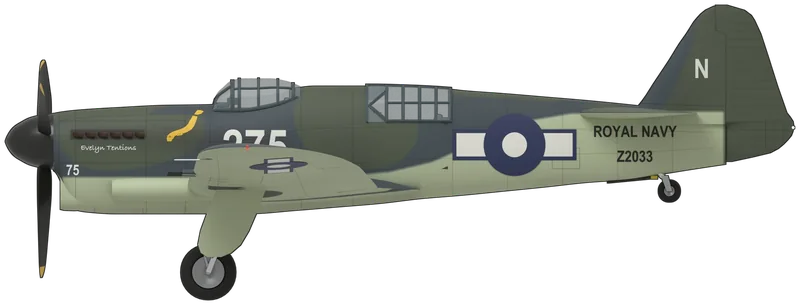
Side view of the Fairey Firefly, Firefly I Z2033, painted as DK431 “275/N”
Port side
Top view of the Fairey Firefly, Firefly I Z2033, painted as DK431 “275/N”
Plan, from above
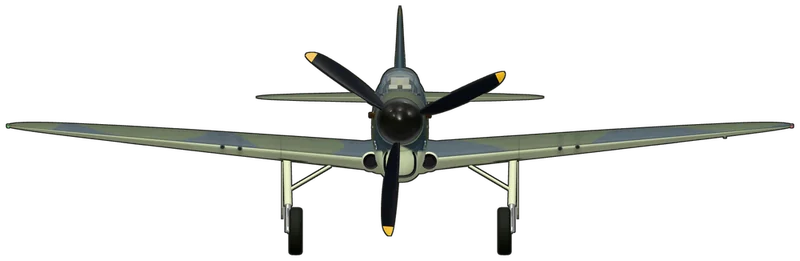
Front view of the Fairey Firefly, Firefly I Z2033, painted as DK431 “275/N”
Head-on

The Royal Navy believed a fighter flying far out over the sea needed a second man aboard to navigate and work the radio, and its first eight-gun monoplane fighter, the Fairey Fulmar of 1940, had one. The Fulmar was sturdy but slow, and in 1940 the Admiralty drew up specification N.5/40 for a faster successor. H. E. Chaplin’s team at Fairey designed a stressed-skin low-winged monoplane round the new Rolls-Royce Griffon, with the radiator under the nose, the observer in a separate cockpit behind the wing, four 20 mm Hispano cannon, and wings that folded back by hand for stowage below deck.

In July 1945 Fireflies of the British Pacific Fleet became the first British-built aircraft to fly over Tokyo.

Z2033 was built by Fairey in 1944 as a Firefly I. In 1945 it joined No. 731 Naval Air Squadron at East Haven, near Dundee, which taught pilots to land on carriers, until a taxiing accident sent it back to Fairey for repair.

First flight
22 December 1941
Role
Two-seat carrier fighter and reconnaissance aircraft
Maker
Fairey, Britain
Engine
Rolls-Royce Griffon IIB twelve-cylinder liquid-cooled V-12, 1,730 hp
Crew
2
Wingspan
13.56 m (44 ft 6 in)
Length
11.46 m (37 ft 7 in)
Height
4.14 m (13 ft 7 in)
Top speed
316 mph
Built
~2,200
In service
1943–1956

Hawker Sea Hawk

05 · Carrier fighter-bomber · FGA.6 WV797 (J-491)
Side view of the Hawker Sea Hawk, FGA.6 WV797 (J-491)
Port side
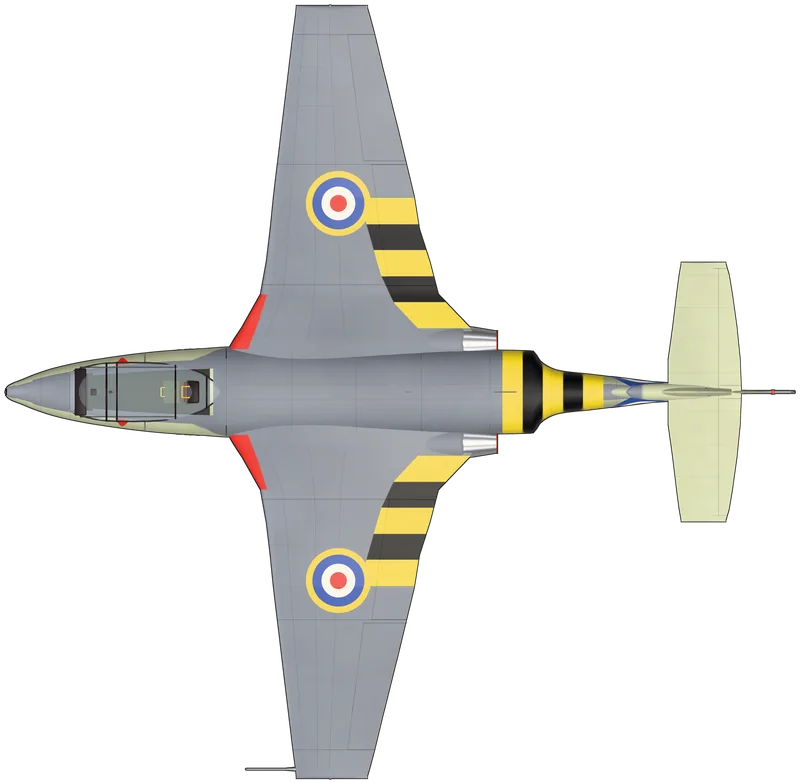
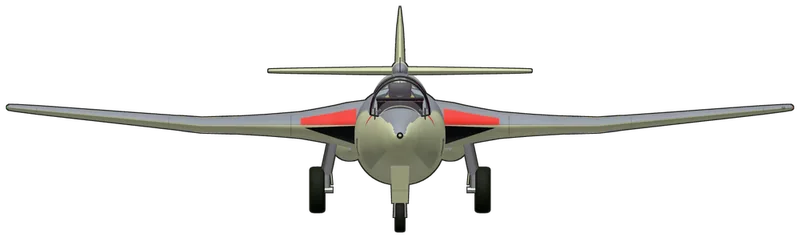
Top view of the Hawker Sea Hawk, FGA.6 WV797 (J-491)
Plan, from above
Front view of the Hawker Sea Hawk, FGA.6 WV797 (J-491)
Head-on

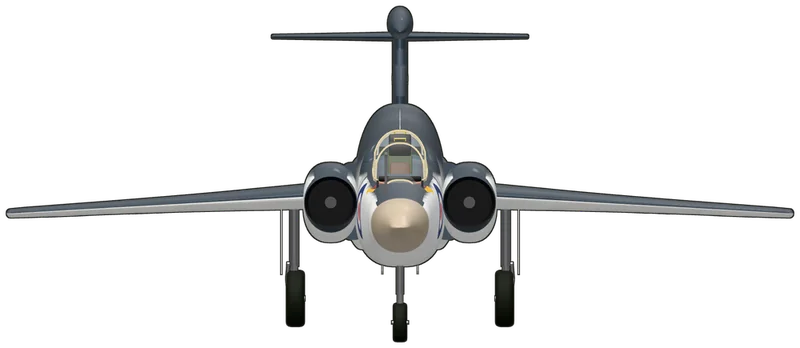
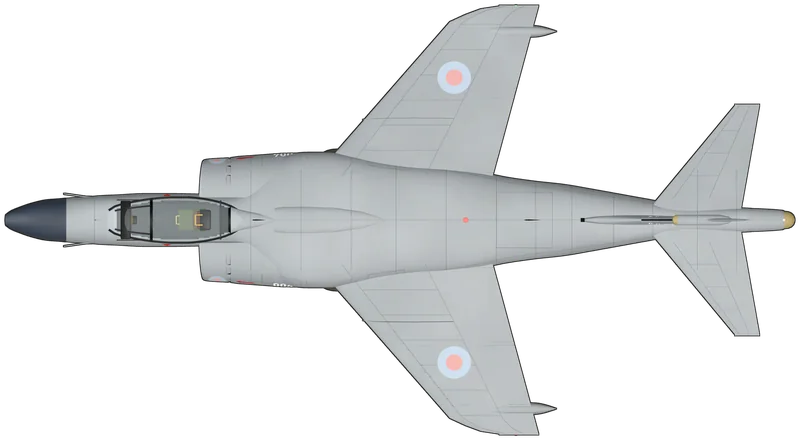
The Sea Hawk began as Hawker’s P.1040, a straight-winged jet fighter built round the Rolls-Royce Nene engine, which first flew on 2 September 1947. Sydney Camm’s team gave it a short fuselage by splitting the jet pipe in two and venting it through slots in the trailing edges of the wing roots, so that the engine could sit well back without a long tailpipe, and the air intakes were set in the wing roots as well.

The Sea Hawk’s jet exhaust leaves through two slots in the wing roots, so the fuselage behind the cockpit could be kept short and the tail clear of the hot gases.

WV797 is a Sea Hawk FGA.6 built by Armstrong Whitworth and flown by the Royal Navy.

First flight
2 September 1947
Role
Carrier fighter-bomber
Maker
Hawker Aircraft (Armstrong Whitworth in production), Britain
Engine
one Rolls-Royce Nene 103 centrifugal turbojet, 5,200 lbf
Crew
1
Wingspan
11.89 m (39 ft 0 in)
Length
12.09 m (39 ft 8 in)
Height
2.64 m (8 ft 8 in)
Top speed
600 mph
Built
542
In service
1953–1960s

de Havilland Venom

06 · Jet fighter-bomber · FB.4 J-1704
Side view of the de Havilland Venom, FB.4 J-1704
Port side
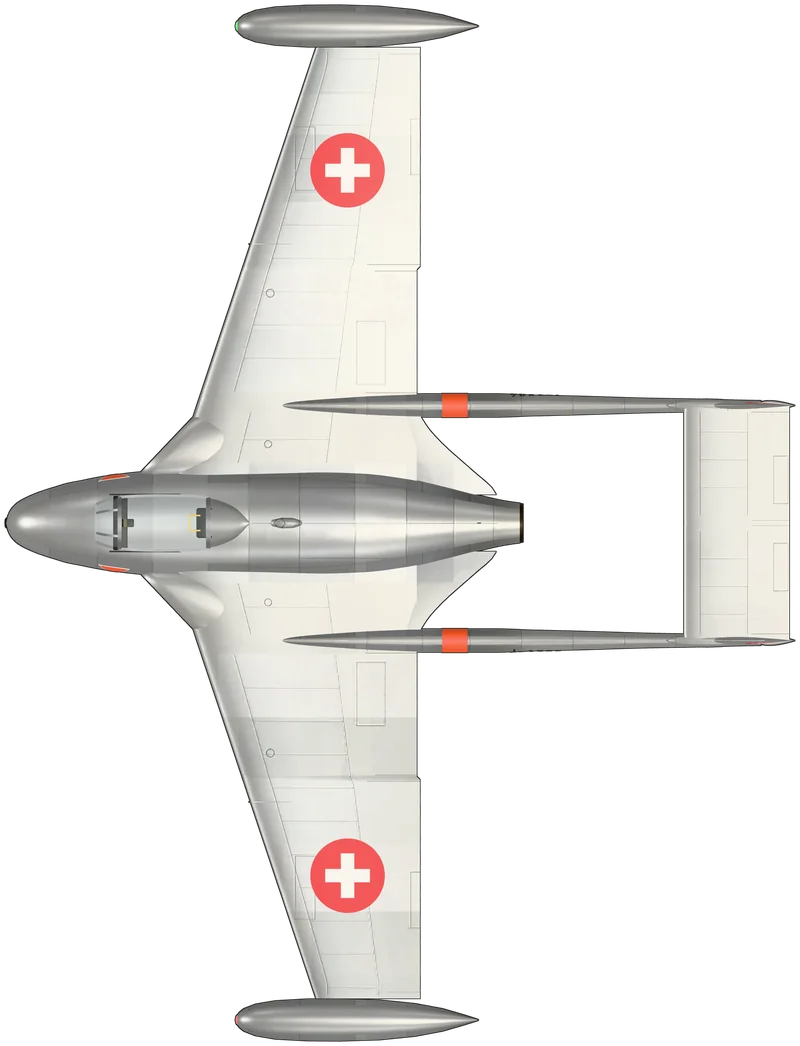
Top view of the de Havilland Venom, FB.4 J-1704
Plan, from above
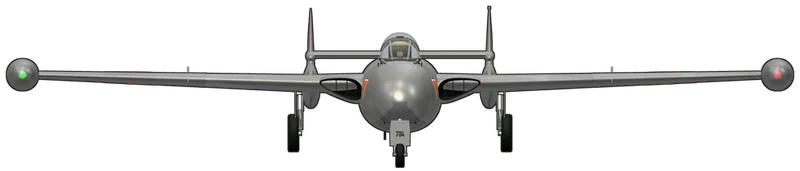
Front view of the de Havilland Venom, FB.4 J-1704
Head-on

The Venom began as a Vampire with a bigger engine. de Havilland fitted the twin-boom layout with the more powerful Ghost and a new, thinner wing swept back along its leading edge, and at first called it the Vampire FB.8. By the time John Derry flew the prototype at Hatfield on 2 September 1949 it had become the DH.112 Venom, and it was a good deal faster and higher-flying than the aircraft it grew from.

Switzerland’s licence-built Venoms outlasted the RAF’s by more than twenty years: the last were retired in 1984.

J-1704 is one of 100 Venom FB.4s, J-1701 to J-1800, built for the Swiss Air Force by a consortium of Swiss firms; it was assembled by the Federal Aircraft Factory at Emmen, made its acceptance flights on 6 September 1956 and was delivered in March 1957.

First flight
2 September 1949
Role
Jet fighter-bomber
Maker
de Havilland (and a Swiss consortium under licence), Britain
Engine
de Havilland Ghost 103 turbojet, 4,850 lbf
Crew
1
Wingspan
12.7 m (41 ft 8 in)
Length
10.06 m (33 ft 0 in)
Height
1.88 m (6 ft 2 in)
Top speed
640 mph
Built
~1,400
In service
1952–1984

Blackburn Buccaneer

07 · Low-level strike aircraft · S.2 XN974
Side view of the Blackburn Buccaneer, S.2 XN974
Port side
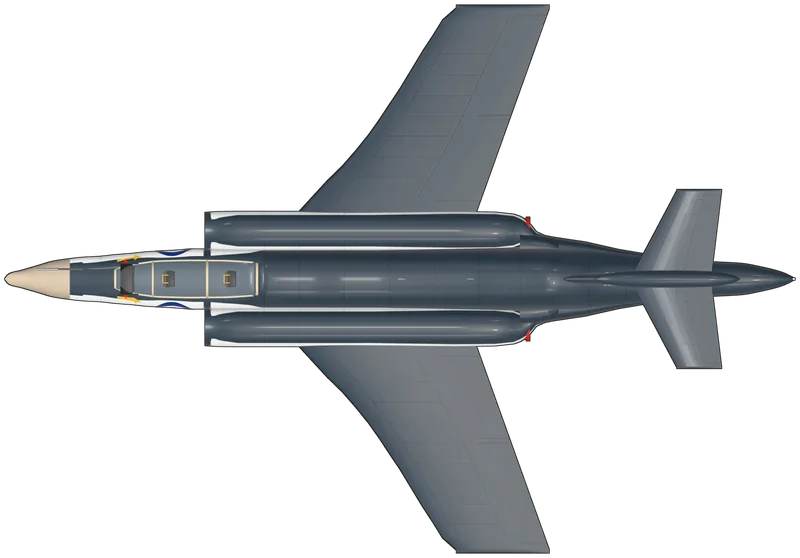
Top view of the Blackburn Buccaneer, S.2 XN974
Plan, from above
Front view of the Blackburn Buccaneer, S.2 XN974
Head-on

The Admiralty wanted a carrier aircraft that could cross the sea at wave-top height, below the radar of the day, and hit a ship with a nuclear weapon or a conventional load. Blackburn’s answer, the NA.39, first flew on 30 April 1958. It had a small, thick, strong wing, a fuselage shaped to the area rule, and a bomb bay whose door rotated to carry the weapons in the belly.

The Buccaneer’s “area ruled” waist and blown wing let it fly fast and low with a heavy load while still landing slowly on a carrier deck.

XN974 is a Buccaneer S.2 preserved at the Yorkshire Air Museum at Elvington, near York.

First flight
30 April 1958
Role
Low-level strike aircraft
Maker
Blackburn (Hawker Siddeley), Britain
Engine
two Rolls-Royce Spey 101 turbofans, 11,100 lbf each
Crew
2
Wingspan
13.41 m (44 ft 0 in)
Length
19.33 m (63 ft 5 in)
Height
4.95 m (16 ft 3 in)
Top speed
667 mph
Built
211
In service
1962–1994

British Aerospace Sea Harrier

08 · Carrier-borne V/STOL fighter · FA.2 ZE694
Side view of the British Aerospace Sea Harrier, FA.2 ZE694
Port side
Top view of the British Aerospace Sea Harrier, FA.2 ZE694
Plan, from above
Front view of the British Aerospace Sea Harrier, FA.2 ZE694
Head-on

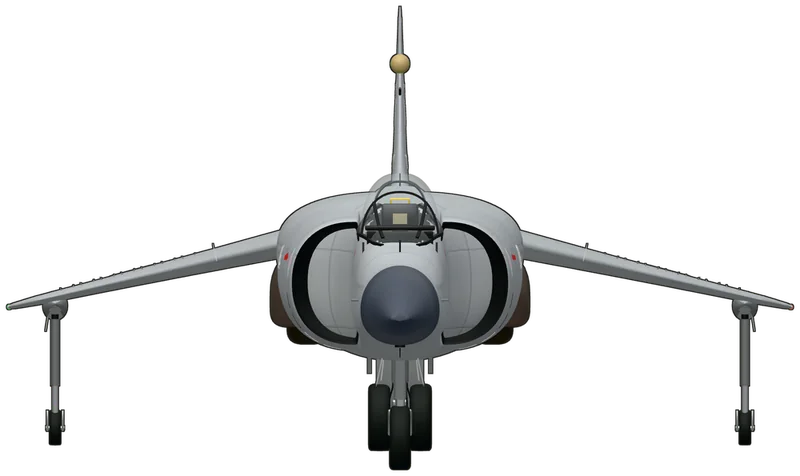
When the Royal Navy lost its big fleet carriers in the 1970s, the Harrier offered a way to keep fixed-wing fighters at sea aboard the new Invincible-class ships. British Aerospace raised the cockpit for a better view, added a Blue Fox radar in a folding nose and used corrosion-resistant materials for life at sea. The first Sea Harrier FRS.1 flew on 20 August 1978, and a bow ‘ski-jump’ ramp let it take off heavier from a short deck.

The FA.2 was the first British aircraft armed with the AIM-120 AMRAAM, and its Blue Vixen radar could track targets below it against the clutter of the sea.

ZE694 was built as a Sea Harrier FRS.1 and later converted to FA.2 standard.

First flight
19 September 1988
Role
Carrier-borne V/STOL fighter
Maker
British Aerospace, Britain
Engine
Rolls-Royce Pegasus 106 vectored-thrust turbofan, 21,500 lbf
Crew
1
Wingspan
7.7 m (25 ft 3 in)
Length
14.17 m (46 ft 6 in)
Height
3.71 m (12 ft 2 in)
Top speed
735 mph
Built
~50
In service
1980–2006 (FA.2 1993–2006)

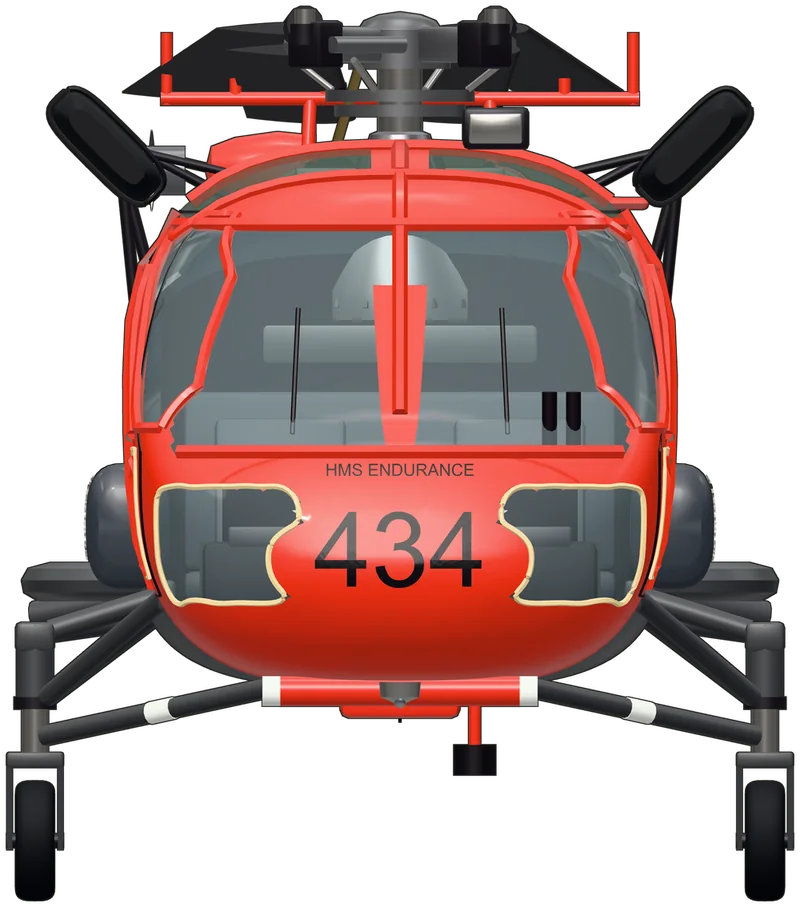
Westland Wasp

09 · Shipborne anti-submarine helicopter · HAS.1 XS567
Side view of the Westland Wasp, HAS.1 XS567
Port side
Top view of the Westland Wasp, HAS.1 XS567
Plan, from above
Front view of the Westland Wasp, HAS.1 XS567
Head-on

The Wasp grew out of the Saunders-Roe P.531, a small turbine helicopter developed from the Skeeter that first flew on 20 July 1958. Westland took over Saunders-Roe in 1959 and developed the design two ways: as the Scout for the Army and as the Wasp for the Royal Navy. The first pre-production Wasps flew on 28 October 1962.

On 25 April 1982 Wasps from HMS Endurance and HMS Plymouth attacked the Argentine submarine Santa Fe off South Georgia with AS.12 missiles, helping to put it out of action.

XS567 was delivered to the Royal Navy in June 1964 and flew with 829 Naval Air Squadron’s ship’s flights, first in HMS Gurkha and then in HMS Apollo, with which it took part in the first Armilla patrol in the Gulf in 1981.

First flight
28 October 1962
Role
Shipborne anti-submarine helicopter
Maker
Westland, Britain
Engine
1 × Rolls-Royce Nimbus 103 turboshaft, derated to 710 shp
Crew
2 (pilot and aircrewman)
Main rotor
9.83 m (32 ft 3 in)
Length
12.29 m (40 ft 4 in)
Height
3.56 m (11 ft 8 in)
Top speed
131 mph
Built
~280
In service
1963–1988

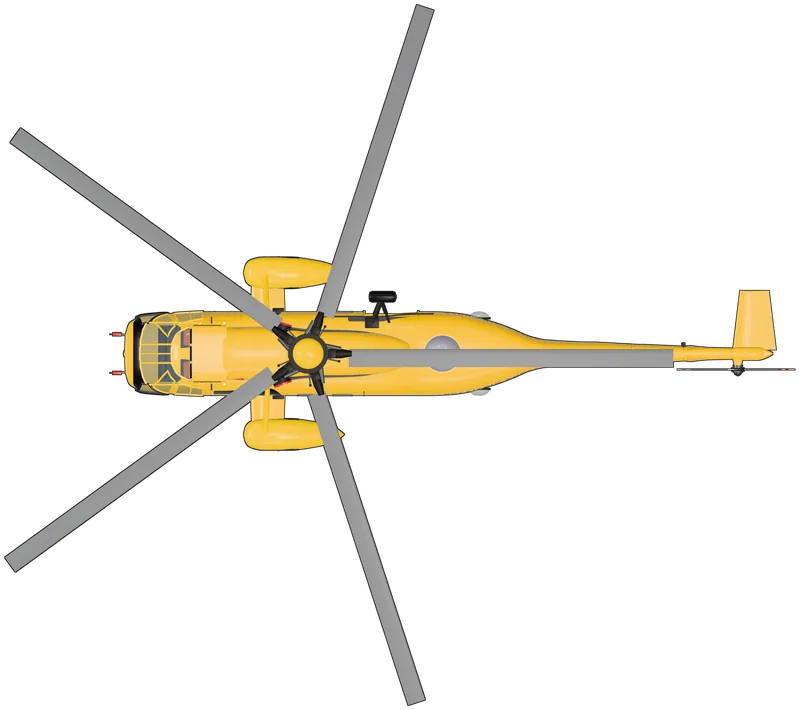
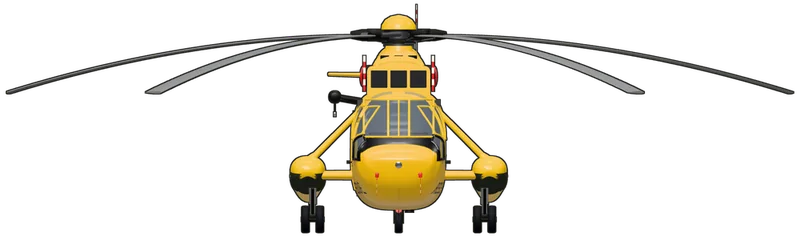
Westland Sea King

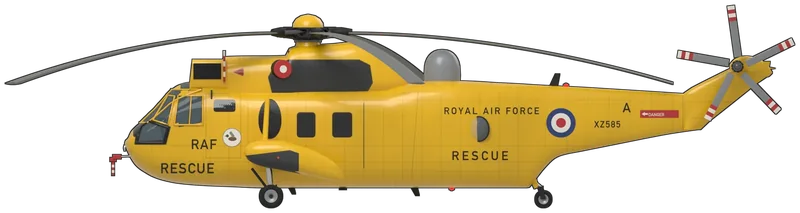
10 · Search and rescue helicopter · Sea King HAR.3 XZ585
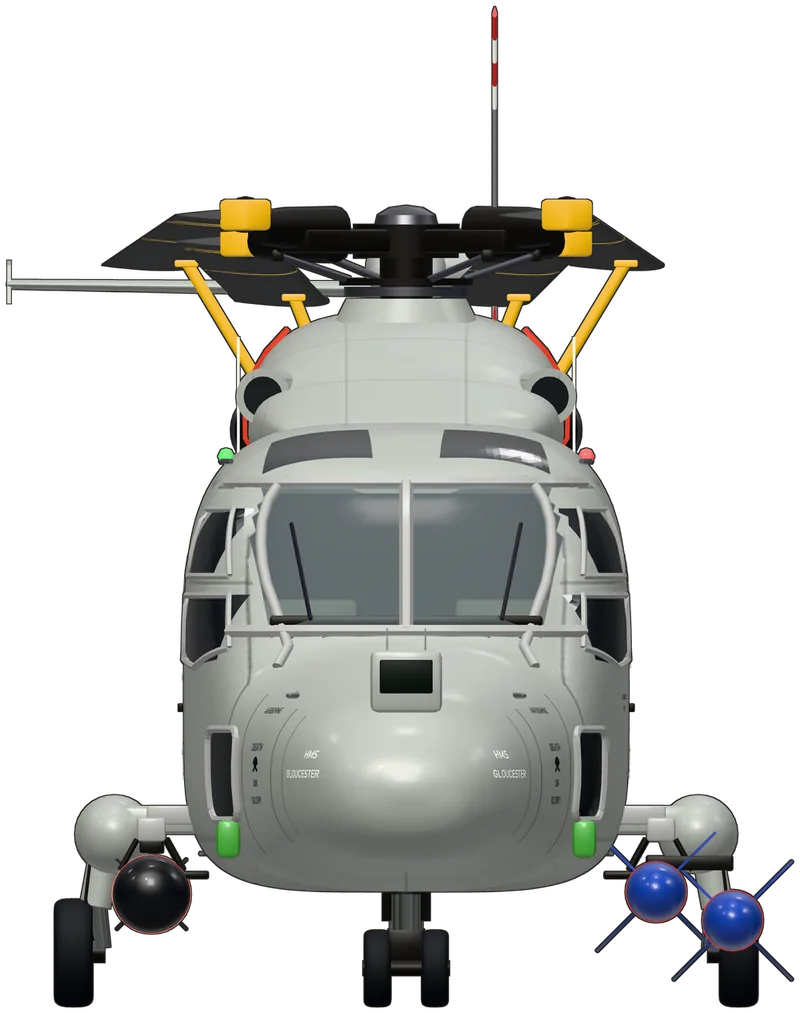
Side view of the Westland Sea King, Sea King HAR.3 XZ585
Port side
Top view of the Westland Sea King, Sea King HAR.3 XZ585
Plan, from above
Front view of the Westland Sea King, Sea King HAR.3 XZ585
Head-on

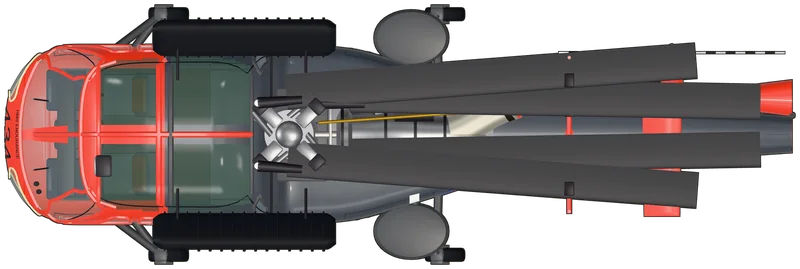
The Sea King began as the Sikorsky S-61, a twin-turbine anti-submarine helicopter for the US Navy that first flew on 11 March 1959 as the SH-3. It had a watertight boat hull with stabilising sponsons, so that it could alight on the sea, and a five-blade rotor driven by two engines mounted side by side above the cabin. Westland took a licence and re-engined it with Rolls-Royce Gnome turboshafts, added British sonar and avionics, and flew the first Sea King HAS.1 at Yeovil on 7 May 1969.

Prince William flew Sea King HAR.3s as a search and rescue pilot with C Flight, No. 22 Squadron, at RAF Valley on Anglesey from 2010 to 2013.

XZ585 was the first Sea King built for the RAF and flew for the first time on 6 September 1977.

First flight
7 May 1969
Role
Search and rescue helicopter
Maker
Westland (Sikorsky design), Britain
Engine
2 × Rolls-Royce Gnome H.1400-1 turboshafts, 1,660 shp each
Crew
4: two pilots, a radar and winch operator and a winchman
Main rotor
18.9 m (62 ft 0 in)
Length
22.15 m (72 ft 8 in)
Height
5.13 m (16 ft 10 in)
Top speed
129 mph
Built
344 (UK)
In service
1969–2018

Westland Lynx

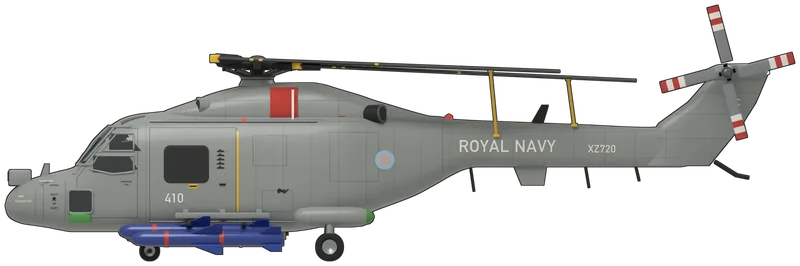
11 · Shipborne anti-submarine and anti-ship helicopter · Lynx HAS.3 (GMS) XZ720
Side view of the Westland Lynx, Lynx HAS.3 (GMS) XZ720
Port side
Top view of the Westland Lynx, Lynx HAS.3 (GMS) XZ720
Plan, from above
Front view of the Westland Lynx, Lynx HAS.3 (GMS) XZ720
Head-on

The Lynx was the British-designed member of the three helicopters that Britain and France agreed to develop together in 1967, alongside the Puma and the Gazelle. Westland drew it up as the WG.13, a fast twin-turbine utility helicopter with a semi-rigid main rotor hub machined from a single titanium forging, which made it unusually agile, and two Rolls-Royce Gem engines. Aérospatiale took a share of the production work.

On 11 August 1986 a modified Lynx, G-LYNX, flown by Westland test pilot Trevor Egginton, set a world speed record for helicopters of 249.1 mph (400.87 km/h) over Somerset. It still stands, and G-LYNX is now at The Helicopter Museum in Weston-super-Mare.

XZ720 was built at Yeovil as a HAS.2 and later brought up to HAS.3 standard.

First flight
21 March 1971
Role
Shipborne anti-submarine and anti-ship helicopter
Maker
Westland (with Aérospatiale), Britain
Engine
2 × Rolls-Royce Gem 41-1 turboshafts, 1,120 shp each
Crew
2 or 3: pilot, observer and sometimes an aircrewman
Main rotor
12.8 m (42 ft 0 in)
Length
15.16 m (49 ft 9 in)
Height
3.48 m (11 ft 5 in)
Top speed
249 mph
Built
~450
In service
1976–2017

Compared

Specifications at a glance

Span, length, speed and production for every aircraft on this page.

Specifications compared
AircraftFirst flewRoleSpanLengthTop speedBuiltUK museums
Fairey Swordfish1934Carrier torpedo bomber13.87 m10.87 m139 mph2,3913
Supermarine Walrus1933Shipborne reconnaissance and air-sea rescue amphibian13.97 m11.45 m135 mph~7403
Grumman Martlet1937Carrier-borne fighter11.58 m8.76 m380 mph~32,0003
Fairey Firefly1941Two-seat carrier fighter and reconnaissance aircraft13.56 m11.46 m316 mph~2,2002
Hawker Sea Hawk1947Carrier fighter-bomber11.89 m12.09 m600 mph5429
de Havilland Venom1949Jet fighter-bomber12.7 m10.06 m640 mph~1,4007
Blackburn Buccaneer1958Low-level strike aircraft13.41 m19.33 m667 mph21110
British Aerospace Sea Harrier1988Carrier-borne V/STOL fighter7.7 m14.17 m735 mph~509
Westland Wasp1962Shipborne anti-submarine helicopter9.83 m rotor12.29 m131 mph~2807
Westland Sea King1969Search and rescue helicopter18.9 m rotor22.15 m129 mph344 (UK)9
Westland Lynx1971Shipborne anti-submarine and anti-ship helicopter12.8 m rotor15.16 m249 mph~4507

Questions

Asked and answered

What is the Fleet Air Arm?

The aviation branch of the Royal Navy. It has flown from carriers, ships and naval air stations ashore since 1924, and under full Admiralty control since 1939.

Which Royal Navy aircraft fought in the Falklands?

The Sea Harrier FRS.1 provided air defence for the task force, with Sea King, Wessex, Lynx and Wasp helicopters. RAF Harrier GR.3s flew from HMS Hermes alongside them.

Where is the Fleet Air Arm Museum?

At RNAS Yeovilton in Somerset. It holds the largest collection of naval aircraft in Europe, including Concorde 002.

More dioramas

Other collections

The models and drawings are procedural interpretations built from published dimensions, three-view drawings and photographs of each airframe, and the airfield is a compressed impression of its period, not a plan of a real station. Treat the museum aircraft as the reference.