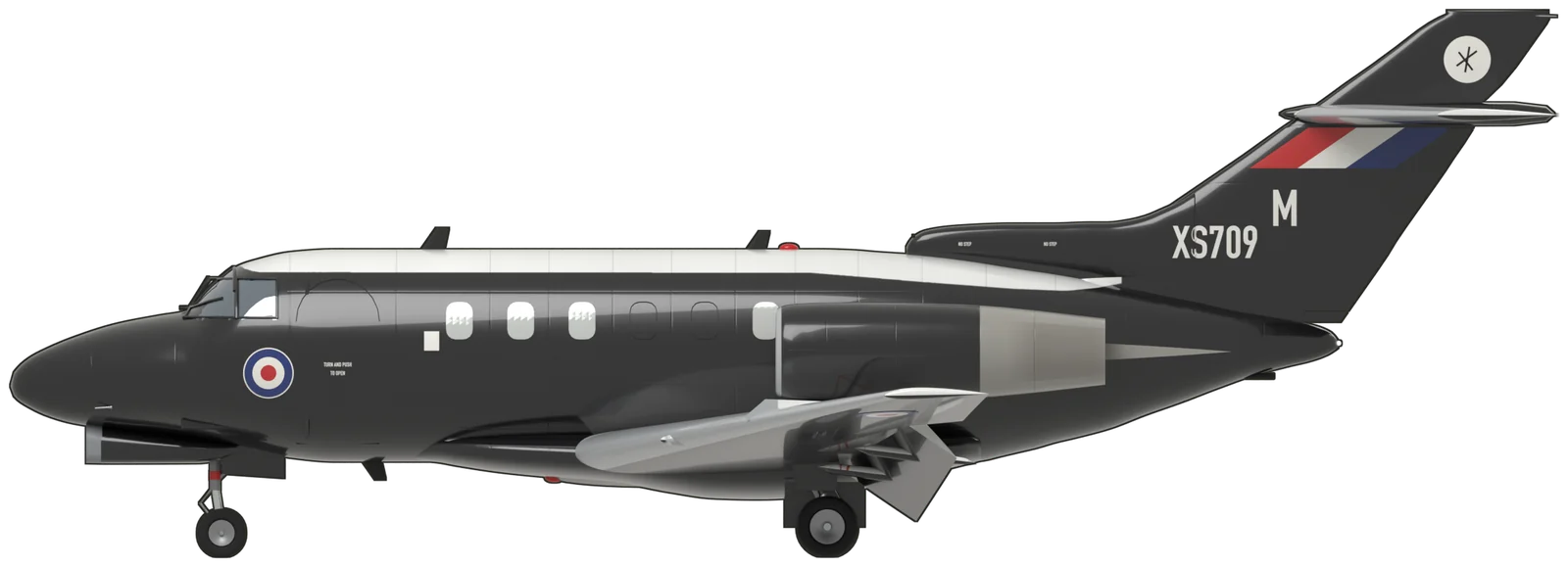
3D model
Turn it over
A procedural model built in Blender from published dimensions, drawings and photographs, painted as XS709 ‘M’ of No. 55 (Reserve) Squadron, a navigator trainer in the squadron’s final gloss black scheme with a white cabin roof, white upper wings and tailplane, Type D roundels, a fin flash below the tailplane and the squadron badge on a white disc above it, with the T.1’s ventral radar fairing under the nose, as it is displayed at the Royal Air Force Museum at Cosford. Drag to orbit, scroll or pinch to zoom · download .glb (1.2 MB)
History
The Dominie T.1
The 125 was the last de Havilland type to fly. The company drew it up at Hatfield as the DH.125 Jet Dragon, a small business jet with a low swept wing, a cabin for six to eight passengers and two Bristol Siddeley Viper turbojets mounted on the rear fuselage, clear of the cabin and the wing. The prototype, G-ARYA, first flew from Hatfield on 13 August 1962. By the time production was under way, de Havilland had been absorbed into Hawker Siddeley, and the aircraft became the HS.125.
The RAF needed a jet to train navigators at the speeds and heights of its V-bombers and fast jets, and in 1964 it ordered twenty military 125s as the Dominie T.1, reviving the wartime name of the Dragon Rapide navigation trainer. The Dominie kept the airliner cabin but fitted it with a pilot’s station up front, navigators’ desks at the rear and a ventral fairing under the nose for its navigation radar. It entered service with No. 1 Air Navigation School at Stradishall in December 1965, and later flew with No. 6 Flying Training School at Finningley and No. 55 (Reserve) Squadron at Cranwell, which trained the RAF’s weapon systems officers and rear crew until the type retired in January 2011.
The civil 125 sold steadily for half a century. Hawker Siddeley, British Aerospace and then Raytheon and Hawker Beechcraft built it in a long line of versions, from the turbofan Series 700 of 1976 to the Hawker 800 and 1000, until production ended in 2013 after about 1,700 had been made. Many went to North America, and the RAF also flew communications versions with No. 32 Squadron at Northolt.
This airframe
Dominie T.1 XS709
XS709 was built at Hawarden, near Chester, and on 30 December 1964 it became the first Dominie to fly; on 30 March 1965 it became the first to be delivered to the RAF. After trials at Boscombe Down it joined No. 1 Air Navigation School at Stradishall, and from 1970 it flew as ‘M’ with No. 6 Flying Training School at Finningley, moving with the navigation squadron to Cranwell in 1995, where it became part of No. 55 (Reserve) Squadron in 1996. It made its last training flight over Wales on 19 January 2011 and was flown into Cosford on 11 February 2011 for the Royal Air Force Museum. The model shows it as displayed there, in the squadron’s high-visibility scheme from about 1997: gloss black with a white cabin roof, white upper wings and tailplane, Type D roundels on the nose, a fin flash below the tailplane, the squadron badge on a white disc above it, ‘XS709’ and the code ‘M’ on the fin, and yellow emergency rescue markings on the starboard side. The flaps are lowered, as they are at Cosford.
Where to see one
In the gazetteer
The gazetteer records the Dominie T.1 in 5 UK collections. The airframe modelled here is marked.