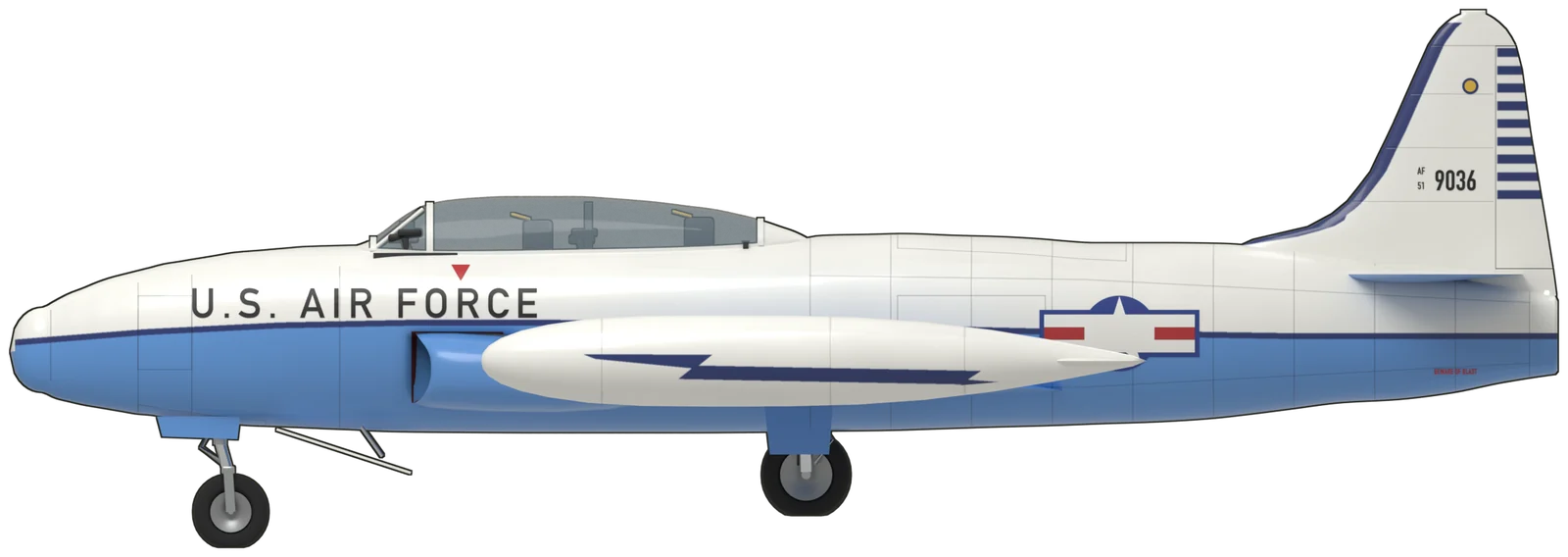
3D model
Turn it over
A procedural model built in Blender from published dimensions, drawings and photographs, painted as 51-9036, a Lockheed-built T-33A-1-LO in the gloss white and light blue of USAF Air Training Command, with a dark blue cheat line, ‘U.S. AIR FORCE’ on the nose, dark blue rudder stripes and lightning flashes on its tip tanks, as it is displayed at the Newark Air Museum. Drag to orbit, scroll or pinch to zoom · download .glb (984 KB)
History
The T-33A
Lockheed built the T-33 by stretching its P-80 Shooting Star, the first American jet fighter to enter squadron service, so that a second cockpit would fit behind the first. The fuselage gained about a metre, the instructor sat in tandem behind the student under one long sliding canopy, and some of the fuel went from the fuselage into the wing and the big tanks on its tips. Tony LeVier flew the prototype, then called the TP-80C, on 22 March 1948.
The US Air Force had been losing pilots who went straight from piston trainers into jets, and the two-seater was the answer. As the T-33A it became the standard advanced trainer for the Air Force, and the Navy flew it as the TV-2. Lockheed built 5,691, Canadair built 656 Nene-powered CT-133 Silver Stars for Canada and Kawasaki built 210 in Japan, 6,557 in all. Under American aid programmes T-33s went to more than thirty air forces, where many also flew as light attack and reconnaissance aircraft.
The trainer long outlived the fighter it came from. Canada flew its CT-133s until 2005, and Bolivia retired the last military T-33s in 2017, almost seventy years after the first flight. In the late 1970s the US Air Force took back many of the T-33s it had lent to France and other NATO air forces, and lent a number of them to British museums; the Newark aircraft is one of them.
This airframe
T-33A 51-9036
Lockheed built 51-9036 as a T-33A-1-LO for the US Air Force, which passed it to the French Air Force, where it flew as 19036. France handed it back to the USAF at Sculthorpe in Norfolk in 1978, and in 1979 it came to the Newark Air Museum at Winthorpe. It was first shown in Thunderbirds-style markings with a made-up serial, and was later repainted with its own serial. The model shows it as it is displayed today: gloss white above and light blue below, in the style of 1950s USAF Air Training Command, with a dark blue cheat line, ‘U.S. AIR FORCE’ on the nose, star-and-bar insignia on the rear fuselage, dark blue rudder stripes, ‘AF 51 9036’ on the fin and dark blue lightning flashes along the white tip tanks. Its dive brakes hang partly open, as they do in the museum.
Where to see one
In the gazetteer
The gazetteer records the T-33A in 5 UK collections. The airframe modelled here is marked.