3D model
Turn it over
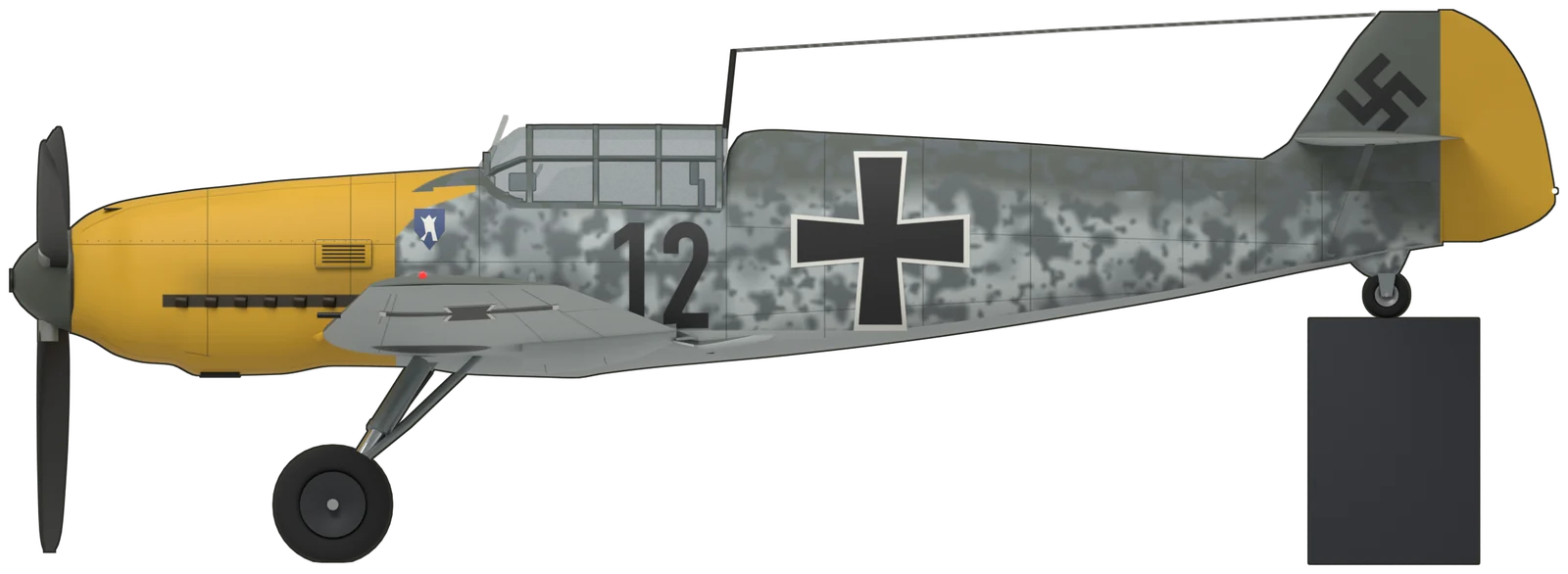
A procedural model built in Blender from published dimensions, drawings and photographs, painted as Werknummer 1190 ‘Black 12’ (later RAF DG200) in the yellow-nosed Luftwaffe scheme it wears at the RAF Museum, Hendon. Drag to orbit, scroll or pinch to zoom · download .glb (1.2 MB)
History
The Bf 109E
Willy Messerschmitt’s design team at Bayerische Flugzeugwerke in Augsburg produced the Bf 109 to a 1934 Luftwaffe call for a modern fighter. The prototype first flew on 29 May 1935, powered by a borrowed Rolls-Royce Kestrel because the German engines were not yet ready. It was small, light and fast, with a cantilever low wing, an all-metal stressed skin and a retractable undercarriage that folded outwards.
The Bf 109E, the “Emil”, carried the Daimler-Benz DB 601 fuel-injected engine and flew in the Battle of Britain in 1940, where it met the Hurricane and the Spitfire over Kent and the Channel. It out-dived both and its cannon hit hard, but its short range gave the pilots only a few minutes over England. Its narrow track undercarriage made landings tricky, and many were lost in accidents.
About 34,000 were built in all, more than any other fighter in history, in a long line of marks that stayed in front-line service until 1945. Spain went on building a version under licence, the Buchón, into the 1950s.
This airframe
Bf 109E-3 Werknummer 1190 (DG200)
Werknummer 1190 is a Bf 109E-3 that came down in England in 1940. The RAF flew it for evaluation under the serial DG200, and it is now displayed at the RAF Museum, Hendon. The model shows the aircraft as exhibited: yellow cowling and rudder, a mottled light grey fuselage, dark upper surfaces, the black number “12” ahead of the fuselage cross and a blue shield with a white stag on the cowling. It is shown with the hood closed and the tail wheel on a plinth, which keeps the fuselage level.
Where to see one
In the gazetteer
The gazetteer records the Bf 109E in 6 UK collections. The airframe modelled here is marked.