3D model
Turn it over
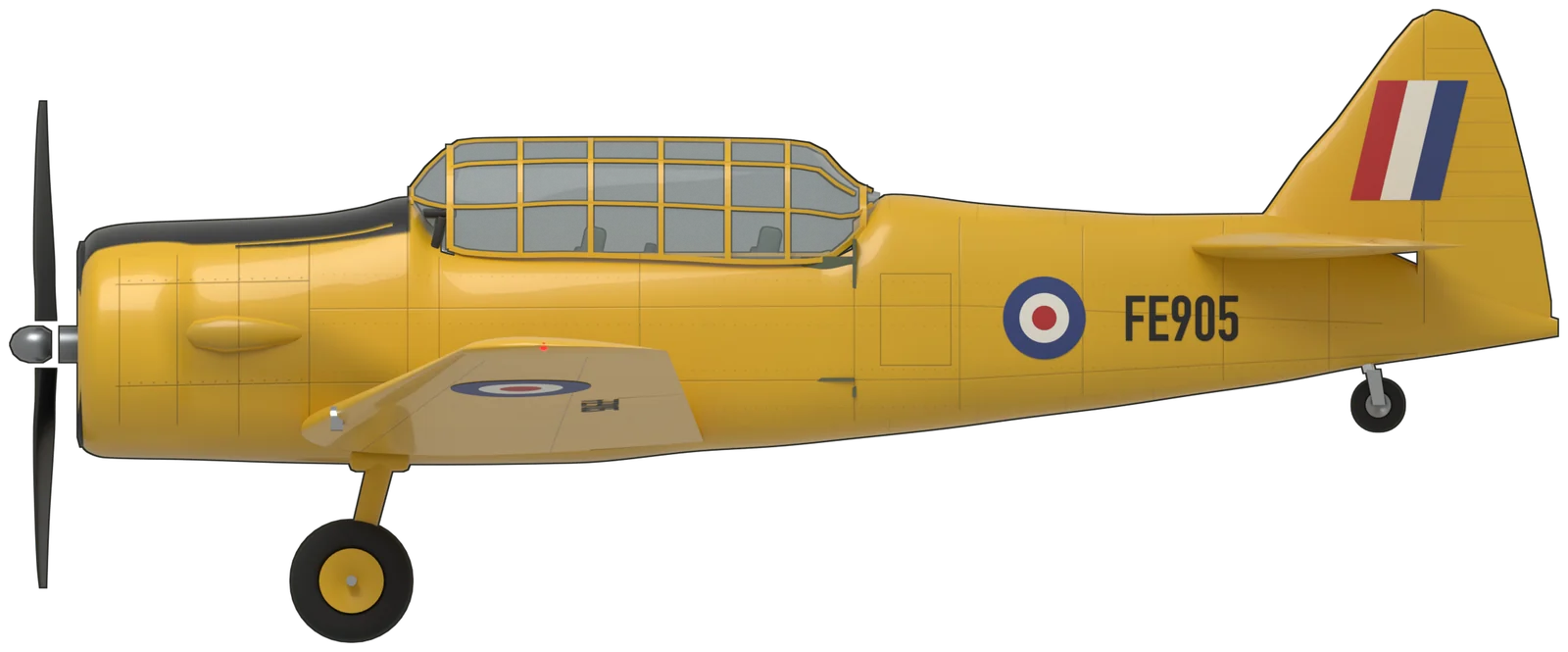
A procedural model built in Blender from published dimensions, drawings and photographs, painted as FE905 in the overall yellow trainer scheme it wears at the RAF Museum, Hendon. Drag to orbit, scroll or pinch to zoom · download .glb (976 KB)
History
The Harvard
North American Aviation’s NA-16 first flew on 1 April 1935 and became the pattern for a long line of advanced trainers. A low-wing monoplane with a Wasp radial, a framed greenhouse canopy over two tandem cockpits and a retractable undercarriage, it taught pupils the habits of a fast, heavy fighter before they ever flew one. The RAF ordered it as the Harvard and the first arrived in 1938.
Production ran into the thousands on both sides of the Atlantic. The Harvard IIB was built by Noorduyn Aircraft in Montreal, and large numbers went to the RAF and to Commonwealth flying schools under the Empire Air Training Scheme, which trained aircrew in Canada, South Africa, Rhodesia and elsewhere. Trainers wore overall yellow so that other pilots could spot them in a crowded circuit.
The Harvard stayed in RAF training into the 1950s and in some air forces much longer. Its short-cut propeller tips run faster than the speed of sound at full power, which gives it the harsh, rasping note that people on an airfield can identify from miles away.
This airframe
Harvard IIB FE905
FE905 was built by Noorduyn in Montreal in 1943 as a Harvard IIB for the Royal Canadian Air Force. It later served with the Royal Danish Air Force and then flew as a civil aircraft in Norway as LN-BNM, and it has been with the RAF Museum since 1994. It is displayed at Hendon in overall trainer yellow, with a black anti-glare panel on the cowling and the serial FE905 in black behind the fuselage roundel. The model shows it with the hood closed.
Where to see one
In the gazetteer
The gazetteer records the Harvard in 6 UK collections. The airframe modelled here is marked.