3D model
Turn it over
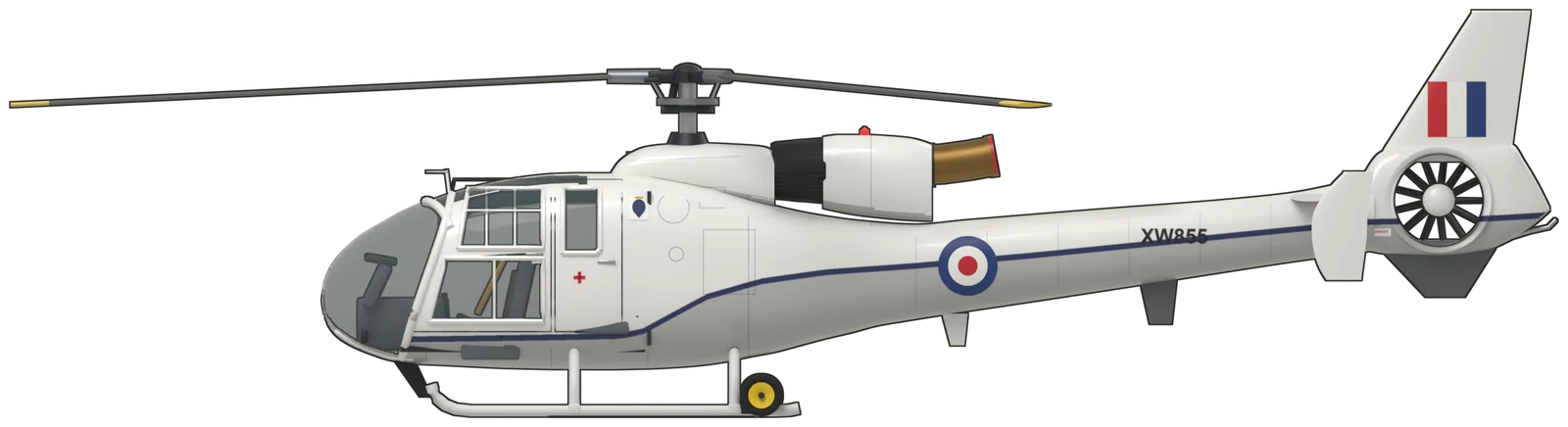
A procedural model built in Blender from published dimensions, drawings and photographs, painted as XW855, a Westland-built Gazelle HT.3 converted to an HCC.4 communications helicopter for No. 32 (The Royal) Squadron at Northolt, in gloss white over light grey with a dark blue cheat line running along the tail boom to the fenestron, Type D roundels, a red, white and blue fin flash and the squadron crest on the cabin, as it is displayed at the Royal Air Force Museum London, Hendon. Drag to orbit, scroll or pinch to zoom · download .glb (874 KB)
History
The Gazelle HCC.4
Sud Aviation designed the Gazelle in the mid-1960s to replace its piston-engined Alouette II, using a Turbomeca Astazou turboshaft, a streamlined fuselage with a large glazed cabin and a three-bladed main rotor. The first prototype, the SA 340, flew on 7 April 1967 with a conventional tail rotor borrowed from the Alouette II. In 1968 the second prototype was given the feature that made the type famous: a fenestron, a small many-bladed fan turning inside a duct in the fin.
In 1967 Britain and France agreed to develop three helicopters together: the Puma, the Gazelle and the Lynx. Westland built the Gazelle under licence for all three British services: the AH.1 for the Army Air Corps and the Royal Marines, the HT.2 trainer for the Royal Navy and the HT.3 for the RAF, which also flew a few as HCC.4 light communications helicopters with No. 32 Squadron at Northolt. Westland built 262 Gazelles, and about 1,775 were made in all, most of them in France and Britain and the rest under licence in Yugoslavia and Egypt.
The Gazelle trained a generation of service helicopter pilots and served the Army in Northern Ireland, the Falklands and the Gulf War as a scout and observation aircraft, as well as with many export air forces. The RAF and Navy retired theirs in the late 1990s, but the Army Air Corps kept flying the AH.1 until October 2023, almost fifty years after its first Gazelles arrived.
This airframe
Gazelle HCC.4 XW855
XW855 was built by Westland as a Gazelle HT.3 and issued to the RAF on 31 July 1973, flying to Ternhill that August to train helicopter pilots with the Central Flying School. On 28 November 1978 it joined No. 32 Squadron at Northolt and was brought up to HCC.4 standard as a light communications and VIP helicopter. It made its last flight on 2 April 1996 after 3,958 flying hours, was stored at Shawbury and arrived at the RAF Museum in Hendon in April 2003. The model shows it as displayed there: gloss white over light grey with a dark blue cheat line running along the boom to the fenestron, Type D roundels, a fin flash, ‘XW855’ on the boom and the squadron crest on the cabin, with grey rotor blades with yellow tips and ground-handling wheels on its skids.
Where to see one
In the gazetteer
The gazetteer records the Gazelle HCC.4 in 5 UK collections. The airframe modelled here is marked.