AP 118 · No. 10 Section II · Aircraft Collection 08 / 12

Aircraft/Collections/RAF Germany

Hardened airbase · 1975–91

RAF Germany and the late Cold War

Concrete shelters in the pine woods, camouflage wrapped round every aircraft and a war expected at a few minutes’ notice: the front line of the 1980s.

6
Aircraft
1975–91
Period
23
UK museums hold them

The diorama

Diorama · 1975–91

Loading the airfield…

A NATO airbase in West Germany in the 1980s: hardened aircraft shelters, squat concrete arches built to survive attack, dispersed among pine trees, with a long runway, taxiways and a control tower. Puma and Gazelle helicopters lift off from the apron.

Drag to look around · ctrl + scroll to zoom · pick an aircraft to follow it

For the last two decades of the Cold War the RAF’s front line was in West Germany. From bases such as Brüggen, Laarbruch, Wildenrath and Gütersloh its squadrons stood ready for a Warsaw Pact attack across the inner German border, expected with very little warning.

The airfields were rebuilt to survive. From the late 1970s aircraft lived in hardened aircraft shelters, concrete arches strong enough to withstand near misses, and the bases were camouflaged, dispersed and practised in fighting on through chemical attack. The Jaguar and the Buccaneer gave way to the Tornado, built to fly at very low level at night and in any weather; Phantoms held the air defence line; and Harriers were trained to leave their base altogether and hide in woods and farmyards.

Helicopters such as the Puma and the Army’s Gazelles were part of the same plan, moving troops and supplies and scouting for the armoured divisions of the British Army of the Rhine. When the Cold War ended in 1990–91, the Tornados and Jaguars went to war instead over Iraq.

To scale

The collection side by side

Every aircraft drawn at the same scale, so a Buccaneer and a Hawk T.1A can be compared at a glance.

  • SEPECAT Jaguar side profile, to scaleJaguar · 16.83 m
  • Hawker Siddeley Harrier side profile, to scaleHarrier · 14.27 m
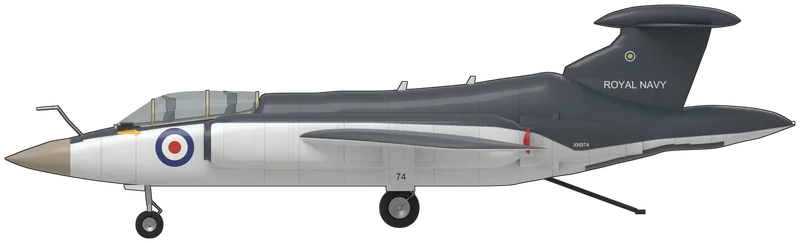
  • Blackburn Buccaneer side profile, to scaleBuccaneer · 19.33 m
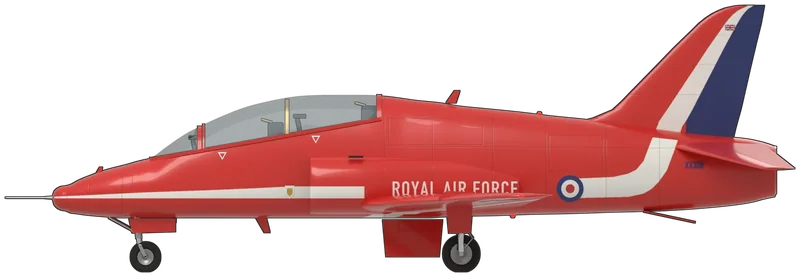
  • BAe Hawk T.1A side profile, to scaleHawk T.1A · 11.17 m
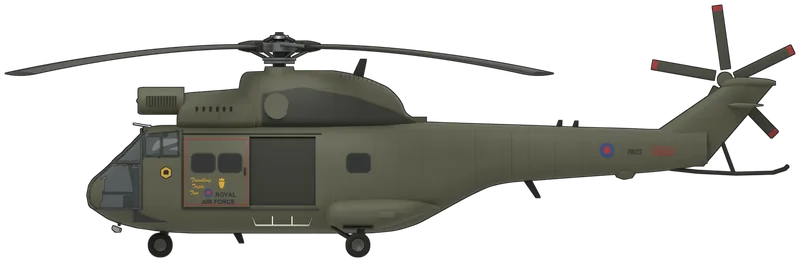
  • Westland/Aérospatiale Puma HC.1 side profile, to scalePuma HC.1 · 18.15 m
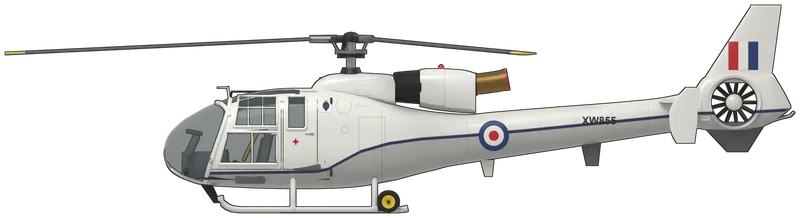
  • Aérospatiale Gazelle side profile, to scaleGazelle HCC.4 · 11.97 m

10 m

Profiles

Side, top and front

Each aircraft drawn from its 3D model, painted as one real airframe, with its specification.

SEPECAT Jaguar

01 · Strike · GR.1A XX824
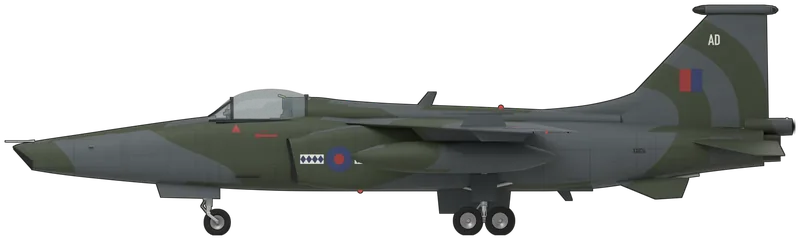
Side view of the SEPECAT Jaguar, GR.1A XX824
Port side
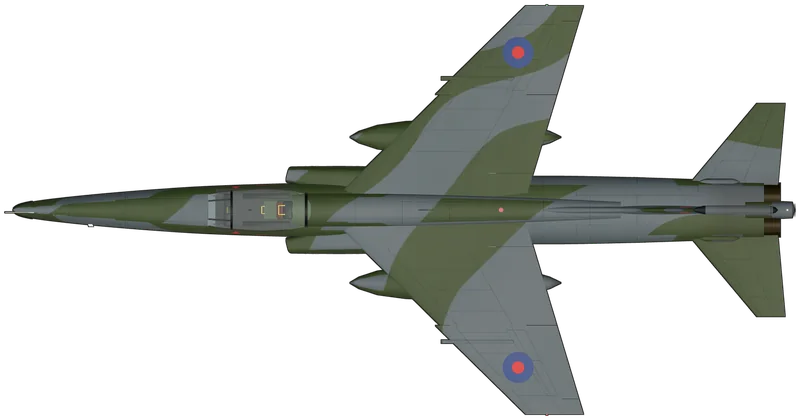
Top view of the SEPECAT Jaguar, GR.1A XX824
Plan, from above
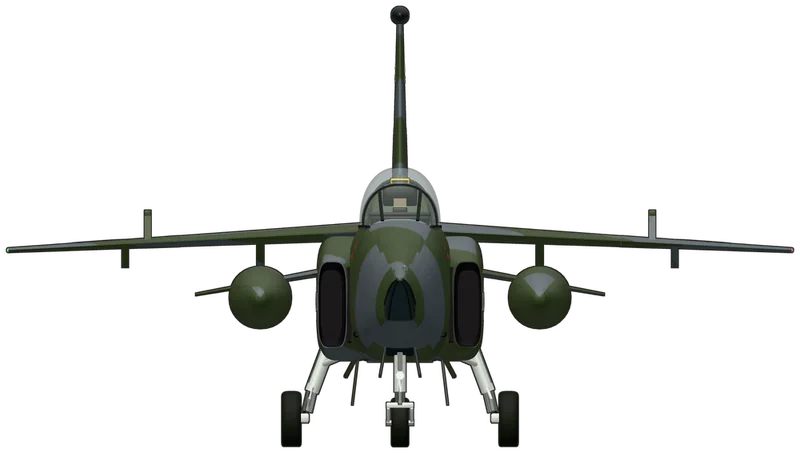
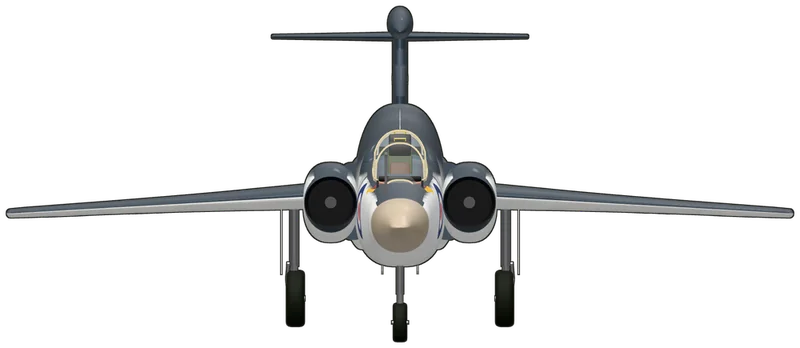
Front view of the SEPECAT Jaguar, GR.1A XX824
Head-on

The Jaguar was born as an Anglo-French trainer and grew into a strike aircraft. SEPECAT, a partnership of Breguet and the British Aircraft Corporation, built it with two Adour turbofans, a shoulder wing and a stalky undercarriage strong enough for rough strips. The first prototype flew in September 1968.

Pilots joked that the Jaguar needed the curvature of the Earth to get airborne on a hot day.

XX824 flew as “AD” with No. 14 Squadron at RAF Brüggen in West Germany in the mid-1980s and is preserved in those colours at the RAF Museum London: wraparound Dark Green and Dark Sea Grey, with the squadron’s white bars and blue diamonds beside the intake roundels.

First flight
8 September 1968
Role
Strike
Maker
SEPECAT, Multinational
Engine
2 × Rolls-Royce/Turboméca Adour 104 turbofans with reheat, about 8,000 lbf each
Crew
1
Wingspan
8.69 m (28 ft 6 in)
Length
16.83 m (55 ft 3 in)
Height
4.89 m (16 ft 1 in)
Top speed
Mach 1.6
Built
543
In service
1974–2007

Hawker Siddeley Harrier

02 · V/STOL attack · GR.3 XZ133
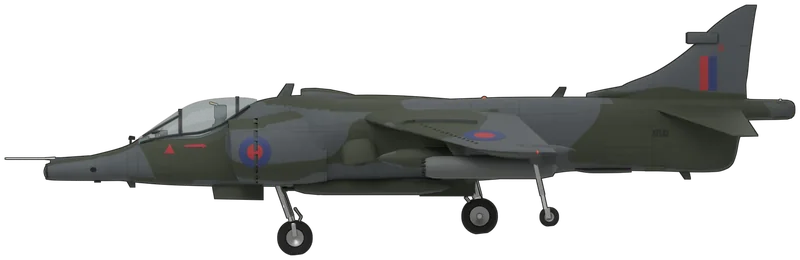
Side view of the Hawker Siddeley Harrier, GR.3 XZ133
Port side
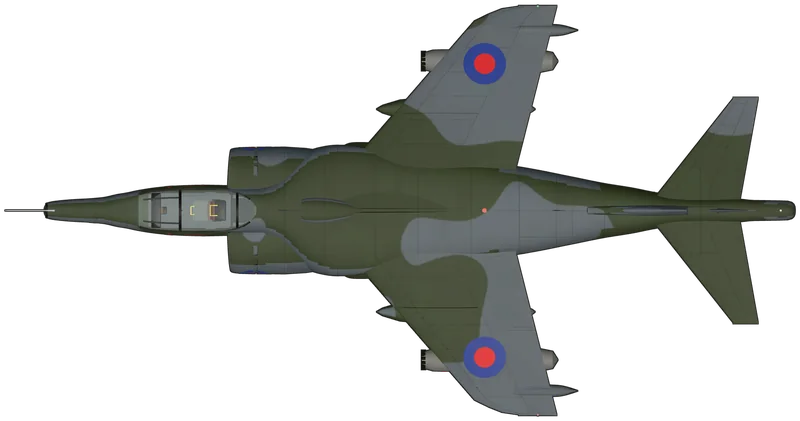
Top view of the Hawker Siddeley Harrier, GR.3 XZ133
Plan, from above
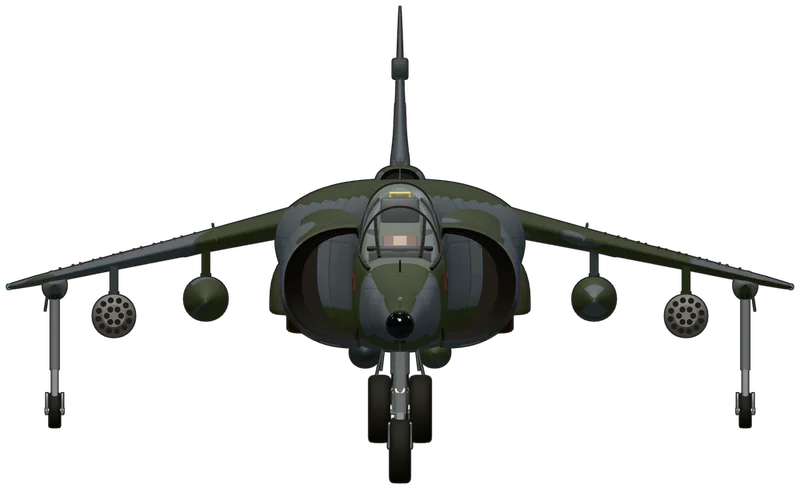
Front view of the Hawker Siddeley Harrier, GR.3 XZ133
Head-on

The Harrier began with an engine. Bristol’s Pegasus turbofan exhausted through four rotating nozzles, so the same thrust could lift the aircraft straight up or push it forward. Hawker built the P.1127 around it and made the first tethered hover in October 1960.

Harrier pilots could “viff”, vectoring thrust in forward flight to brake or turn in ways no conventional fighter could.

XZ133 is displayed in AirSpace at IWM Duxford in its 1982 configuration with No. 1(F) Squadron: wraparound Dark Green and Dark Sea Grey, red and blue roundels, and the red code 10 on the fin.

First flight
21 October 1960
Role
V/STOL attack
Maker
Hawker Siddeley, Britain
Engine
Rolls-Royce Pegasus 103 vectored-thrust turbofan, 21,500 lbf
Crew
1
Wingspan
7.7 m (25 ft 3 in)
Length
14.27 m (46 ft 10 in)
Height
3.63 m (11 ft 11 in)
Top speed
735 mph
Built
~825
In service
1969–2010

Blackburn Buccaneer

03 · Low-level strike aircraft · S.2 XN974
Side view of the Blackburn Buccaneer, S.2 XN974
Port side
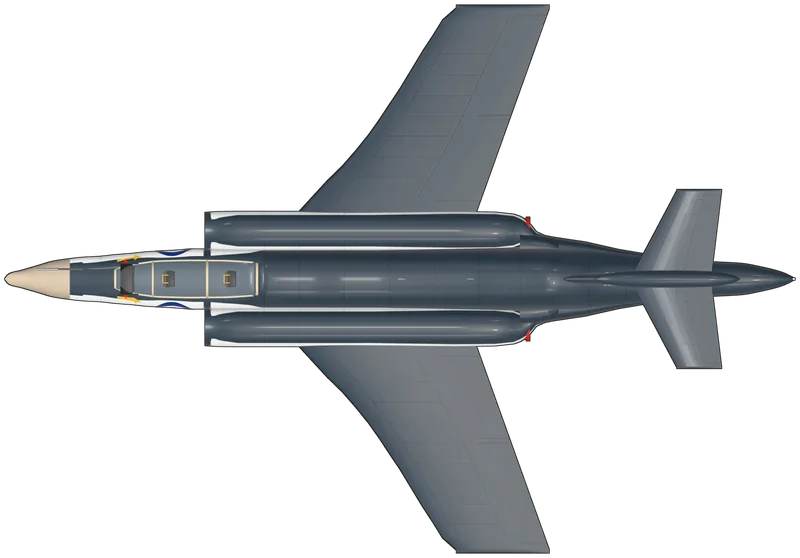
Top view of the Blackburn Buccaneer, S.2 XN974
Plan, from above
Front view of the Blackburn Buccaneer, S.2 XN974
Head-on

The Admiralty wanted a carrier aircraft that could cross the sea at wave-top height, below the radar of the day, and hit a ship with a nuclear weapon or a conventional load. Blackburn’s answer, the NA.39, first flew on 30 April 1958. It had a small, thick, strong wing, a fuselage shaped to the area rule, and a bomb bay whose door rotated to carry the weapons in the belly.

The Buccaneer’s “area ruled” waist and blown wing let it fly fast and low with a heavy load while still landing slowly on a carrier deck.

XN974 is a Buccaneer S.2 preserved at the Yorkshire Air Museum at Elvington, near York.

First flight
30 April 1958
Role
Low-level strike aircraft
Maker
Blackburn (Hawker Siddeley), Britain
Engine
two Rolls-Royce Spey 101 turbofans, 11,100 lbf each
Crew
2
Wingspan
13.41 m (44 ft 0 in)
Length
19.33 m (63 ft 5 in)
Height
4.95 m (16 ft 3 in)
Top speed
667 mph
Built
211
In service
1962–1994

BAe Hawk T.1A

04 · Advanced jet trainer · Hawk T.1A XX308
Side view of the BAe Hawk T.1A, Hawk T.1A XX308
Port side
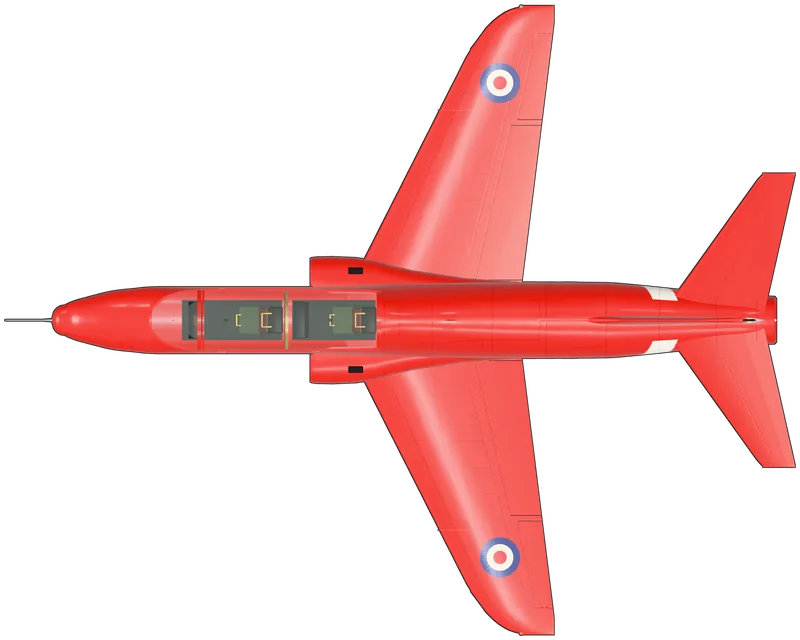
Top view of the BAe Hawk T.1A, Hawk T.1A XX308
Plan, from above
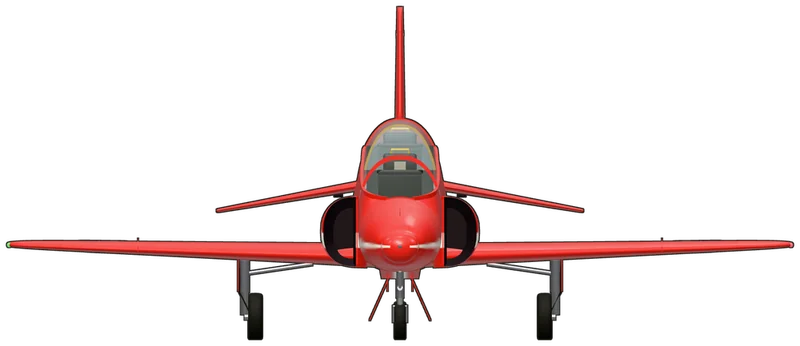
Front view of the BAe Hawk T.1A, Hawk T.1A XX308
Head-on

In the late 1960s the RAF needed one aircraft to replace both the Gnat, its advanced trainer, and the Hunter, on which pilots learned weapons and tactics. Hawker Siddeley at Kingston answered with the HS.1182: a low-wing, tandem-seat jet with a single Rolls-Royce Turbomeca Adour turbofan, the engine of the Jaguar, and the instructor’s seat raised behind the pupil’s so that both had a clear view ahead. In 1971 the RAF ordered 175 off the drawing board, with no prototype, and the first aircraft, XX154, first flew from Dunsfold on 21 August 1974 with Duncan Simpson at the controls.

The RAF bought the Hawk without a prototype: the first aircraft to fly, XX154, was ordered as a production machine and used for development flying, and it is preserved at Boscombe Down.

XX308, construction number 143/312133, was delivered to the RAF on 23 April 1980 and later modified to T.1A standard.

First flight
21 August 1974
Role
Advanced jet trainer
Maker
Hawker Siddeley (British Aerospace from 1977), Britain
Engine
Rolls-Royce Turbomeca Adour Mk 151 turbofan, 5,200 lbf
Crew
2
Wingspan
9.39 m (30 ft 10 in)
Length
11.17 m (36 ft 8 in)
Height
3.99 m (13 ft 1 in)
Top speed
638 mph
Built
~1,000
In service
1976–present (Red Arrows from 1980)

Westland/Aérospatiale Puma HC.1

05 · Medium support helicopter · Puma HC.1 XW222
Side view of the Westland/Aérospatiale Puma HC.1, Puma HC.1 XW222
Port side
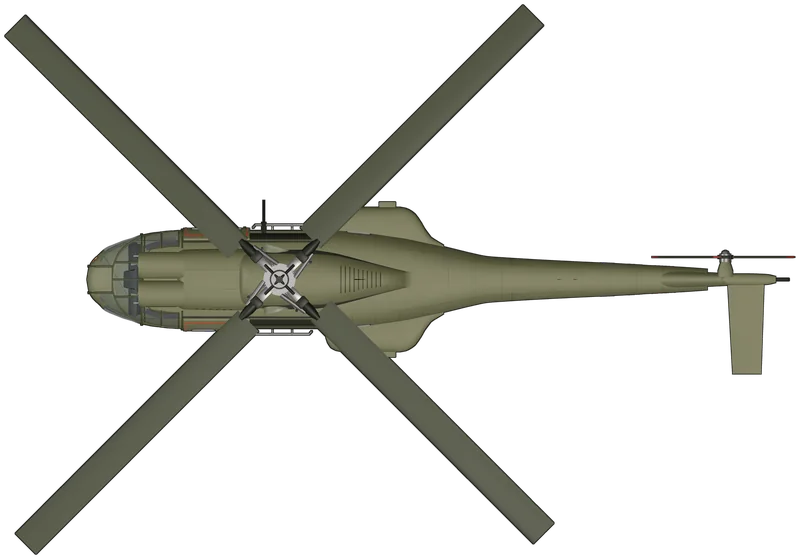
Top view of the Westland/Aérospatiale Puma HC.1, Puma HC.1 XW222
Plan, from above
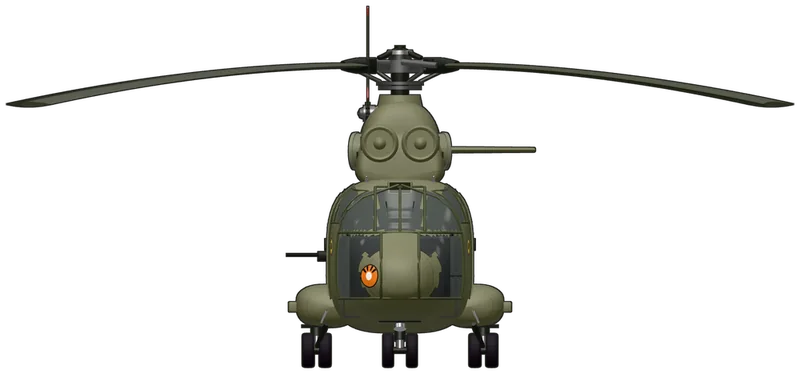
Front view of the Westland/Aérospatiale Puma HC.1, Puma HC.1 XW222
Head-on

The Puma was designed by Sud Aviation in the early 1960s to give the French Army a medium transport helicopter that could carry a section of troops in any weather. Two Turbomeca Turmo turboshafts sat side by side on the cabin roof, driving a four-bladed main rotor, with the tail rotor on the starboard side of the boom and the main wheels retracting into sponsons on the cabin sides. The prototype SA 330 first flew on 15 April 1965.

The Puma came to the RAF through the 1967 Anglo-French helicopter agreement, the same deal that produced the Gazelle and the Westland Lynx.

XW222 was one of the RAF’s 48 Westland-assembled Puma HC.1s, delivered in the early 1970s.

First flight
15 April 1965
Role
Medium support helicopter
Maker
Sud Aviation / Aérospatiale, assembled by Westland, France
Engine
2 × Turbomeca Turmo IIIC4 turboshafts, 1,328 shp each
Crew
3, plus up to 16 troops
Main rotor
15 m (49 ft 3 in)
Length
18.15 m (59 ft 7 in)
Height
5.14 m (16 ft 10 in)
Top speed
174 mph
Built
~940
In service
1971–2025

Aérospatiale Gazelle

06 · Light helicopter · Gazelle HCC.4 XW855
Side view of the Aérospatiale Gazelle, Gazelle HCC.4 XW855
Port side
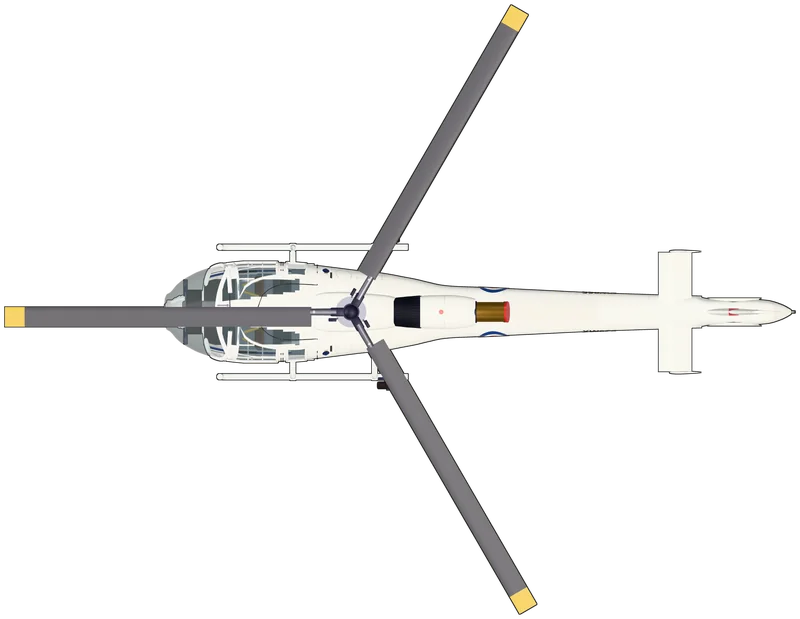
Top view of the Aérospatiale Gazelle, Gazelle HCC.4 XW855
Plan, from above
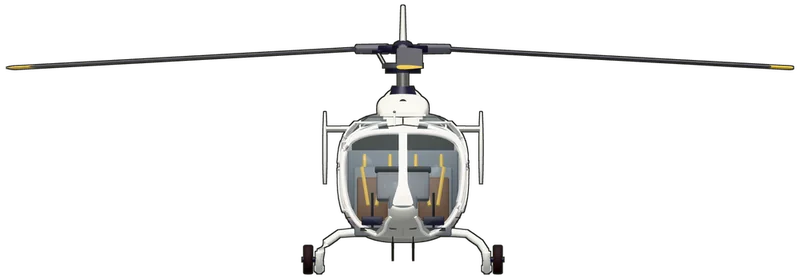
Front view of the Aérospatiale Gazelle, Gazelle HCC.4 XW855
Head-on

Sud Aviation designed the Gazelle in the mid-1960s to replace its piston-engined Alouette II, using a Turbomeca Astazou turboshaft, a streamlined fuselage with a large glazed cabin and a three-bladed main rotor. The first prototype, the SA 340, flew on 7 April 1967 with a conventional tail rotor borrowed from the Alouette II. In 1968 the second prototype was given the feature that made the type famous: a fenestron, a small many-bladed fan turning inside a duct in the fin.

The Gazelle was the first helicopter to fly with a fenestron, a tail rotor of thirteen blades spinning inside a duct in the fin, which is safer for people on the ground and quieter than an open rotor.

XW855 was built by Westland as a Gazelle HT.3 and issued to the RAF on 31 July 1973, flying to Ternhill that August to train helicopter pilots with the Central Flying School.

First flight
7 April 1967
Role
Light helicopter
Maker
Aérospatiale and Westland, France
Engine
1 × Turbomeca Astazou IIIN2 turboshaft, 592 shp
Crew
1 or 2 pilots, with up to three passengers
Main rotor
10.5 m (34 ft 5 in)
Length
11.97 m (39 ft 3 in)
Height
3.15 m (10 ft 4 in)
Top speed
193 mph
Built
~3,000
In service
1973–2023

Compared

Specifications at a glance

Span, length, speed and production for every aircraft on this page.

Specifications compared
AircraftFirst flewRoleSpanLengthTop speedBuiltUK museums
SEPECAT Jaguar1968Strike8.69 m16.83 mMach 1.654315
Hawker Siddeley Harrier1960V/STOL attack7.7 m14.27 m735 mph~82517
Blackburn Buccaneer1958Low-level strike aircraft13.41 m19.33 m667 mph21110
BAe Hawk T.1A1974Advanced jet trainer9.39 m11.17 m638 mph~1,0008
Westland/Aérospatiale Puma HC.11965Medium support helicopter15 m rotor18.15 m174 mph~9405
Aérospatiale Gazelle1967Light helicopter10.5 m rotor11.97 m193 mph~3,0006

Questions

Asked and answered

What is a hardened aircraft shelter?

A reinforced concrete hangar, usually a low arch with heavy doors, designed to protect an aircraft from attack. NATO built hundreds across Europe from the 1970s.

Which RAF aircraft were based in Germany in the 1980s?

Tornados, Jaguars (until the mid-1980s), Harriers, Phantoms and Buccaneers (until 1983), with Puma and Chinook helicopters, Army Air Corps Gazelles and Lynx, and Rapier air defence.

Where can I see a Tornado?

Tornados are on display at the RAF Museum, IWM Duxford and several other UK collections; each profile below lists them.

More dioramas

Other collections

The models and drawings are procedural interpretations built from published dimensions, three-view drawings and photographs of each airframe, and the airfield is a compressed impression of its period, not a plan of a real station. Treat the museum aircraft as the reference.