3D model
Turn it over
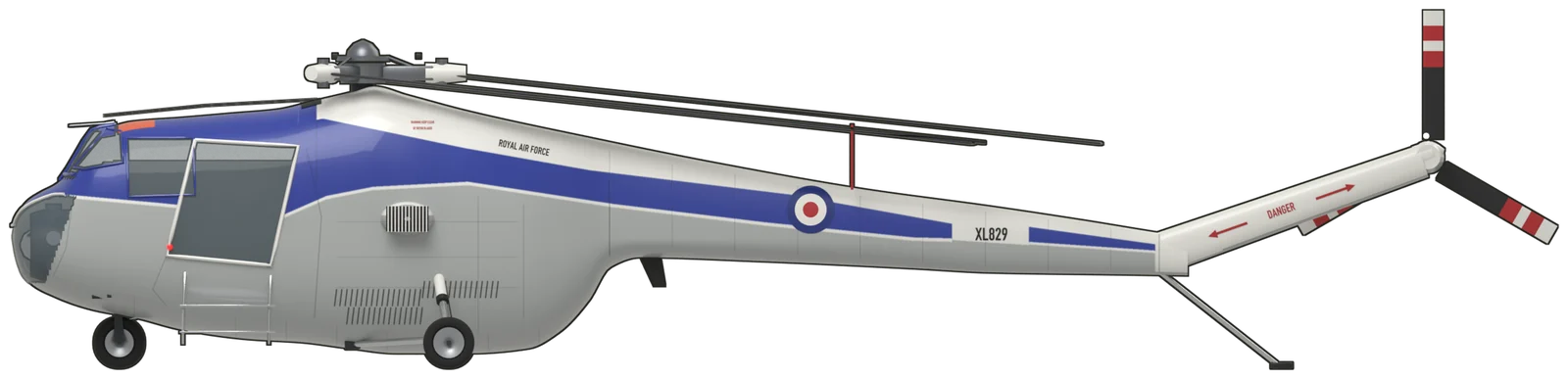
A procedural model built in Blender from published dimensions, drawings and photographs, painted as XL829 in the RAF search-and-rescue scheme of silver and blue it wears at The Helicopter Museum, Weston-super-Mare, with its rotor blades folded. Drag to orbit, scroll or pinch to zoom · download .glb (966 KB)
History
The Sycamore HR.14
Bristol’s helicopter department designed the Sycamore around a single main rotor and a piston radial engine mounted low in the nose, under the glazed dome. The prototype Type 171 flew on 27 July 1947, and the type was the first British-designed helicopter to enter RAF service.
The RAF took the Sycamore in 1953 and used the HR.14 for search and rescue, with a winch for lifting people from the sea and mountains, and as a utility transport. Sycamores served in Malaya, Cyprus and Borneo, and Australia, Belgium and West Germany also bought them.
Bristol built 180 of them. They were gradually replaced in the 1960s by turbine helicopters such as the Whirlwind, and the RAF retired the last in 1972.
This airframe
HR.14 XL829
XL829 is a Sycamore HR.14 in the RAF search-and-rescue finish of silver below and royal blue above, with a white cheat line, Type D roundels and the serial on the tail boom. The model shows it as displayed at The Helicopter Museum in Weston-super-Mare, with its main rotor blades folded back along the tail.
Where to see one
In the gazetteer
The gazetteer records the Sycamore HR.14 in 6 UK collections. The airframe modelled here is marked.