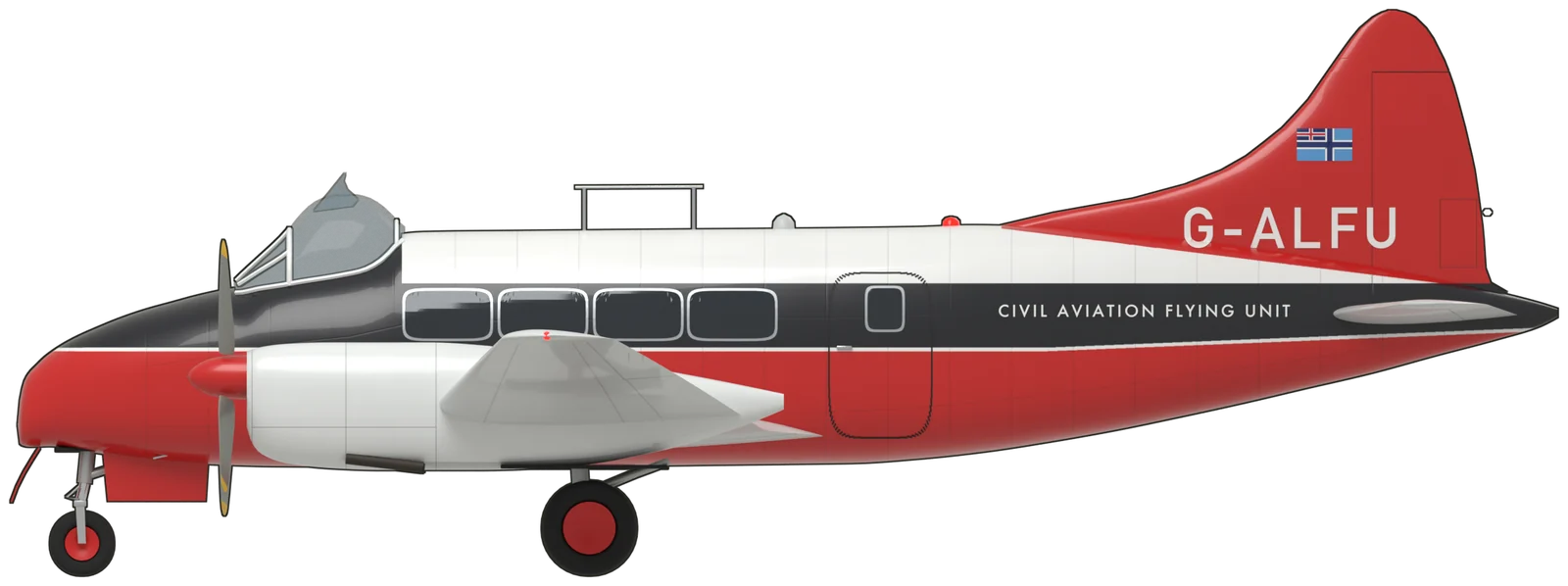
3D model
Turn it over
A procedural model built in Blender from published dimensions, drawings and photographs, painted as G-ALFU in the red, white and black of the Civil Aviation Flying Unit, as displayed at IWM Duxford. Drag to orbit, scroll or pinch to zoom · download .glb (1.1 MB)
History
The Dove
During the war the Brabazon Committee drew up the airliners Britain would need once peace came. One was a small feeder-liner to replace the wooden Dragon Rapide, and de Havilland answered it with the DH.104 Dove: an all-metal, low-winged twin with flaps, constant-speed propellers and a retractable tricycle undercarriage. The prototype first flew at Hatfield on 25 September 1945.
The Dove carried up to eight passengers on short routes, and it sold all over the world to airlines, companies and air forces. The RAF took it as the Devon and the Royal Navy as the Sea Devon, and both flew it on communications and VIP work for more than thirty years. Production ended in 1967 after 544 had been built.
Later Doves had more powerful Gipsy Queen engines and a raised cockpit canopy that gave the pilots more headroom. de Havilland also stretched the design and gave it four engines to make the Heron, which the Queen’s Flight used. Many Doves were still flying as executive and survey aircraft long after the last one was built.
This airframe
Dove 6 G-ALFU
G-ALFU was built as a Dove 4 and later brought up to Dove 6 standard with more powerful engines. From 1948 to 1972 it flew from Stansted with the Civil Aviation Flying Unit, which checked radio navigation aids and tested aircrew; it carried instruments rather than passengers. Retired with almost 10,600 flying hours, it went to Duxford in 1973 and passed to the Duxford Aviation Society in 1984. It hung from the roof of AirSpace for many years and now stands on its wheels again, still in its red, white and black CAFU colours with the Civil Air Ensign on the fin.
Where to see one
In the gazetteer
The gazetteer records the Dove in 8 UK collections. The airframe modelled here is marked.