3D model
Turn it over
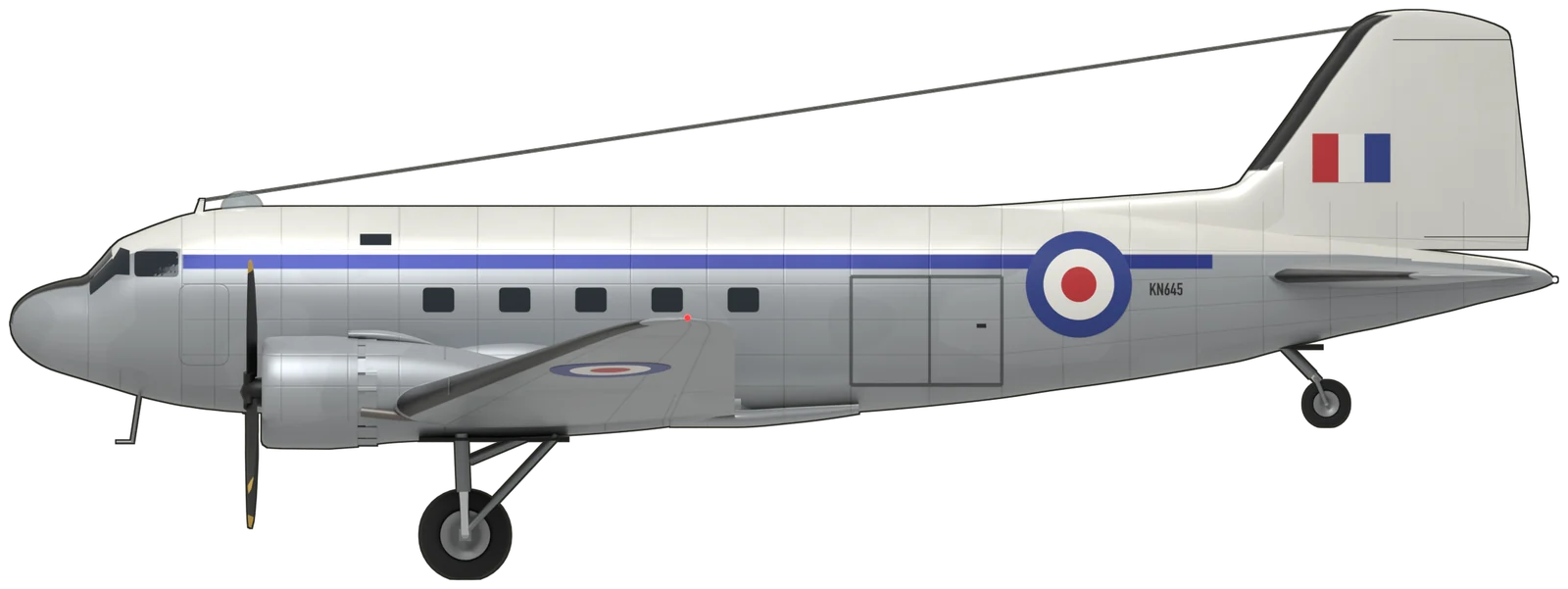
A procedural model built in Blender from published dimensions, drawings and photographs, painted as KN645, a C-47B built at Oklahoma City and delivered to the RAF under Lend-Lease in 1945, which flew as a VIP transport for Field Marshal Montgomery and the British Military Governors of Germany and was the last Dakota in RAF service: the post-war Transport Command scheme of white upper fuselage, fin and rudder over high-speed silver, a dark-blue cheatline, a black anti-glare panel on the nose, Type D roundels, a fin flash, black de-icer boots on the leading edges and black propellers with yellow tips, as it is displayed at RAF Museum Midlands, Cosford. Drag to orbit, scroll or pinch to zoom · download .glb (1.2 MB)
History
The Dakota IV
The Dakota began as an airliner. In 1934 American Airlines asked Douglas for a wider sleeper version of its DC-2, and the Douglas Sleeper Transport flew at Santa Monica on 17 December 1935, 32 years to the day after the Wright brothers’ first flight. Its day-coach sister, the 21-seat DC-3, could cross the United States in about 15 hours with three stops and was the first airliner that could make a profit from passengers alone, without a mail contract. By the end of the 1930s it was carrying most of the world’s airline passengers.
For the war Douglas strengthened the floor, fitted a large double cargo door on the port side and a glider-towing hook, and built the result as the C-47 Skytrain at Long Beach and Oklahoma City. More than 10,000 were built in America, and with licence-built copies in the Soviet Union and Japan the family passed 16,000. The RAF took about 1,900 under Lend-Lease as the Dakota. They dropped paratroops and towed gliders on D-Day and at Arnhem, where Flight Lieutenant David Lord of No. 271 Squadron won a posthumous Victoria Cross, and they kept the Fourteenth Army supplied from the air in Burma.
After the war RAF Dakotas flew in the Berlin Airlift of 1948–49 and served Transport Command and communications squadrons across the world, carrying commanders, ministers and royalty as well as freight. The last of them was retired in April 1970. Many hundreds were turned into civil airliners and freighters after the war, and more than eighty years after the first flight some are still at work, while the Battle of Britain Memorial Flight has flown ZA947 since 1993.
This airframe
Dakota IV KN645
KN645 was built at Oklahoma City as a C-47B, USAAF serial 44-77003, and taken on RAF charge under Lend-Lease on 18 May 1945. It joined the communications squadron of the 2nd Tactical Air Force in Belgium, moved with it to Bückeburg in Germany, and was fitted out as a VIP aircraft with armchairs, settees, a galley and a cocktail cabinet. Field Marshal Montgomery used it, and from 1946 to 1949 it was the personal aircraft of the British Military Governors of Germany, Sir Sholto Douglas and Sir Brian Robertson, flying to Berlin each week for the Control Commission. Later it served in Singapore, Malta, with the SHAPE communications flight at Northolt, briefly with The Queen’s Flight for the Nepal leg of the Queen’s 1961 Asian tour, and finally with NATO’s northern headquarters in Oslo. Its flight from Oslo to Northolt on 1 April 1970 was the last operational sortie by an RAF Dakota. It reached Cosford in 1975, was repainted in 2005 in the post-war Transport Command scheme it had worn in its last years of service, and in 2007 was hung in the National Cold War Exhibition. The model shows it in that scheme: white upper fuselage, fin and rudder over high-speed silver, a dark-blue cheatline, a black anti-glare panel, Type D roundels, a fin flash, black de-icer boots and black propellers with yellow tips. It is modelled standing on its wheels, although at Cosford it hangs with its undercarriage retracted.
Where to see one
In the gazetteer
The gazetteer records the Dakota IV in 4 UK collections. The airframe modelled here is marked.