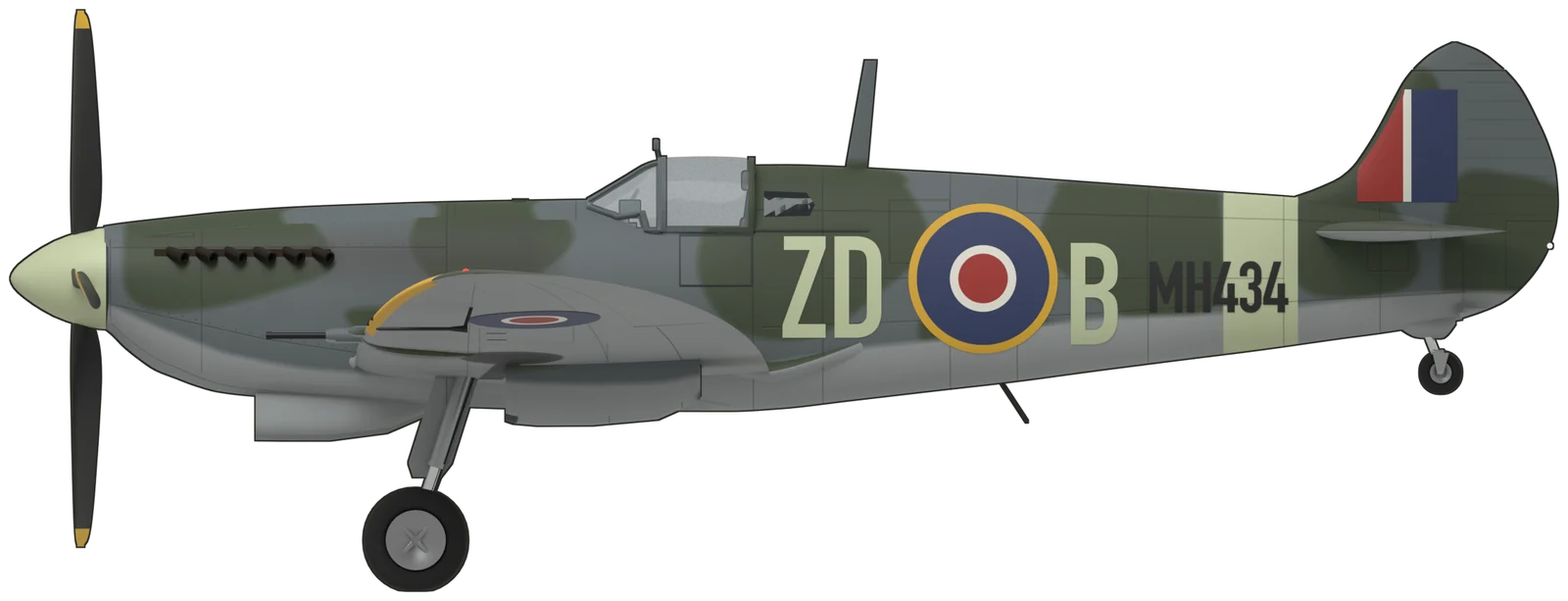
3D model
Turn it over
A procedural model built in Blender from published dimensions, drawings and photographs, painted as MH434, ZD-B of No. 222 Squadron in 1943. Drag to orbit, scroll or pinch to zoom · download .glb (1.4 MB)
History
The Spitfire
R.J. Mitchell’s Spitfire grew out of his Schneider Trophy racers and first flew on 5 March 1936. Its thin elliptical wing gave it the speed and agility to meet the best German fighters, and Spitfires were in production from before the war until after it: more than 22,000 Spitfires and Seafires were built.
By 1942 the Focke-Wulf Fw 190 was outclassing the Spitfire V. The answer was the Mk IX, a Merlin 60-series engine with a two-stage supercharger in a strengthened Mk V airframe, recognisable by its longer nose and the matching radiators under each wing. Meant as a stopgap, it became one of the most numerous marks.
The LF Mk IX modelled here had its supercharger tuned for low altitude, where much of the fighting over north-west Europe took place in 1943 and 1944.
This airframe
LF Mk IX MH434
MH434 was built at Castle Bromwich in 1943 and flew as ZD-B with No. 222 (Natal) Squadron from Hornchurch, where Flt Lt Henry Lardner-Burke shot down a Focke-Wulf Fw 190 in it that August. After service with the Dutch and Belgian air forces it became a film star, and it has flown from Duxford with the Old Flying Machine Company since 1983.
Where to see one
In the gazetteer
The gazetteer records the Spitfire in 13 UK collections. The airframe modelled here is marked.
- Battle Of Britain Memorial Flight Visitors Centre
- Biggin Hill Heritage Hangar
- IWM Duxford
- Montrose Air Station Museum
- National Museum Of Flight
- Royal Air Force Museum London
- Royal Air Force Museum Midlands
- Solent Sky
- Spitfire Visitor Centre, Hangar 42, Blackpool
- Tangmere Military Aviation Museum
- The Shuttleworth Collection
- Ulster Aviation Society (Maze Long Kesh)
- Yorkshire Air Museum