3D model
Turn it over
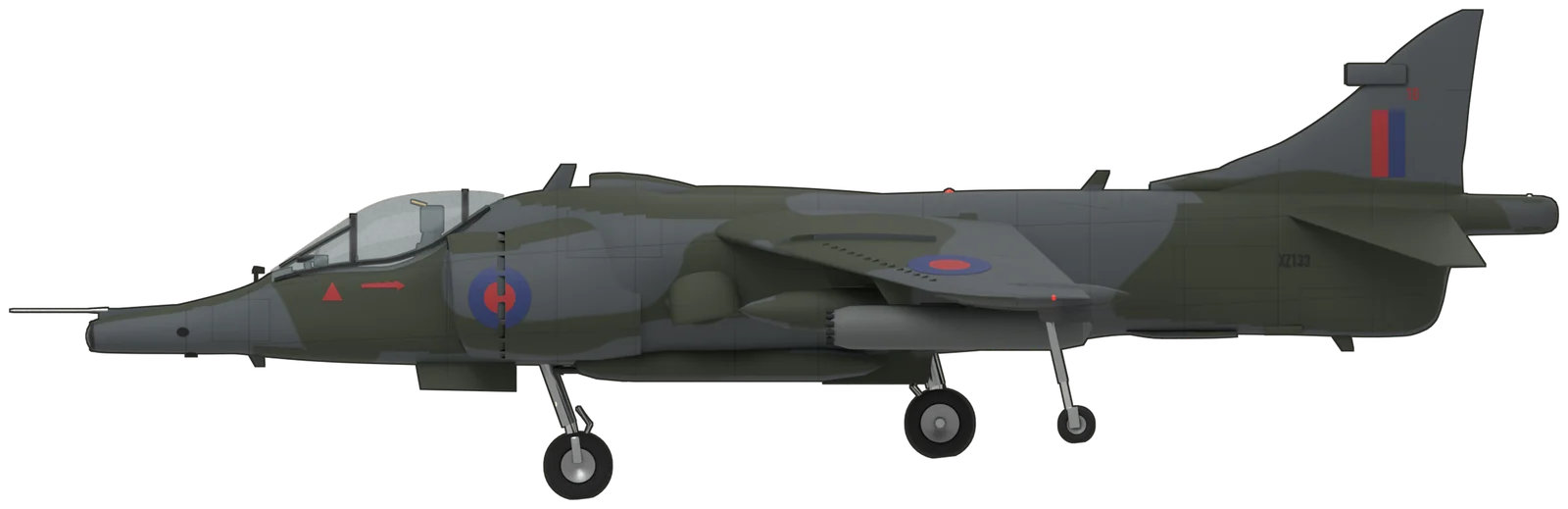
A procedural model built in Blender from published dimensions, drawings and photographs, painted as XZ133 '10' of No. 1(F) Squadron, Falklands 1982. Drag to orbit, scroll or pinch to zoom · download .glb (979 KB)
History
The Harrier
The Harrier began with an engine. Bristol’s Pegasus turbofan exhausted through four rotating nozzles, so the same thrust could lift the aircraft straight up or push it forward. Hawker built the P.1127 around it and made the first tethered hover in October 1960. In 1969 the Harrier GR.1 entered RAF service as the world’s first operational vertical and short take-off fighter.
Hidden in woods and flying from clearings, RAF Harriers were meant to keep fighting after the airfields of West Germany had been destroyed. The idea went to sea in the Sea Harrier, and a much-redesigned second generation, built with McDonnell Douglas, served the RAF and Royal Navy until December 2010.
In 1982 No. 1(F) Squadron’s GR.3s sailed for the Falklands, flying ground-attack missions from HMS Hermes and from a short metal strip at Port San Carlos. The GR.3 shown here carries the laser nose, radar-warning fairings, Aden gun pods, drop tanks and SNEB rocket pods of that campaign.
This airframe
GR.3 XZ133
XZ133 is displayed in AirSpace at IWM Duxford in its 1982 configuration with No. 1(F) Squadron: wraparound Dark Green and Dark Sea Grey, red and blue roundels, and the red code 10 on the fin.
Where to see one
In the gazetteer
The gazetteer records the Harrier in 15 UK collections. The airframe modelled here is marked.
- Aerospace Bristol
- Boscombe Down Aviation Collection
- Fleet Air Arm Museum
- Gatwick Aviation Museum
- IWM Duxford
- Midland Air Museum
- Newark Air Museum
- Norfolk and Suffolk Aviation Museum
- Royal Air Force Museum London
- Royal Air Force Museum Midlands
- Solent Sky
- South Wales Aviation Museum
- Tangmere Military Aviation Museum
- Ulster Aviation Society (Maze Long Kesh)
- Yorkshire Air Museum