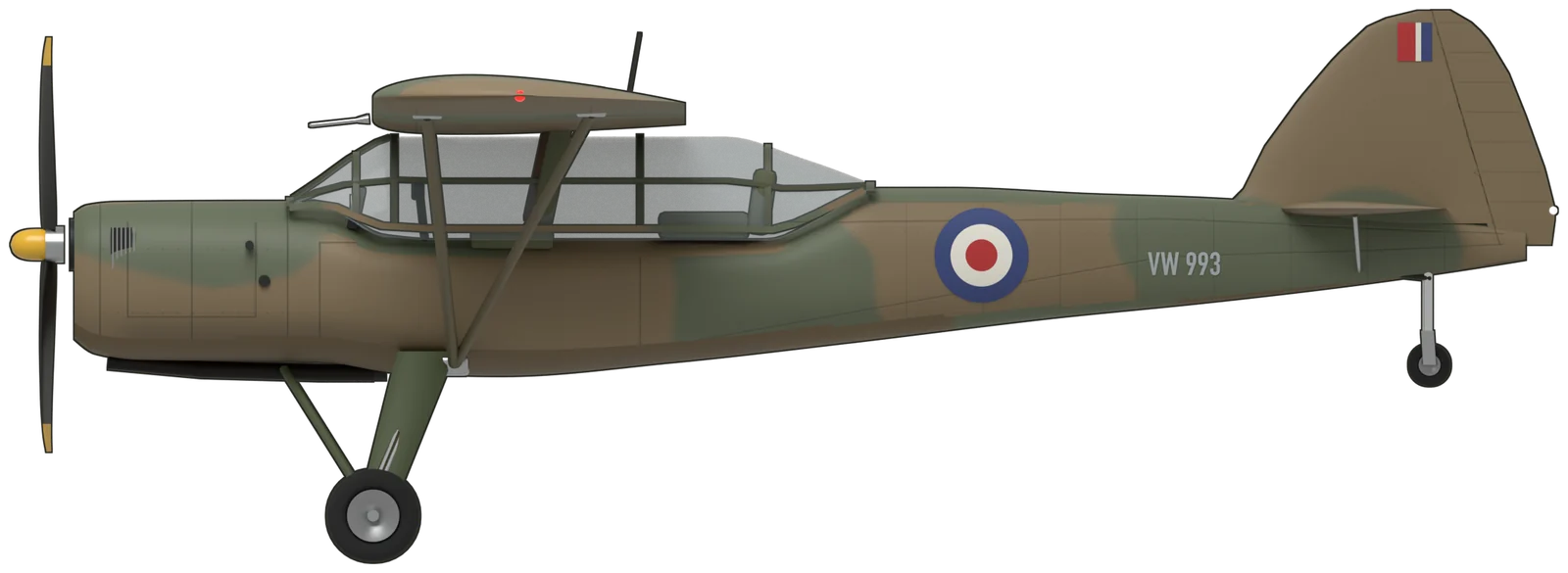
3D model
Turn it over
A procedural model built in Blender from published dimensions, drawings and photographs, painted as VW993 in the Dark Green and Dark Earth army camouflage it wears at the Yorkshire Air Museum, Elvington. Drag to orbit, scroll or pinch to zoom · download .glb (750 KB)
History
The Auster AOP.6
The Auster began as the American Taylorcraft Plus C, a light high-wing cabin monoplane that Taylorcraft Aeroplanes (England) built at Thurmaston, Leicester, from 1939. The army took up the idea of using such light aircraft to spot for the guns, and in 1941 the first Air Observation Post squadron was formed. The type was renamed Auster in 1946.
The AOP.6 was the post-war production version, built by Auster Aircraft at Rearsby, Leicestershire, with a 145 hp Cirrus Bombardier engine and a long-stroke undercarriage for rough fields. It had large flaps, a glazed cabin and a long glazed roof so that the army pilot and observer could see the fall of shot. It flew from fields and roadsides, and several hundred were built for the Royal Artillery’s Air OP squadrons, which were manned by army officers and RAF technicians.
Austers served in Korea, Malaya, Kenya, Cyprus and elsewhere in the 1950s. The AOP.9, with a more powerful engine, replaced it from 1955, and the army’s Air OP flights passed to helicopters in the 1960s. Many Austers were sold off and flew on as civil light aircraft.
This airframe
AOP.6 VW993 (G-ASCD)
VW993 is an Auster AOP.6 built in the late 1940s for the Royal Air Force and the army’s Air OP squadrons. It was later converted to a civil Terrier 2 and registered G-ASCD, and it is now displayed at the Yorkshire Air Museum, Elvington, restored to its military configuration. The model shows it in the Dark Green and Dark Earth camouflage seen there, with a black wooden propeller with yellow tips, roundels on the fuselage and upper wings, a red, white and blue fin flash and the serial “VW 993” on the rear fuselage.
Where to see one
In the gazetteer
The gazetteer records the Auster AOP.6 in 6 UK collections. The airframe modelled here is marked.