3D model
Turn it over
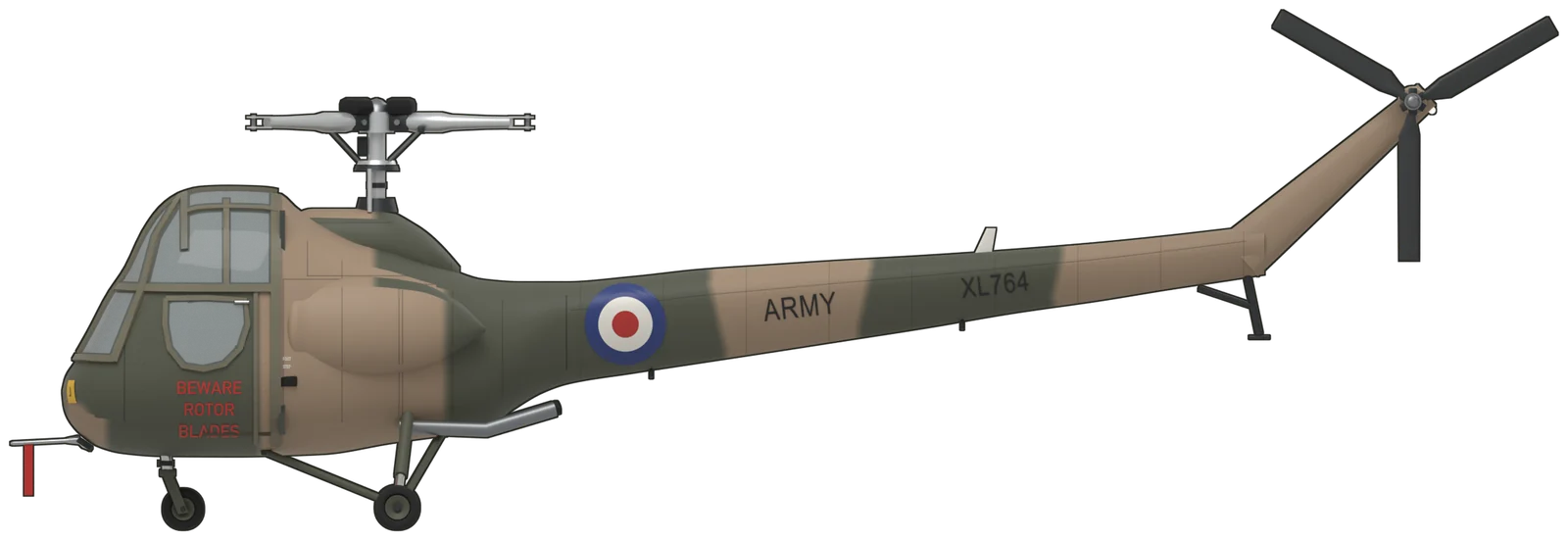
A procedural model built in Blender from published dimensions, drawings and photographs, painted as XL764 ‘J’, an Army Air Corps air observation post Skeeter delivered in 1958 and later used for trials at Boscombe Down: olive green and light earth camouflage, a Type D roundel and black ‘ARMY’ and serial titles on the tail boom, red ‘BEWARE ROTOR BLADES’ on the cabin door and a yellow code square with a black ‘J’ on the nose, its main rotor blades removed and the blade sleeves left on the head, as it is displayed at Newark Air Museum. Drag to orbit, scroll or pinch to zoom · download .glb (738 KB)
History
The Skeeter AOP.12
The Skeeter began as the Cierva W.14, a small two-seat helicopter designed by the Cierva Autogiro Company. The first prototype flew at Eastleigh on 10 October 1948 with a 110 hp Jameson engine. When Cierva’s helicopter work passed to Saunders-Roe in January 1951, the Skeeter came with it, and the Isle of Wight firm spent the next few years curing its faults.
The worst of them was ground resonance, a violent shaking that can tear a helicopter apart on its wheels; it destroyed the Mark 2 during ground tests in June 1950. A redesigned undercarriage and new blade dampers put it right, and the Skeeter 5 passed its trials at Boscombe Down in 1954. The British Army then ordered 64 Skeeter 6s as the AOP.12, powered by a 215 hp de Havilland Gipsy Major.
The Skeeter entered service in October 1956 and became the first helicopter of the Army Air Corps when the corps was formed in 1957. Its pilots spotted for the artillery, flew reconnaissance and carried officers and messages, at home and with the British Army of the Rhine in Germany. Germany bought ten for its army and navy, which later went to Portugal. The Sioux and the Scout replaced the Skeeter in British service by 1968.
This airframe
AOP.12 XL764
XL764 was delivered to Eastleigh in September 1958 and joined the Army Air Corps at Middle Wallop on 9 October. It crashed in January 1962 and went back to Westland, by then Saunders-Roe’s owner, for repair; from February 1964 it moved between Westland and the Aeroplane and Armament Experimental Establishment at Boscombe Down on trials. It became an instructional airframe at the Army Apprentice School at Arborfield in March 1967, was sold in 1975 and shown at Nostell Priory, and came to Newark Air Museum in July 1980. The model shows it as displayed there: olive green and light earth camouflage, a Type D roundel and black “ARMY” and serial titles on the tail boom, red “BEWARE ROTOR BLADES” on the cabin door and a yellow square with a black “J” on the nose, with its main rotor blades removed and the blade sleeves left on the head.
Where to see one
In the gazetteer
The gazetteer records the Skeeter AOP.12 in 4 UK collections. The airframe modelled here is marked.