3D model
Turn it over
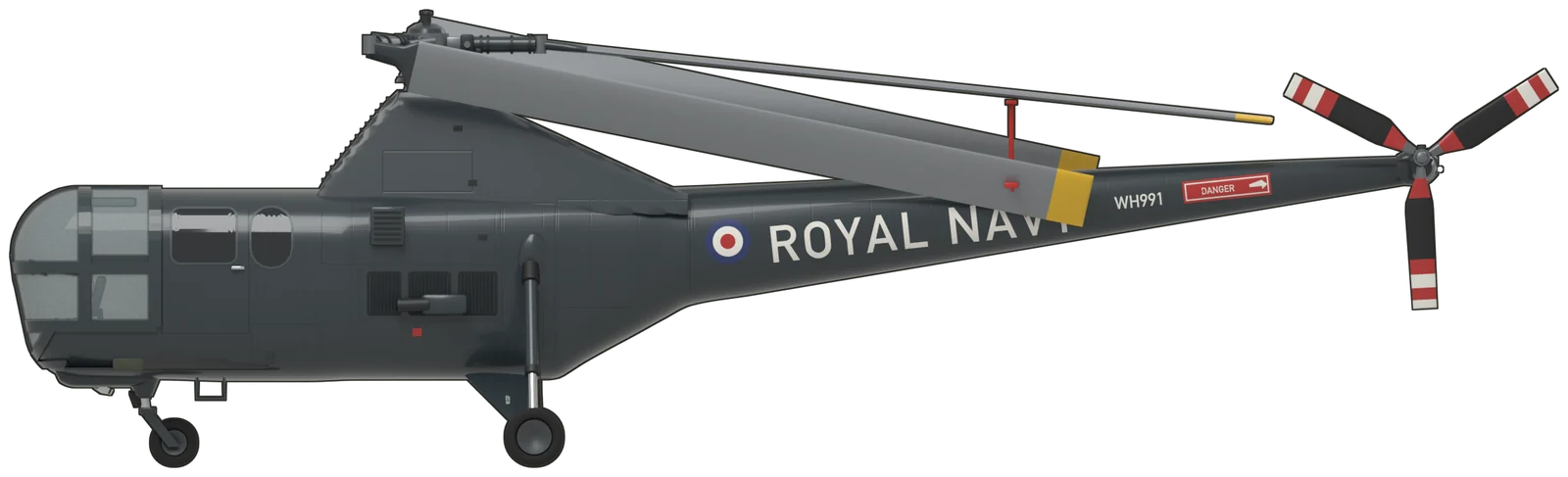
A procedural model built in Blender from published dimensions, drawings and photographs, painted as WH991, a Royal Navy HR.5 that flew from HMS Illustrious and HMS Centaur, surveyed Trinidad with HMS Vidal and ended its service with 705 Squadron at Culdrose: overall gloss dark sea grey, a Type D roundel and white ‘ROYAL NAVY’ on the tail boom, the serial WH991 aft of it, grey main rotor blades with yellow tips folded back over the boom onto a red crutch and a black tail rotor banded in red and white, as it is displayed at the Yorkshire Air Museum, Elvington. Drag to orbit, scroll or pinch to zoom · download .glb (1.3 MB)
History
The Dragonfly
The Dragonfly was the Sikorsky S-51 built under licence by Westland at Yeovil, with a British Alvis Leonides radial in place of the American Pratt & Whitney Wasp Junior. The first Westland machine flew on 5 October 1948, and 149 were built up to 1954. The Royal Navy took its first HR.1s in 1950, which made the Dragonfly the first British-built helicopter in military service.
Its main job at sea was plane guard. A Dragonfly hovered off a carrier’s quarter during flying, ready to pluck a ditched pilot from the water, a task that until then had fallen to a destroyer steaming astern. Ashore it flew search and rescue from naval air stations, carried casualties out of the jungle in the Malayan Emergency and helped after the North Sea flood of 1953.
The HR.3 brought all-metal rotor blades, and the HR.5 of 1953, 25 of them converted from earlier airframes, a Leonides 23/1 engine with better instruments and radio. The Whirlwind took over the Navy’s rescue work from the late 1950s, but the last Dragonflies were not retired until 1967. Westland later rebuilt the design with a deeper five-seat cabin as the Widgeon.
This airframe
HR.5 WH991
WH991 first flew on 4 February 1953 and joined HMS Illustrious soon afterwards, then served aboard HMS Centaur and at Lee-on-Solent and Eglinton in Northern Ireland. After modification in 1958 it went to Trinidad to fly from the survey ship HMS Vidal, and back in England from 1960 it served with 700 Squadron at Yeovilton and 705 Squadron at Culdrose. In 1994 museum member Ray McElwain found it in a scrapyard near Elvington, and it was restored for static display at the Yorkshire Air Museum. The model shows it as displayed there: overall dark sea grey, a Type D roundel and white “ROYAL NAVY” on the tail boom, grey main blades with yellow tips folded back over the boom onto a red crutch, and a black tail rotor banded in red and white.
Where to see one
In the gazetteer
The gazetteer records the Dragonfly in 4 UK collections. The airframe modelled here is marked.