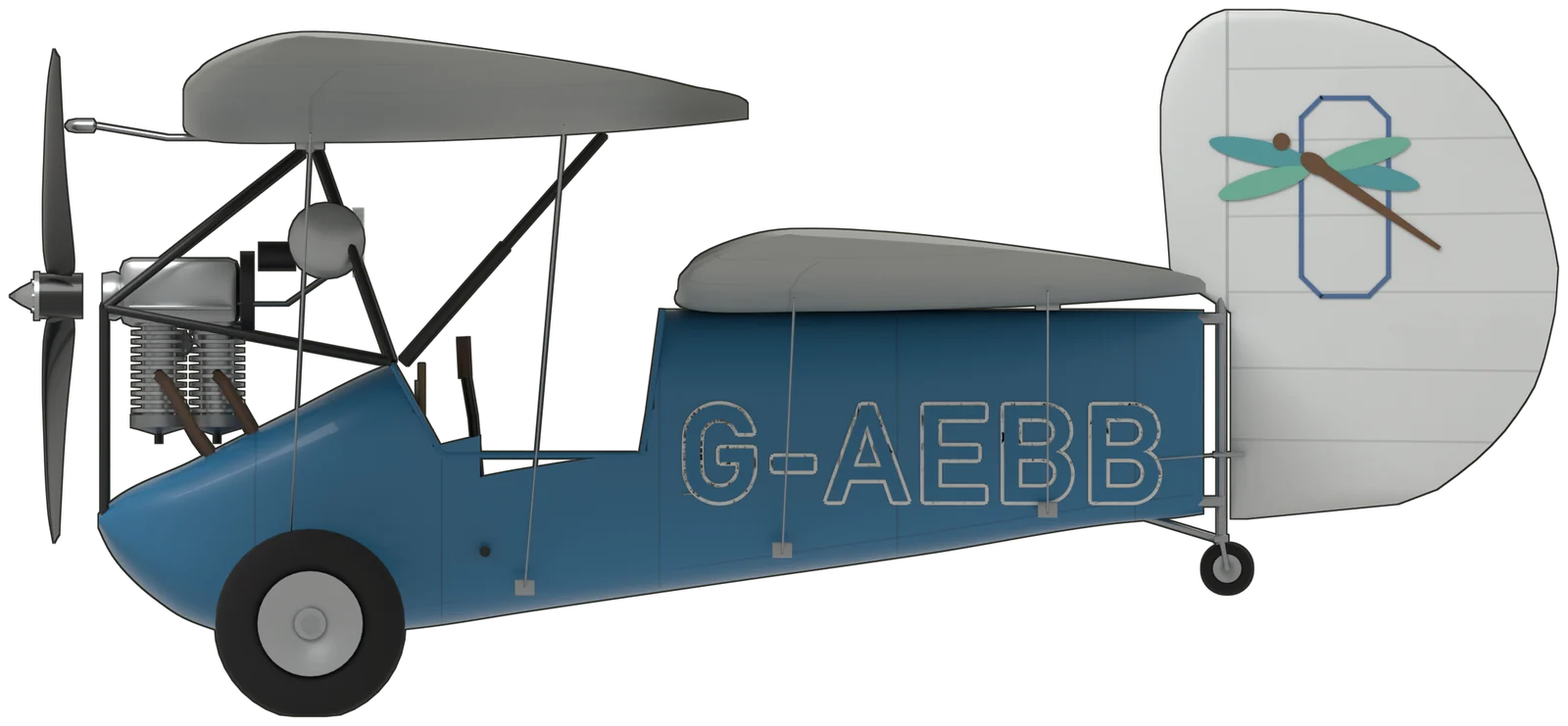
3D model
Turn it over
A procedural model built in Blender from published dimensions, drawings and photographs, painted as G-AEBB, a Scott Flying Squirrel-engined Flea built by K. W. Owen of Southampton in 1935–36, with a sky-blue plywood fuselage, aluminium-doped wings, black struts and the white rudder with its painted dragonfly, as it hangs in the Shuttleworth Collection at Old Warden. Drag to orbit, scroll or pinch to zoom · download .glb (722 KB)
History
The Flying Flea
Henri Mignet was a self-taught French designer who wanted an aeroplane anyone could build and fly. His HM.14 Pou-du-Ciel, or ‘sky louse’, first flew on 10 September 1933. It had two wings in tandem and no tailplane: the pilot moved the stick fore and aft to tilt the whole front wing and side to side to swing the large rudder. There were no ailerons and no rudder pedals.
Mignet described how to build it in his book ‘Le Sport de l’Air’ (1934), and an English translation, ‘The Flying Flea’, followed in 1935. The book set off a craze. A Flea needed little more than plywood, spruce, fabric and a motorcycle or small aero engine, and hundreds were started in sheds and garages in France and Britain, where kits and plans were sold and Fleas raced at flying meetings.
Then the Fleas began to crash. Several pilots were killed in 1935 and 1936, and full-size tests in the wind tunnels at Farnborough and Chalais-Meudon found the cause: at low incidence the front wing’s downwash raised the rear wing, so the aircraft could pitch into a dive that pulling back on the stick could not stop. Flying permits were withdrawn in Britain and France in 1936. Mignet’s later designs cured the fault, but most British Fleas never flew again, and some went straight from the workshop to the museum.
This airframe
HM.14 G-AEBB
G-AEBB was built by K. W. Owen in Southampton in 1935–36 and registered in January 1936, just as the Flea was grounded; it probably never flew. It has the 16 hp Scott Flying Squirrel engine, a two-stroke motorcycle twin from Shipley in Yorkshire. After years with an Air Training Corps squadron it came to the Shuttleworth Collection in 1967, was restored by A. Dowson, and now hangs from the hangar roof at Old Warden. The model shows it in a sky-blue plywood fuselage with aluminium-doped wings, black struts and engine mount, a black propeller, and the off-white rudder with its painted dragonfly, with G-AEBB in white-outlined blue letters on both sides of the rear fuselage.
Where to see one
In the gazetteer
The gazetteer records the Flying Flea in 5 UK collections. The airframe modelled here is marked.