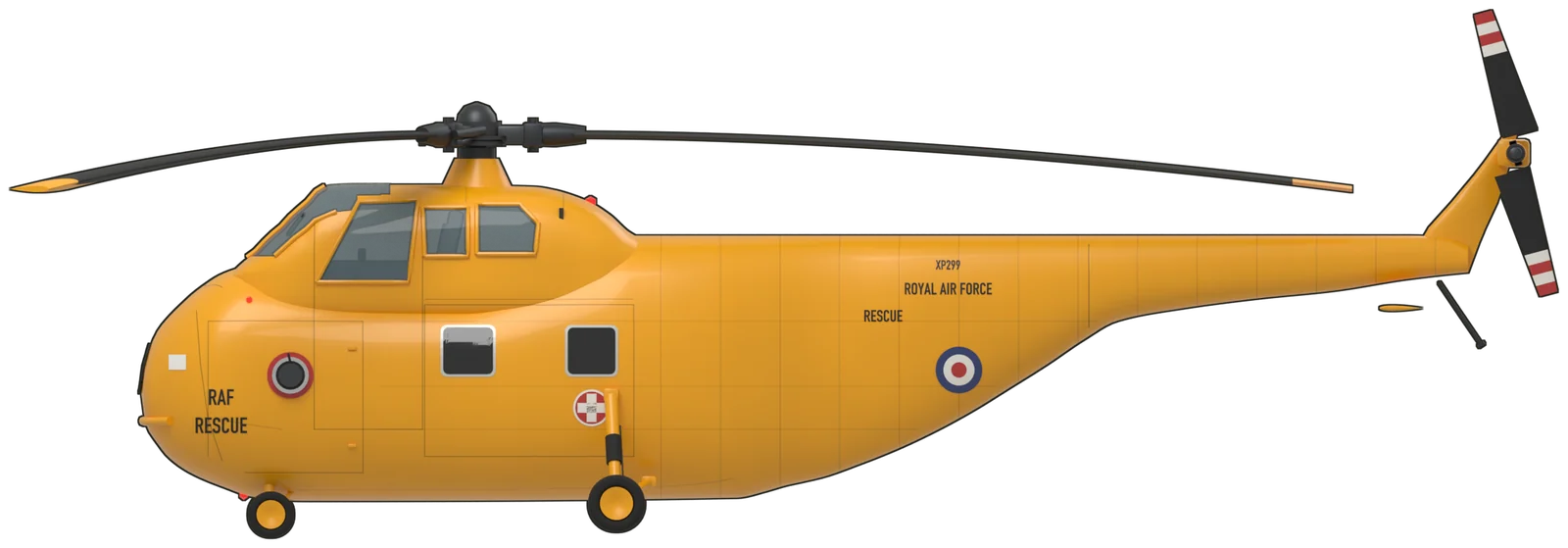
3D model
Turn it over
A procedural model built in Blender from published dimensions, drawings and photographs, painted as XP299 in the yellow search-and-rescue scheme of No. 22 Squadron, as displayed at the RAF Museum. Drag to orbit, scroll or pinch to zoom · download .glb (1007 KB)
History
The Whirlwind
Westland built the Whirlwind under licence from Sikorsky’s S-55. The first British-built machine flew in November 1953, and it served the Royal Navy and the RAF in a long run of marks, powered at first by the American Pratt & Whitney Wasp radial engine in the nose.
It was the RAF’s first dedicated search-and-rescue helicopter. Crews lifted climbers, sailors and airmen from cliffs and the sea around Britain, and the bright yellow scheme became a familiar sight at coastal stations. The same airframe also served as a troop carrier and a VIP transport.
The HAR.10 of the early 1960s replaced the piston engine with a Rolls-Royce Gnome turboshaft, which gave more power and a neater nose with a round intake in front and the exhaust to one side. The Sea King took over the rescue role in the early 1980s.
This airframe
HAR.10 XP299
XP299 is a Westland-built HAR.10 delivered to the RAF in 1962 and flown on search and rescue with No. 22 Squadron in the overall yellow scheme, with “RAF RESCUE” on the nose and a red-and-white rescue badge on each cabin side. The RAF Museum has it in those markings; it was first shown at Hendon and is now at RAF Museum Midlands, Cosford.
Where to see one
In the gazetteer
The gazetteer records the Whirlwind in 8 UK collections. The airframe modelled here is marked.