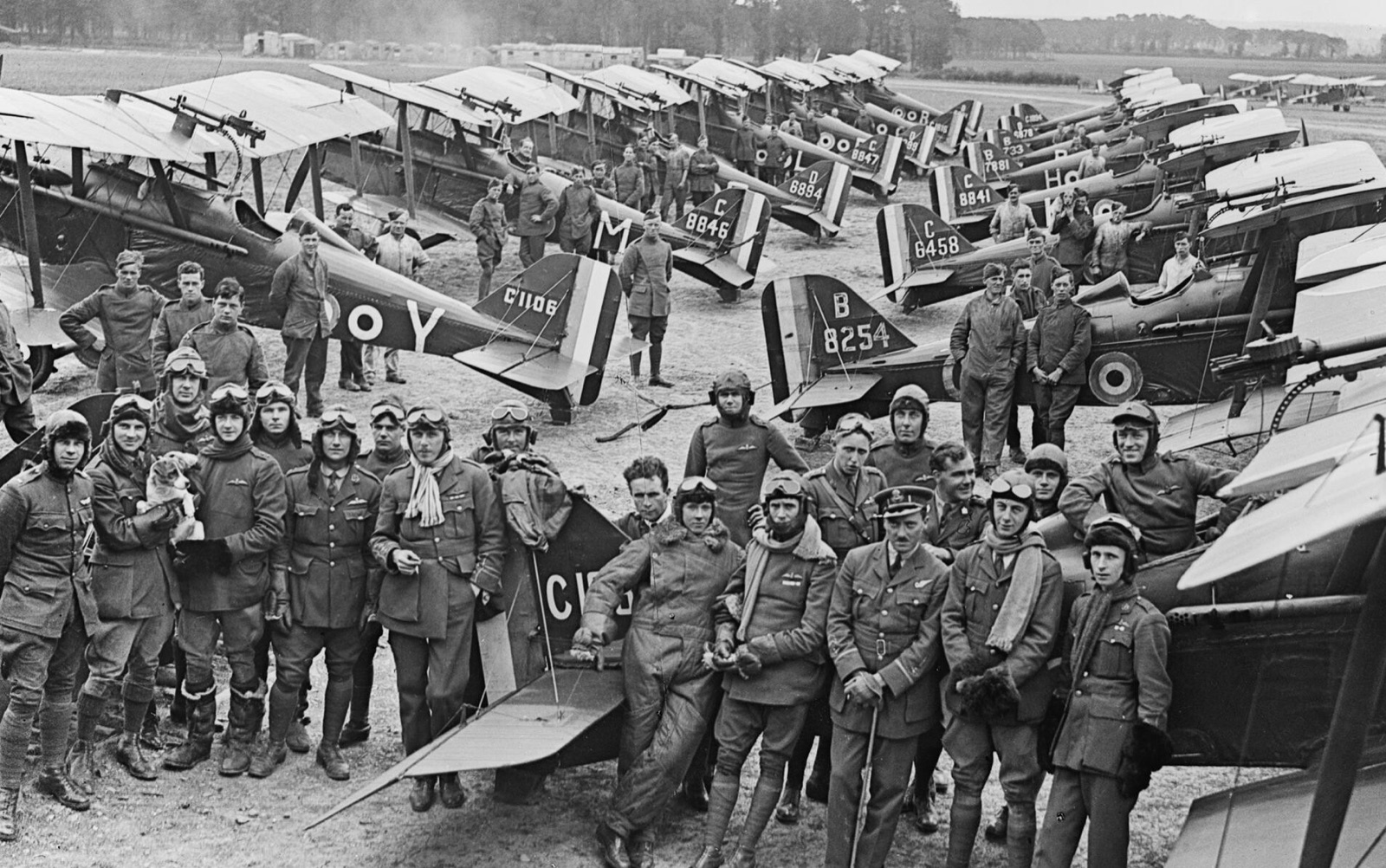
When the war began, the aeroplane was eleven years old. The Royal Flying Corps’ Military Wing went to war with 147 officers, 1,097 airmen and 179 aeroplanes on its books, and on 13 August 1914 Nos. 2, 3 and 4 Squadrons flew the Channel to join the British Expeditionary Force, with No. 5 Squadron close behind. Few of them carried a gun. Their job was to look.
By the Armistice the picture had been redrawn. France had built close to 68,000 aircraft, Britain nearly 58,000 and Germany around 48,000. The best fighters of 1918 had two to three times the engine power of those of 1915 and flew half as fast again. On 1 April 1918 Britain had merged its army and naval air arms into the world’s first independent air force, and by November the RAF had more than 22,000 aircraft and 291,000 people.
The figures in this almanac come from the official histories and the standard reference works. First World War numbers are softer than those of the next war: records were incomplete, claims were optimistic, and sources count different things. Where they disagree, we say so.
The factories
A cottage industry of carpenters and dope-painters became, in four years, the biggest engineering effort the world had seen
No nation went to war with an aircraft industry worth the name. Britain’s output in the first year of the war averaged about 50 machines a month; by 1918 it was some 2,700 a month, from hundreds of firms, many of them furniture makers and coachbuilders turned over to wood, wire and doped linen. France out-built everyone, and its engines powered the Allied air forces. Germany, blockaded and short of materials, fell behind from 1917.
Aircraft built, 1914–1918
aircraft= 2,000 aircraft
- France67,987
- Britain58,144
- Germany48,537
- ItalyRound figure; Italy flew French SPADs and Nieuports alongside its own Capronis and Ansaldos20,000
- United StatesRound figure, almost all from 1917–18; most US pilots in France flew French-built aircraft15,000
- Austria-Hungary5,431
- RussiaTo the revolution; Russia left the war in March 19184,700
The most-cited totals. Ellis and Cox’s World War I Databook gives lower airframe counts for some nations (France 52,146; Germany 45,704; Italy 11,986; USA 4,089 in 1918 alone), largely because of what each source counts as delivered.
Source The Aerodrome, WWI aircraft statistics (unattributed there; usually credited to Angelucci, Illustrated Encyclopedia of Military Aircraft)
Aircraft built each year
aircraft- Britain
- France
- Germany
- Italy
- Austria-Hungary
| Year | Britain | France | Germany | Italy | Austria-Hungary |
|---|---|---|---|---|---|
| 1915 | 1680 | 4489 | 2950 | 382 | 281 |
| 1916 | 5716 | 7549 | 7112 | 1255 | 732 |
| 1917 | 14382 | 14915 | 13997 | 3861 | 1272 |
| 1918 | 32536 | 24652 | 20971 | 6488 | 1989 |
Calendar years. 1914 output was small (France 541, Germany 694; British figure not available). On this count Britain built 54,314 aircraft in 1915–18, against the 58,144 above for the whole war.
Source Ellis & Cox, The World War I Databook, via TheWorldWars.net
Front-line aircraft, November 1918
aircraft= 125 aircraft
- France138 in August 19144,500
- Britain113 in August 19143,300
- Germany232 in August 19142,390
- Italy150 in 19141,200
- United States55 in 1914; the Air Service in France flew mostly French SPADs and Nieuports740
Combat aircraft with front-line units only; the RAF’s total strength, including training and home defence, was far higher.
Source The Aerodrome, WWI aircraft statistics (unattributed there)
Source Western Front Association; Historic England; Roskill (1969); Penrose; Jones, The War in the Air, Appendices (1937); RAF Museum
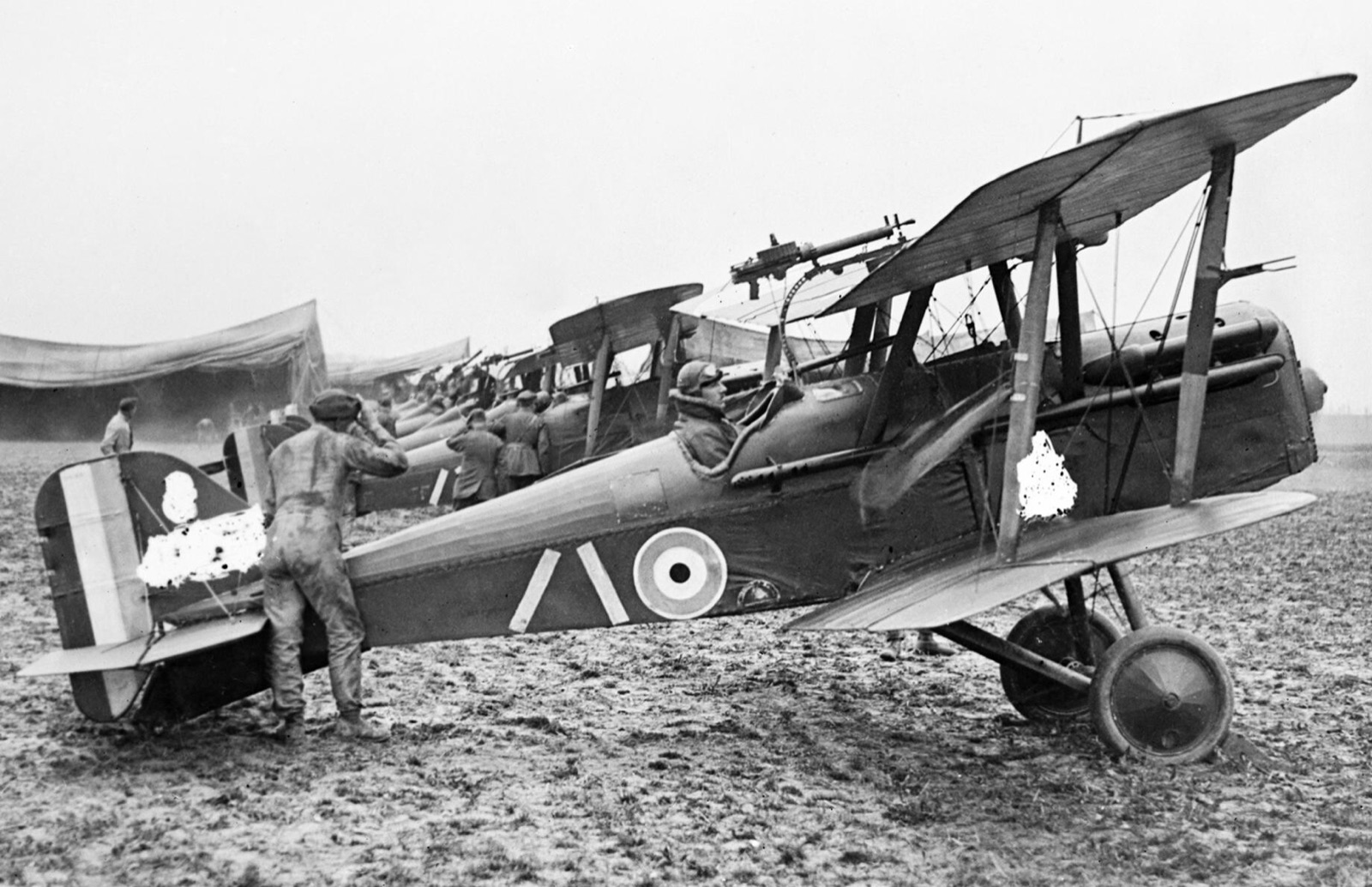
- Lewis gun on its Foster mounting above the top wing, able to slide down for reloading or upward fire
- Pilot in his cockpit, ready to start up
- Nose of the 200 hp water-cooled V8, a Hispano-Suiza or its Wolseley Viper licence copy
- White bars: No. 32 Squadron’s marking, which the censor left in
- Serial number scratched out of the negative by the censor
Faster, higher
Engine power doubled, speeds rose by half, and a fighter could be obsolete within six months of arriving
The air war was a race between engine makers as much as between pilots. In 1915 a Fokker Eindecker with 100 hp and one synchronised gun was enough to dominate the front. By 1917 the best fighters had 200 hp, two guns and a ceiling above 17,000 ft. Each leap made the previous generation a liability: the B.E.2, designed to be stable for observation, became notorious as “Fokker fodder”.
Engine power of the leading single-seat fighters
hp- Britain
- France
- Germany
| Year | Britain | France | Germany |
|---|---|---|---|
| 1915 | 80 | 80 | 100 |
| 1916 | 110 | 150 | 160 |
| 1917 | 200 | 200 | 180 |
| 1918 | 230 | 220 | 185 |
Most powerful engine fitted to a front-line single-seat fighter type in service that year: Britain, Bristol Scout C (80 hp Gnome), Nieuport 17 (110 hp Le Rhône; French-built, flown by the RFC), S.E.5a (200 hp Hispano-Suiza), Sopwith Snipe (230 hp Bentley BR2); France, Nieuport 11, SPAD VII, SPAD XIII (200 then 220 hp); Germany, Fokker E.III, Albatros D.II, Albatros D.V (180 hp Mercedes D.IIIa), Fokker D.VII (185 hp BMW IIIa). Two-seaters were more powerful: the Bristol F.2b had a 275 hp Rolls-Royce Falcon III.
Source Manufacturers’ ratings as given in Bruce, British Aeroplanes 1914–18, and type histories
Top speed, from B.E.2 to S.E.5a
mphYear of service entry in brackets. Metric originals converted: SPAD XIII 211 km/h, Fokker D.VII 189 km/h, Fokker Dr.I 180 km/h at 2,600 m, Nieuport 17 170 km/h, Fokker E.III 140 km/h. Speeds varied with altitude and engine, so treat these as representative.
Source Manufacturers’ and test figures as given in the type entries of Bruce (1957), Loftin, Quest for Performance (NASA SP-468) and standard references
Camel against triplane
Sopwith Camel F.1
Fokker Dr.I
- 130 hpEngine110 hp
- 113 mphTop speed112 mph
- 1,085 ft/minClimb1,122 ft/min
- 19,000 ftService ceiling20,000 ft
- 930 lbEmpty weight895 lb
- 28 ftWingspan24 ft
- 2 machine gunsGuns2 machine guns
- 5,490 aircraftBuilt320 aircraft
Verdict On paper a dead heat: both were rotary-engined, twin-gun, unstable and very quick to turn. The difference was numbers. Sopwith and its subcontractors built seventeen Camels for every triplane, and by the summer of 1918 the Dr.I had been replaced by the Fokker D.VII.
Camel with 130 hp Clerget 9B; Dr.I with 110 hp Oberursel Ur.II (metric originals: 180 km/h, 6,100 m, 5.7 m/s). Camel pilots were credited with 1,294 enemy aircraft, more than any other Allied type (credited claims, not confirmed German losses).
Source Bruce (1965); Loftin, Quest for Performance (NASA SP-468); Gazetteer compendium for production totals
The two best fighters of 1918
Royal Aircraft Factory S.E.5a
Fokker D.VII
- 200 hpEngine160 hp
- 138 mphTop speed117 mph
- 17,000 ftService ceiling19,700 ft
- 1,410 lbEmpty weight1,477 lb
- 1,935 lbLoaded weight1,997 lb
- 5,205 aircraftBuilt3,300 aircraft
Verdict The S.E.5a was faster and steadier as a gun platform; the D.VII climbed and held its height better and was forgiving to fly. The Armistice named the Fokker D.VII specifically among the equipment Germany had to hand over, a unique compliment.
S.E.5a with 200 hp Hispano-Suiza 8B or Wolseley Viper; D.VII with 160 hp Mercedes D.III (later BMW IIIa of 185 hp, which improved its climb sharply). D.VII production ~3,300 (estimates run from about 2,000 to 3,300).
Source Bruce (1957); Fokker D.VII type data (factory figures, Flugsport 1919); Article IV, Armistice of 11 November 1918
Bloody April and the aces
In one month over Arras the RFC lost at least 245 aircraft, and many of the men who scored most did not live to see the Armistice
The Battle of Arras opened on 9 April 1917. To support it the RFC put around 365 serviceable aeroplanes into the air against roughly 195 German machines. The Germans had the Albatros D.III, better-trained pilots (90 to 100 flying hours before reaching the front, against as few as 35 for some British pilots) and the advantage of fighting over their own lines, while Trenchard’s offensive doctrine kept sending British aircraft across. The result was the worst month the RFC had yet suffered.
April 1917: the numbers
Jasta 11’s 89 and Richthofen’s 21 are credited victories. British claims ran far ahead of German records: for 29 April the British eventually claimed 11 destroyed and 21 out of control; the Germans recorded four aircraft (and a balloon) lost that day.
Source Hart, Bloody April (2005), p. 11; Levine (2009); Corum, Bloody April 1917 (2022), pp. 46–86; Franks, Guest & Bailey, Bloody April… Black September (2017), pp. 9, 127
Aircraft lost over Arras, April 1917
aircraft= 10 aircraft
- Royal Flying CorpsLower estimate; up to 275245
- German air service66
Corum also attributes 75 British losses in the month to German anti-aircraft guns.
Source Hart (2005); Corum (2022)
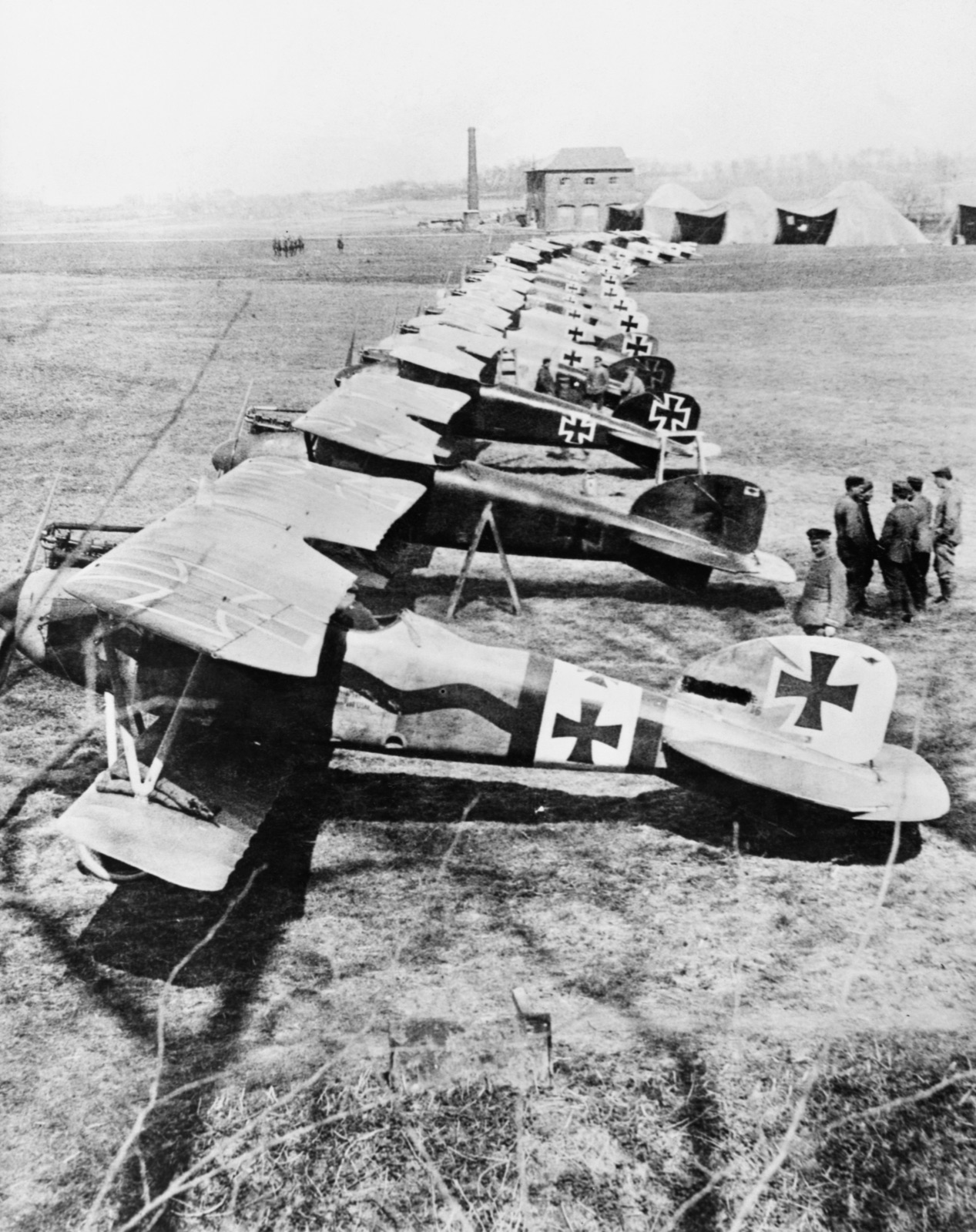
- Richthofen’s red-painted D.III, second in line, with a trestle and step in place
- The V-shaped interplane strut and narrow lower wing, the D.III’s weak point in a steep dive
- Iron Cross on a white square, the national marking before the 1918 straight-sided cross
- Canvas tent hangars of the airfield at La Brayelle, near Douai
- Ground crew and officers beside the line
An ace was a pilot with five or more victories, a French invention the British officially ignored and the newspapers did not. The list below is of credited victories, which are claims accepted at the time by each air service using different rules. German and British totals are not strictly comparable: the RFC counted aircraft driven down “out of control”, the Germans required wreckage or a witness on their side of the lines.
The leading aces
| Manfred von Richthofen | Germany | Luftstreitkräfte | 80 | Killed in action, 21 April 1918 |
| René Fonck | France | Aéronautique Militaire | 75 | Survived |
| Billy Bishop | Canada | RFC / RAF | 72 | Survived |
| Ernst Udet | Germany | Luftstreitkräfte | 62 | Survived |
| Edward “Mick” Mannock | United Kingdom | RFC / RAF | 61 | Killed in action, 26 July 1918 |
| Raymond Collishaw | Canada | RNAS / RAF | 60 | Survived |
| James McCudden | United Kingdom | RFC / RAF | 57 | Killed in a flying accident, 9 July 1918 |
| Andrew Beauchamp-Proctor | South Africa | RFC / RAF | 54 | Survived |
| Erich Löwenhardt | Germany | Luftstreitkräfte | 54 | Killed in a mid-air collision, 10 August 1918 |
| Donald MacLaren | Canada | RFC / RAF | 54 | Survived |
| Georges Guynemer | France | Aéronautique Militaire | 53 | Missing in action, 11 September 1917 |
| William Barker | Canada | RFC / RAF | 50 | Survived |
| Josef Jacobs | Germany | Luftstreitkräfte | 48 | Survived |
| Werner Voss | Germany | Luftstreitkräfte | 48 | Killed in action, 23 September 1917 |
| Robert Little | Australia | RNAS / RAF | 47 | Killed in action, 27 May 1918 |
| Charles Nungesser | France | Aéronautique Militaire | 43 | Survived |
| Lothar von Richthofen | Germany | Luftstreitkräfte | 40 | Survived |
| Willy Coppens | Belgium | Aviation Militaire | 37 | Survived |
| Godwin Brumowski | Austria-Hungary | Luftfahrtruppen | 35 | Survived |
| Francesco Baracca | Italy | Corpo Aeronautico Militare | 34 | Killed in action, 19 June 1918 |
| Eddie Rickenbacker | United States | US Air Service | 26 | Survived |
| Alexander Kazakov | Russia | Imperial Air Service | 20 | Survived the war; killed in a crash, 1 August 1919 |
| Credited victories. Totals for Mannock (61 to 73), Collishaw (60 or 61), Kazakov (20 credited, up to 32 claimed) and Bishop, whose claims have long been questioned, vary by source. | ||||
Source Franks, Bailey & Guest, Above the Lines (1993); Shores, Franks & Guest, Above the Trenches (1990); Franks (2000); Guttman (2002); Chant (2002)
Each nation’s top scorer
credited victoriesIcons show a type each pilot is known to have flown: Richthofen the Dr.I (his last victories and death), Fonck, Baracca and Rickenbacker the SPAD XIII, Bishop and Mannock the S.E.5a. Coppens flew the Hanriot HD.1, Brumowski the Oeffag-built Albatros D.III, Kazakov mainly Nieuports.
Source As the table above
Bombs on Britain
For the first time in centuries the war came to the British home: first by Zeppelin, then by Gotha
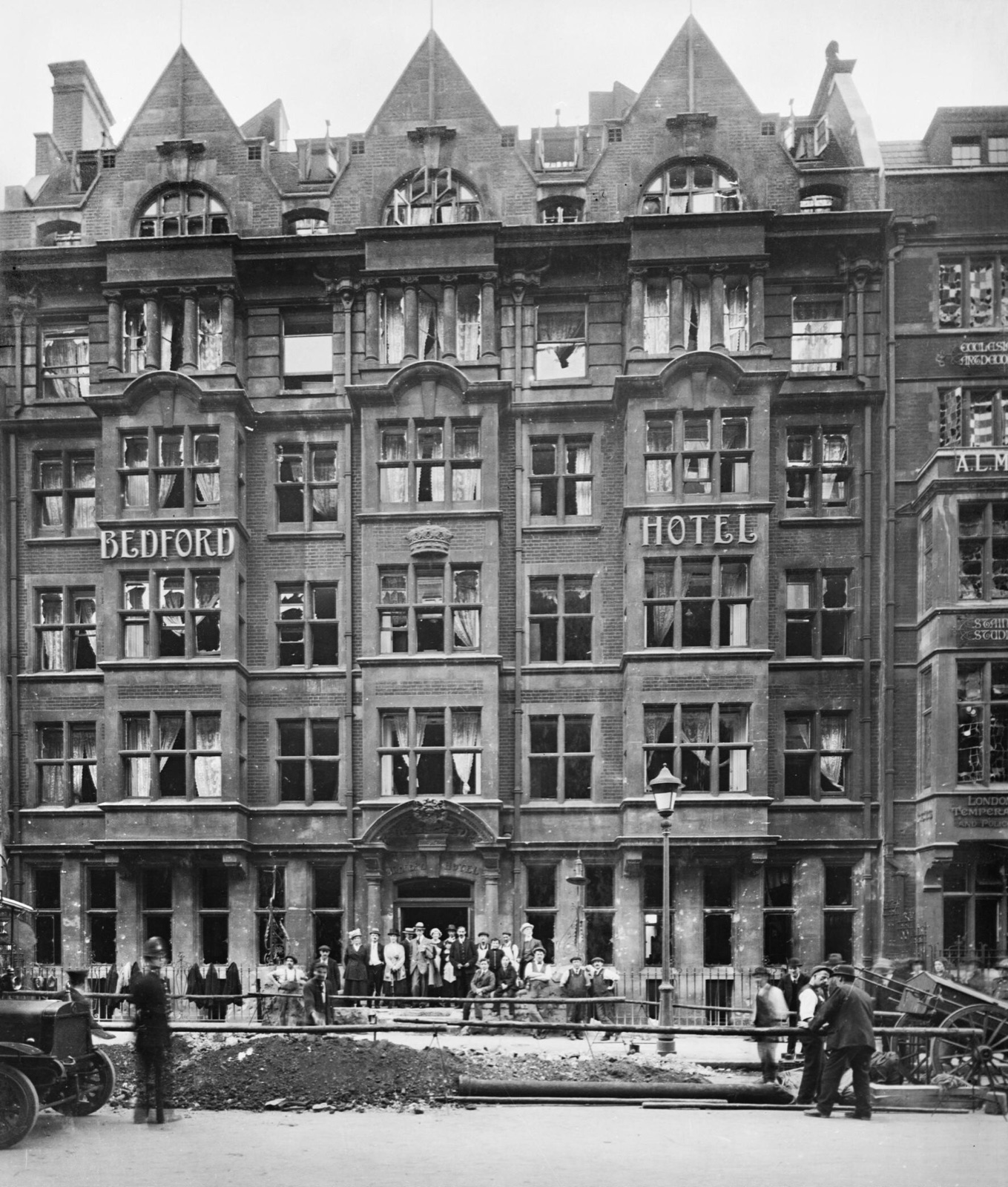
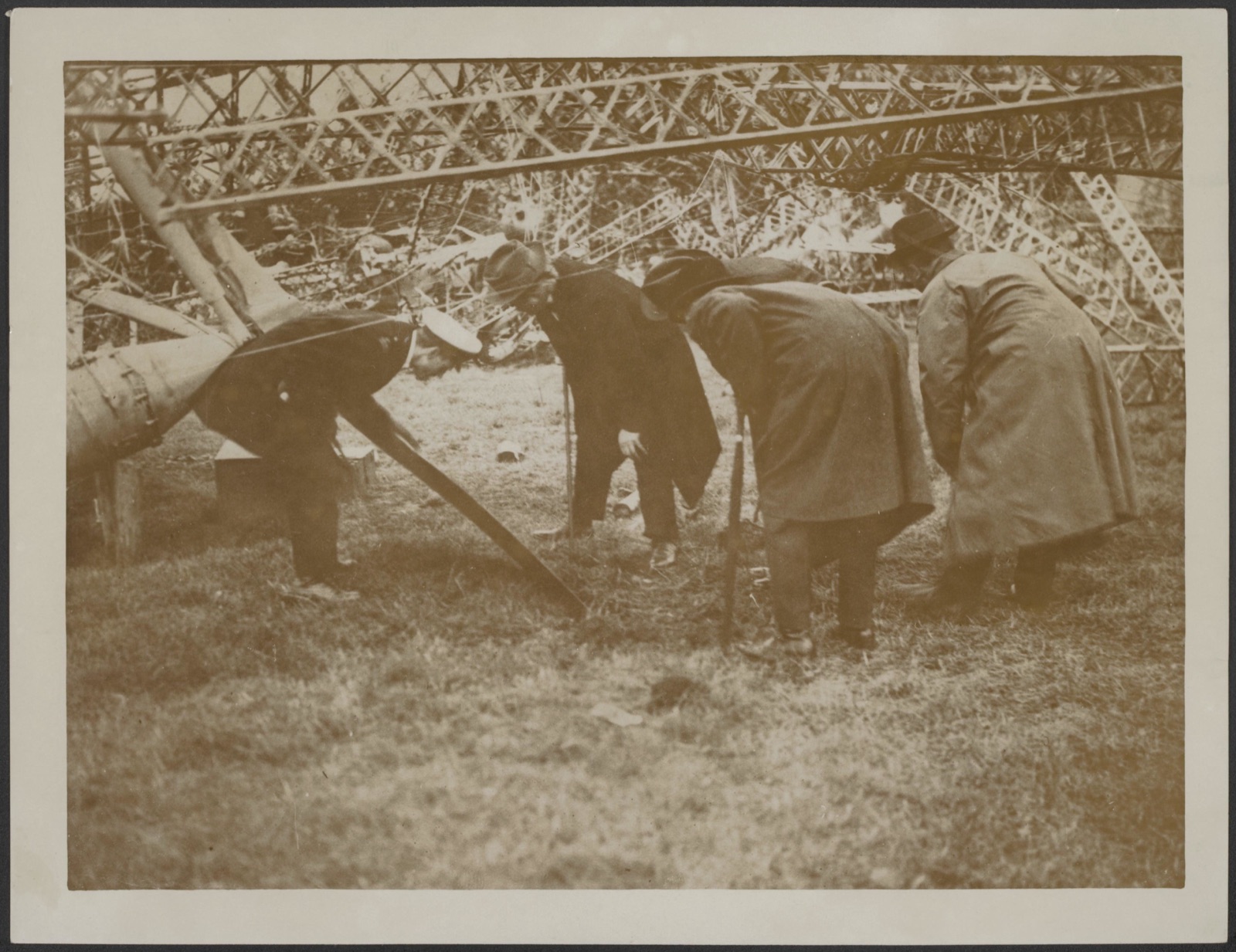
The first airship raid on Britain fell on Great Yarmouth and King’s Lynn on the night of 19–20 January 1915 and killed four people. The airships were vast, slow and at the mercy of the weather, but for a year and a half the defences could barely reach them. Then incendiary and explosive bullets arrived, and airships began to fall in flames over Essex and Hertfordshire. From May 1917 the Gotha twin-engined bombers took over, raiding London in daylight. The deadliest single raid of the war, on 13 June 1917, killed 162 people, eighteen of them children at a school in Poplar.
Killed in air raids on Britain, 1915–1918
people killed= 25 people killed
- Airship raids (51)1,358 injured557
- Aeroplane raids (52)2,058 injured857
Totals of 1,414 killed and 3,416 injured include casualties from falling anti-aircraft shell fragments. Other counts give slightly different airship figures (for example 556 killed).
Source Jones, The War in the Air, vol. V; Cole & Cheesman, The Air Defence of Britain 1914–1918 (1984), p. 449
Raids and raiders lost
Airships dropped 5,806 bombs, about 192 tons, causing £1,527,585 of damage; 84 airships took part, of which 30 were shot down or lost in accidents. Aeroplanes dropped 2,772 bombs weighing 73.5 tons, causing £1,434,526 of damage, for the loss of 62 aircraft: other accounts give 24 Gothas shot down over England and 37 more lost in accidents.
Source Jones, The War in the Air, vol. V, p. 164; Liddell Hart (1934)
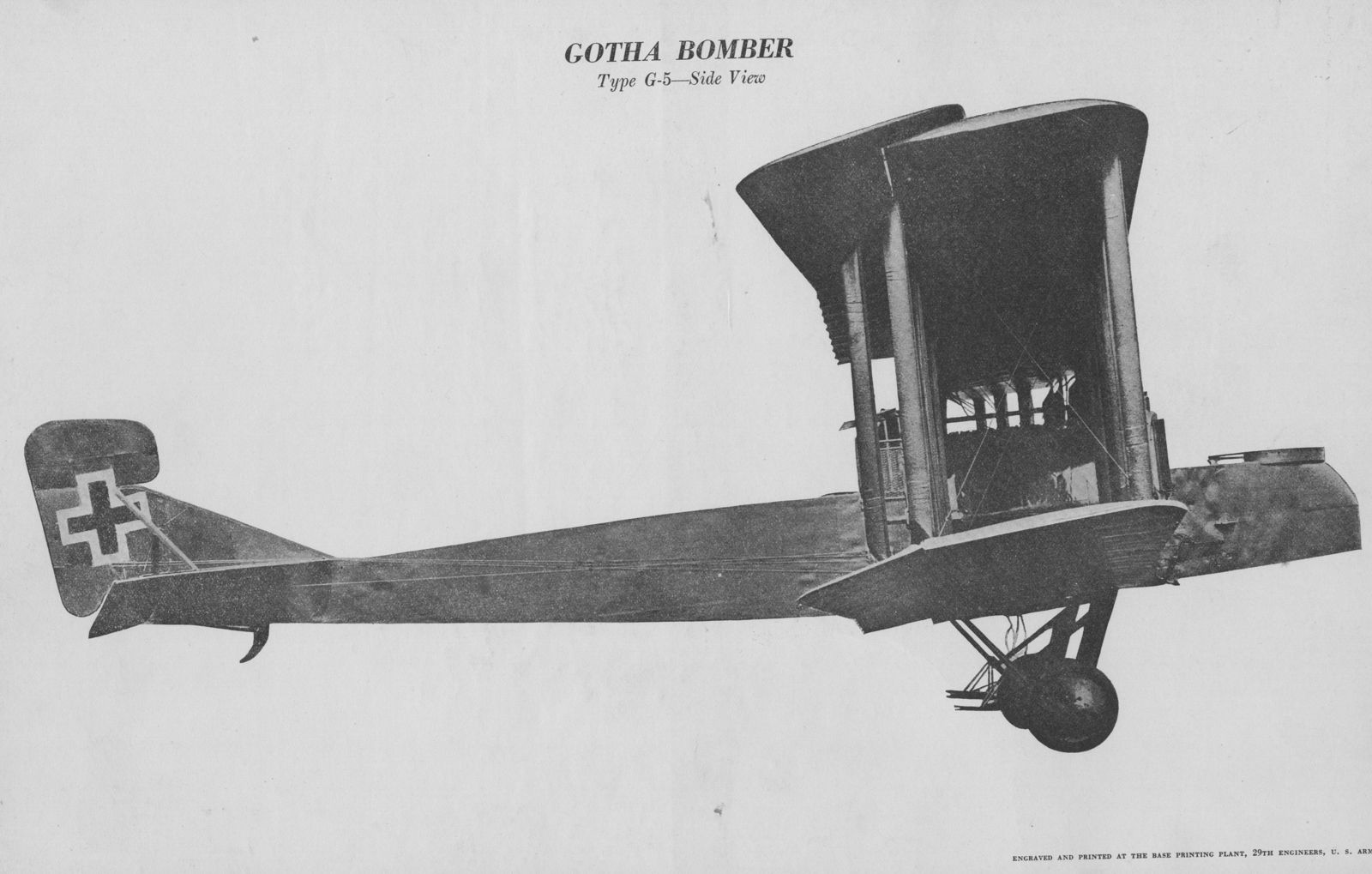
- Upper wing: about 23.7 m (78 ft) of span, a wider spread than a Second World War Blenheim
- Nose gunner’s cockpit; the bomb aimer also worked from the nose
- Main undercarriage. Landing a Gotha at night was so dangerous that more were lost in accidents than to British fighters
- Cross on the fin. Out of sight below the fuselage, a ventral tunnel let the rear gunner fire downwards and back
Some of the worst raids
| 19–20 Jan 1915 | Two Navy Zeppelins | Great Yarmouth, King’s Lynn | 4 | 16 |
| 30–31 May 1915 | Army Zeppelin LZ38 | London, first raid | 7 | 35 |
| 8–9 Sep 1915 | Zeppelin L13 (Mathy) | City of London | 22 | 87 |
| 13–14 Oct 1915 | Five Navy Zeppelins | London “Theatreland”, Kent, Hertford | 71 | 128 |
| 31 Jan–1 Feb 1916 | Nine Navy Zeppelins | Black Country (aimed at Liverpool) | 61 | 101 |
| 25 May 1917 | Gothas, daylight | Folkestone and Shorncliffe | 95 | 195 |
| 13 Jun 1917 | Gothas, daylight | London, East End and City | 162 | 432 |
| 28–29 Jan 1918 | Gothas and Giants | London, Odhams works shelter | 67 | 166 |
| 19–20 May 1918 | 38 Gothas, 3 Giants | London, last aeroplane raid | 49 | 177 |
| The 8–9 September 1915 raid did £534,287 of damage, more than a sixth of all the bomb damage of the war. The Folkestone raid also killed 17 Canadian soldiers at Shorncliffe and Cheriton camps; counts differ on whether they are in the 95. | ||||
Source Cole & Cheesman (1984); Jones (2009); Fredette, The Sky on Fire (1976); Hyde (2012), via German bombing of Britain, 1914–1918 (Wikipedia)
The air war, 1914–1918
RFC squadrons fly to France (13 August); first British aircraft lost to enemy fire, an Avro 504 of 5 Squadron (22 August)
Frantz and Quénault make the first air-to-air kill with a machine gun (5 October)
First Zeppelin raid on Britain: Great Yarmouth and King’s Lynn (19–20 January)
4Immelmann’s first victory in a Fokker Eindecker (1 August): the “Fokker Scourge” begins
Leefe Robinson shoots down SL11 over Cuffley, the first German airship brought down on British soil (2–3 September)
“Bloody April” over Arras: at least 245 RFC aircraft lost
245Gothas bomb London in daylight; 162 killed (13 June)
162RFC and RNAS merge to form the Royal Air Force (1 April); Richthofen killed (21 April)
Last and largest aeroplane raid on London (19–20 May)
49Last Zeppelin raid: L70 shot down off Norfolk with Peter Strasser aboard (5 August)
Armistice: the RAF has 291,170 people and over 22,000 aircraft (11 November)
Source Royal Flying Corps; Bloody April; German bombing of Britain, 1914–1918 (Wikipedia and sources cited there)
The cost
Myths about life expectancy and training deaths are repeated everywhere. The records tell a grim enough story without them
The best single run of British figures is an Air Ministry casualty return covering August 1914 to October 1918, compiled for the Canadian official history. It counts 16,261 RFC and RAF casualties: 8,355 killed or missing, 6,813 wounded or injured and 1,093 taken prisoner or interned. More than half of them fell in 1918, when the air war was at its largest and the RAF was fighting every day over the retreat and then the advance.
RFC and RAF casualties by year
casualties- Killed & missing
- Wounded & injured
- Prisoner & interned
- 2,5032,369
- 5,1053,690
Wise’s printed table gives 1917 killed and missing as 2,053, an evident transposition: the row and column totals require 2,503. The 1918 prisoner count is low because many listed as missing in the last weeks later turned up as prisoners. A fuller return gave 8,136 killed, died or presumed dead and 7,245 wounded and injured. The return covers the RFC and RAF; RNAS casualties before April 1918 are probably not included.
Source “Casualties, RFC–RAF, August 1914–Oct. 1918”, AIR 1/39/1517, tabulated in Wise, Canadian Airmen and the First World War (1980), Appendix C, Table 25
What happened to 16,261 British air service casualties
casualties- 51% Killed or missing 8,355
- 42% Wounded or injured 6,813
- 7% Prisoner or interned 1,093
Source AIR 1/39/1517, via Wise (1980)
Source Winter (1982); Jones (1937); Hobson, Airmen Died in the Great War (1995); Hart (2005); Corum (2022); RAF Museum
The heavens are their battlefield. They are the Cavalry of the Clouds.
David Lloyd George, House of Commons, 29 October 1917
What survives
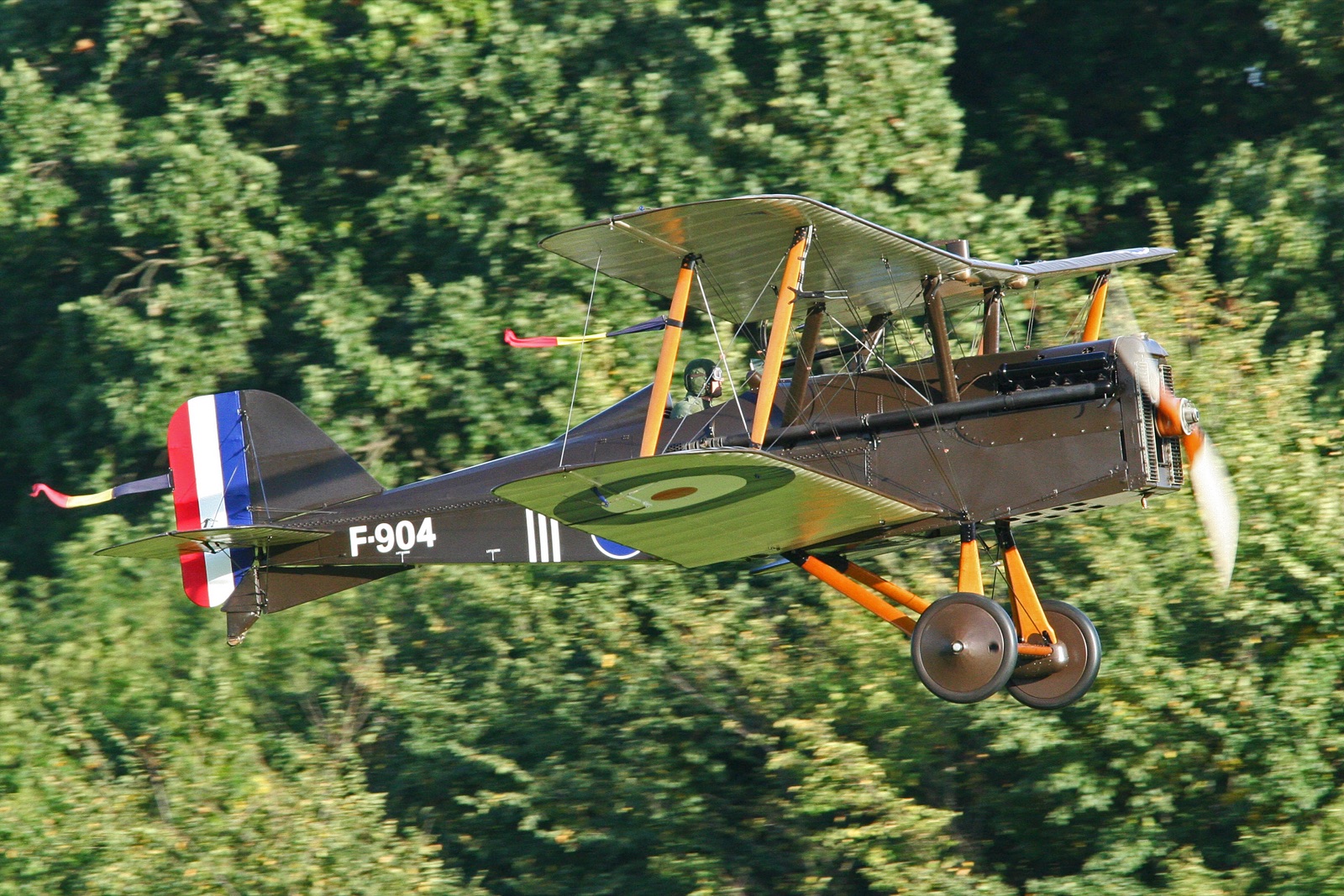
Of the tens of thousands built, only a handful of originals remain. A few still fly
Wood, linen and wire do not last, and most First World War aircraft were burnt, scrapped or sold off for a few pounds in 1919. The survivors are precious. The lineup below puts twelve of the Gazetteer’s own Great War models side by side at true scale, with a Spitfire, built twenty years after the Armistice, for comparison. The trainer that taught most of the RFC to fly, the Avro 504, is longer than either fighter, and a Fokker triplane is barely half as long as a Spitfire is wide.
The Great War at one scale
drawn to one scale-
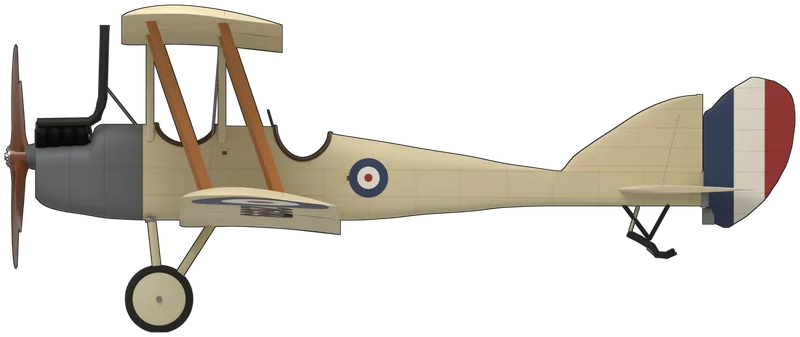 Royal Aircraft Factory B.E.2c 8.3 m · The RFC’s workhorse of 1914–16; about 3,500 B.E.2s of all versions built
 -
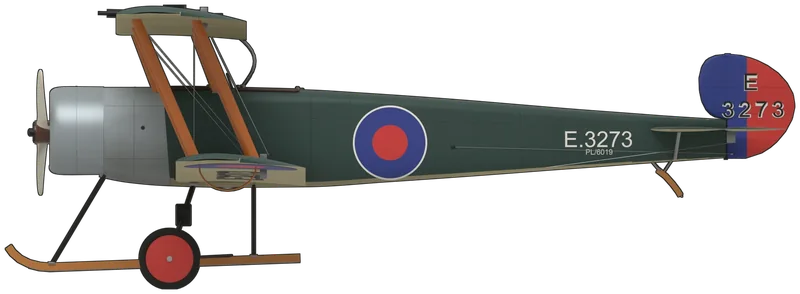 Avro 504K 9.0 m · Trainer to a generation: 8,970 built during the war, more than 10,000 in all
 -
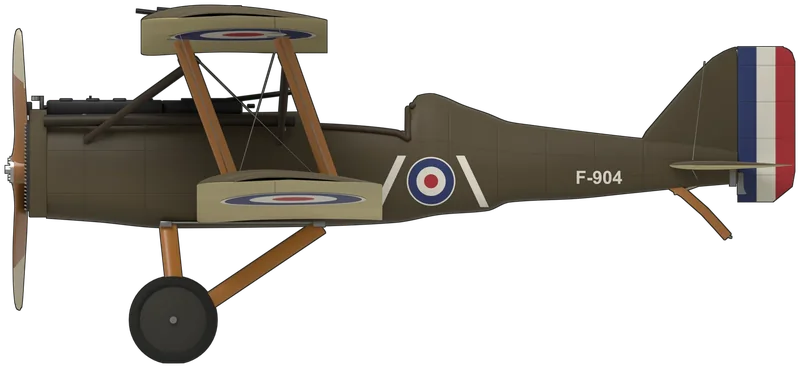 Royal Aircraft Factory S.E.5a 6.4 m · 5,205 built
 -
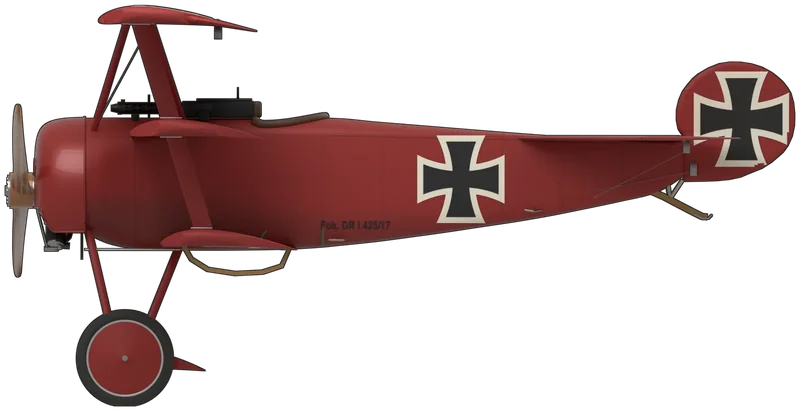 Fokker Dr.I 5.8 m · 320 built
 -
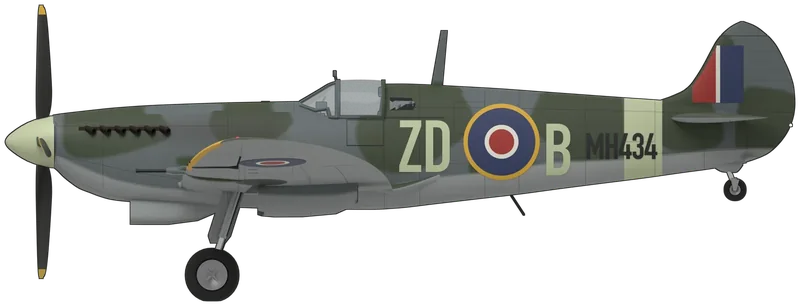 Supermarine Spitfire Mk I (1938) 9.5 m · For scale: the next war’s fighter
 -
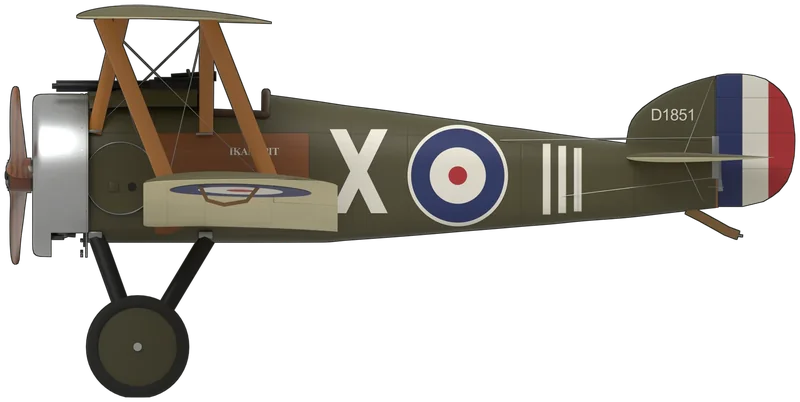 Sopwith Camel F.1 5.7 m
 -
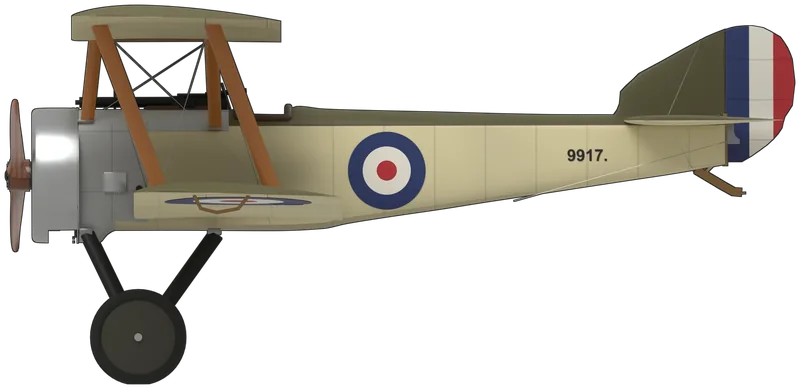 Sopwith Pup 5.9 m
 -
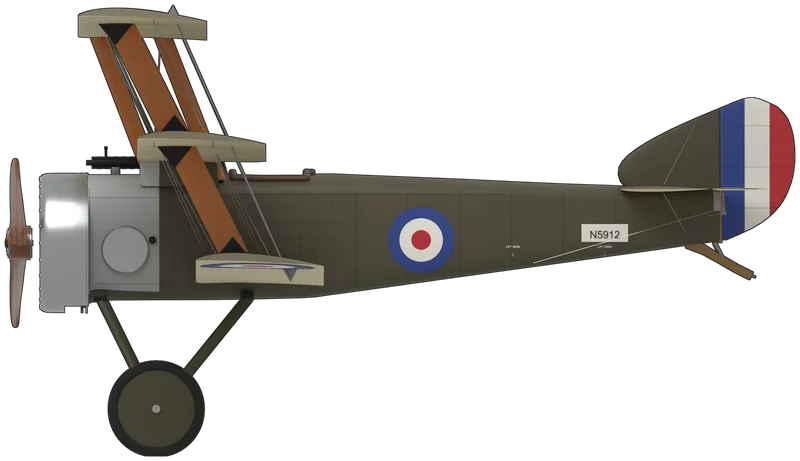 Sopwith Triplane 5.7 m
 -
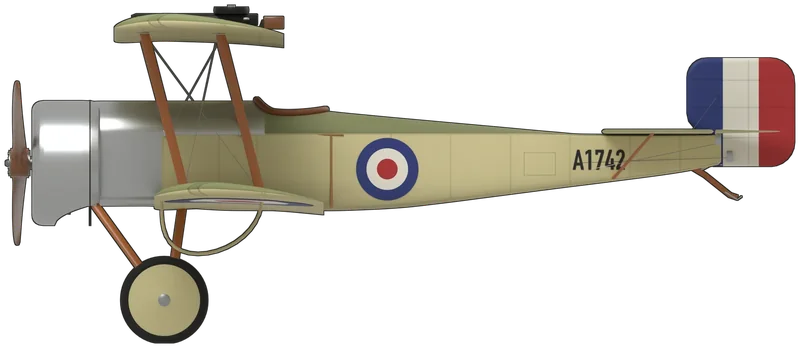 Bristol Scout D 6.3 m
 -
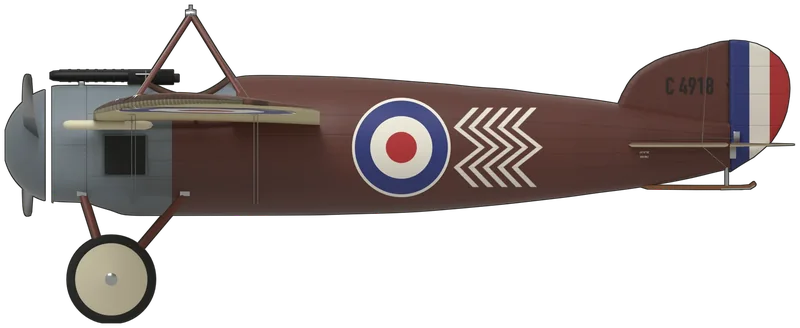 Bristol M.1C 6.2 m
 -
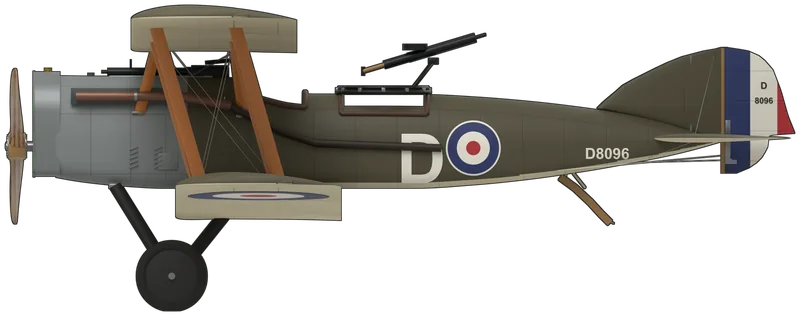 Bristol F.2B Fighter 7.9 m
 -
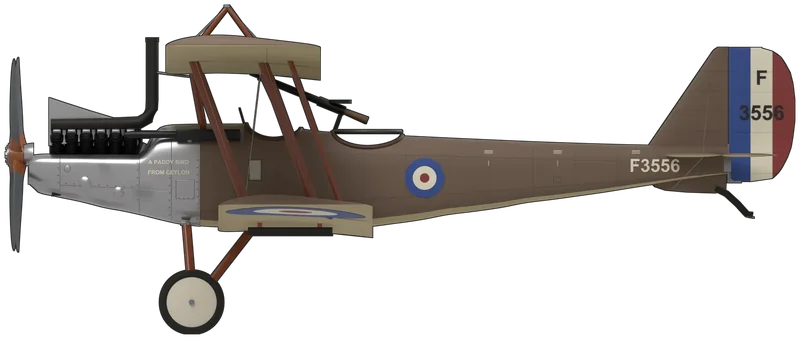 RAF R.E.8 8.5 m
 -
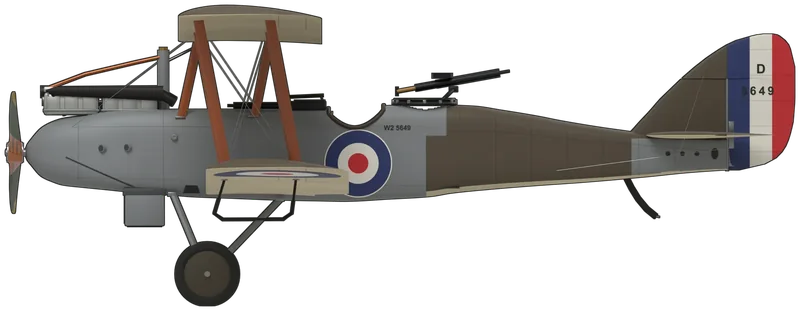 Airco DH.9 9.3 m
On the apron: the 1914–18 collection
live 3D, true scaleDrag to walk round · pinch or buttons to zoom
- B.E.2c 8.3 m long, 11.3 m span
- Avro 504K 9.0 m long, 11.0 m span
- S.E.5a 6.4 m long, 8.1 m span
- Fokker Dr.I 5.8 m long, 7.2 m span
- Sopwith Camel F.1 5.7 m long, 8.5 m span
- Sopwith Pup 5.9 m long, 8.1 m span
- Sopwith Triplane 5.7 m long, 8.1 m span
- Bristol Scout D 6.3 m long, 7.5 m span
- Bristol M.1C 6.2 m long, 9.4 m span
- Bristol F.2B Fighter 7.9 m long, 12.0 m span
- RAF R.E.8 8.5 m long, 13.0 m span
- Airco DH.9 9.3 m long, 12.9 m span
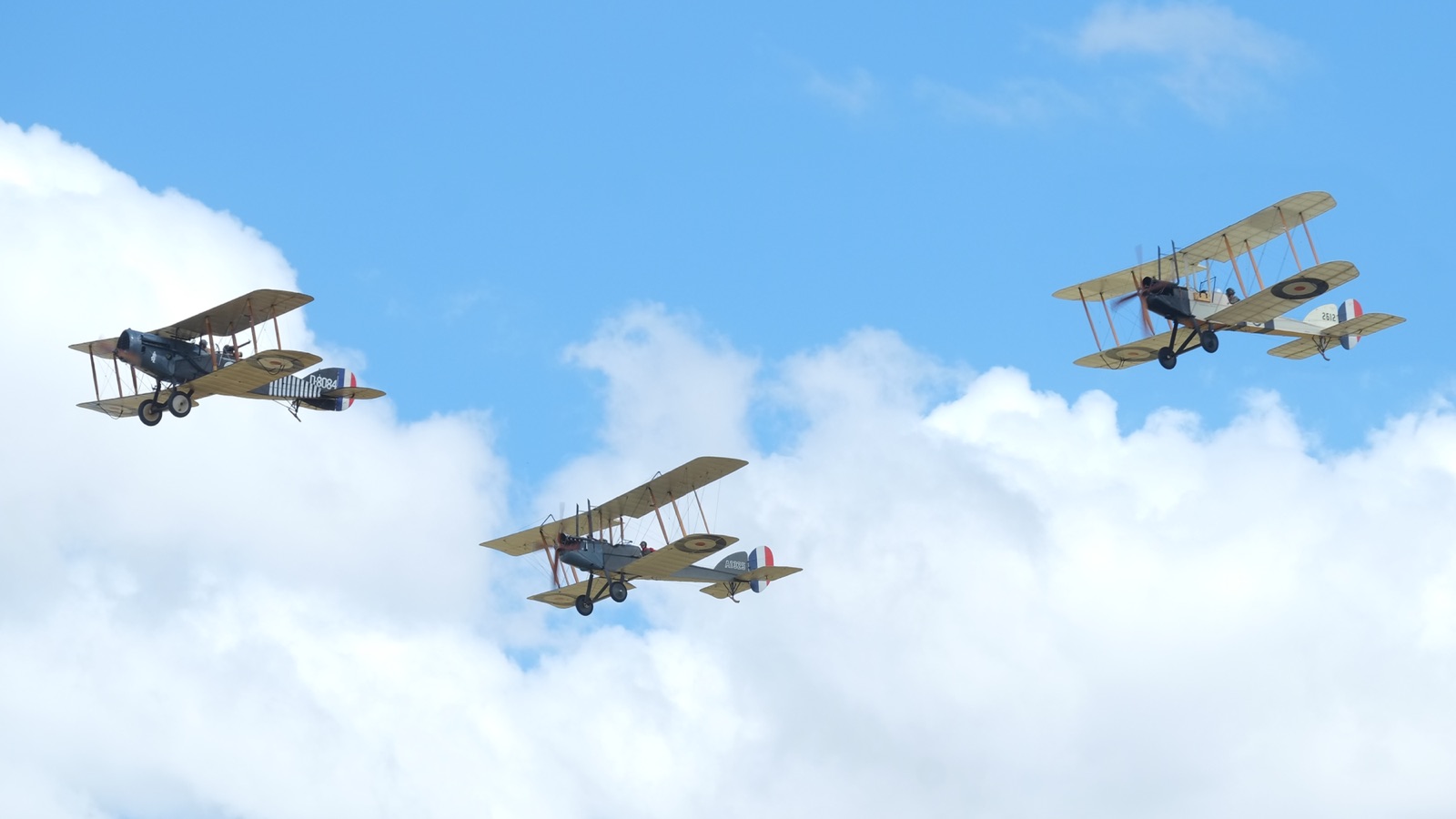
- Bristol F.2B, an original airframe painted as D8084
- B.E.2f, rebuilt from an original wartime aircraft
- B.E.2c reproduction marked 2612, built by The Vintage Aviator
Where to see them in Britain
in British museumsMany of these are reproductions or rebuilds; the Gazetteer’s compendium notes which.
Sources
- The Aerodrome, WWI aircraft statistics (production and strength tables, unattributed there; usually credited to Angelucci, The Illustrated Encyclopedia of Military Aircraft)
- Ellis & Cox, The World War I Databook (1993), aircraft production by year, via TheWorldWars.net
- Jones, The War in the Air, vols III and V and Appendices (Clarendon Press, 1931–37)
- Wise, Canadian Airmen and the First World War (Official History of the RCAF, vol. I, 1980), Appendix C
- Cole & Cheesman, The Air Defence of Britain 1914–1918 (Putnam, 1984)
- German bombing of Britain, 1914–1918 (Wikipedia, citing Jones, Cole & Cheesman, Fredette and Hyde)
- Hart, Bloody April: Slaughter in the Skies over Arras, 1917 (2005); Corum, Bloody April 1917 (Osprey, 2022); Franks, Guest & Bailey, Bloody April… Black September (2017), via Bloody April (Wikipedia)
- Franks, Bailey & Guest, Above the Lines (1993); Shores, Franks & Guest, Above the Trenches (1990), via List of World War I aces credited with 20 or more victories
- Bruce, British Aeroplanes 1914–18 (Putnam, 1957)
- Loftin, Quest for Performance: The Evolution of Modern Aircraft (NASA SP-468, 1985)
- Western Front Association, Amongst the First to Fall: Early Casualties of the Royal Flying Corps in August 1914
- Historic England, 100 Years of the Royal Air Force (2018)
- Royal Air Force Museum, First World War flying training
- Personnel numbers in the Royal Air Force (Wikipedia, citing Fowler et al., RAF Records in the PRO, 1994)
- Roskill (ed.), Documents Relating to the Naval Air Service, 1908–1918 (Navy Records Society, 1969), via Royal Naval Air Service (Wikipedia)
- Great War Forum, RFC/RNAS/RAF training deaths 100 years on (discussion of Winter’s figures, Hobson’s Airmen Died and the official appendix)
- Lloyd George Society, “The Cavalry of the Clouds”: David Lloyd George and the formation of the Royal Air Force
- Historic England, First World War aircraft factories
Photographs
- Officers of No. 1 Squadron, RAF, with their S.E.5as at Clairmarais, near Ypres, — David McLellan, official photographer (IWM), Public domain (expired Crown Copyright) · source
- S.E.5as of No. 32 Squadron at Humières, near St Pol, 6 April 1918. The censor sc — David McLellan, official photographer (IWM Q 12010), Public domain (expired Crown Copyright) · source
- Albatros D.IIIs of Jasta 11 and Jasta 4 at La Brayelle, near Douai, in the sprin — German official photographer (IWM Q 50328), Public domain · source
- A Gotha G.V, from an American Expeditionary Forces recognition sheet, November 1 — 2nd Section, General Staff, AEF (US National Archives 17342189), Public domain (US federal work) · source
- The Bedford Hotel, Southampton Row, after a 50 kg bomb fell in the street during — Home Office photographer (IWM HO 102), Public domain (expired Crown Copyright) · source
- Lloyd George and Balfour among visitors examining the wreck of one of the two Ze — Nationaal Archief, Netherlands (158-2581), CC0 · source
- An original Bristol F.2B, a B.E.2f rebuilt from original parts, and a B.E.2c rep — Pseudopanax, Public domain · source
- The Shuttleworth Collection’s S.E.5a F904, a genuine 1918 airframe, displaying a — Alan Wilson, CC BY-SA 2.0 · source
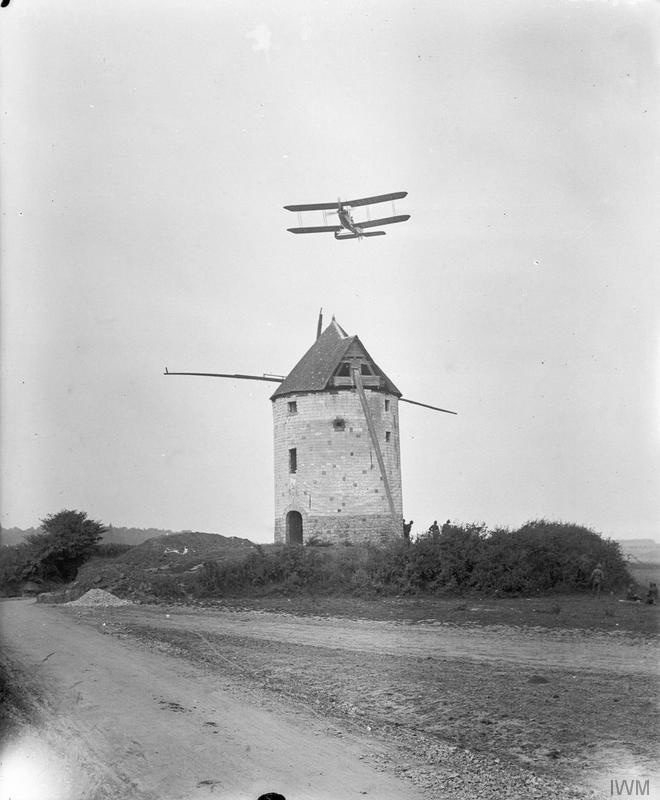
- A B.E.2c over the mill at Franvillers during the Somme battle, 25 August 1916. S — John Warwick Brooke, official photographer (IWM Q 4153), Public domain (expired Crown Copyright) · source
Figures are drawn from the sources above; where they disagree the most widely cited figure is used and the range is given in the notes. Side profiles and 3D models are the gazetteer’s own procedural models, drawn to scale from published dimensions. Spotted an error? Tell us.