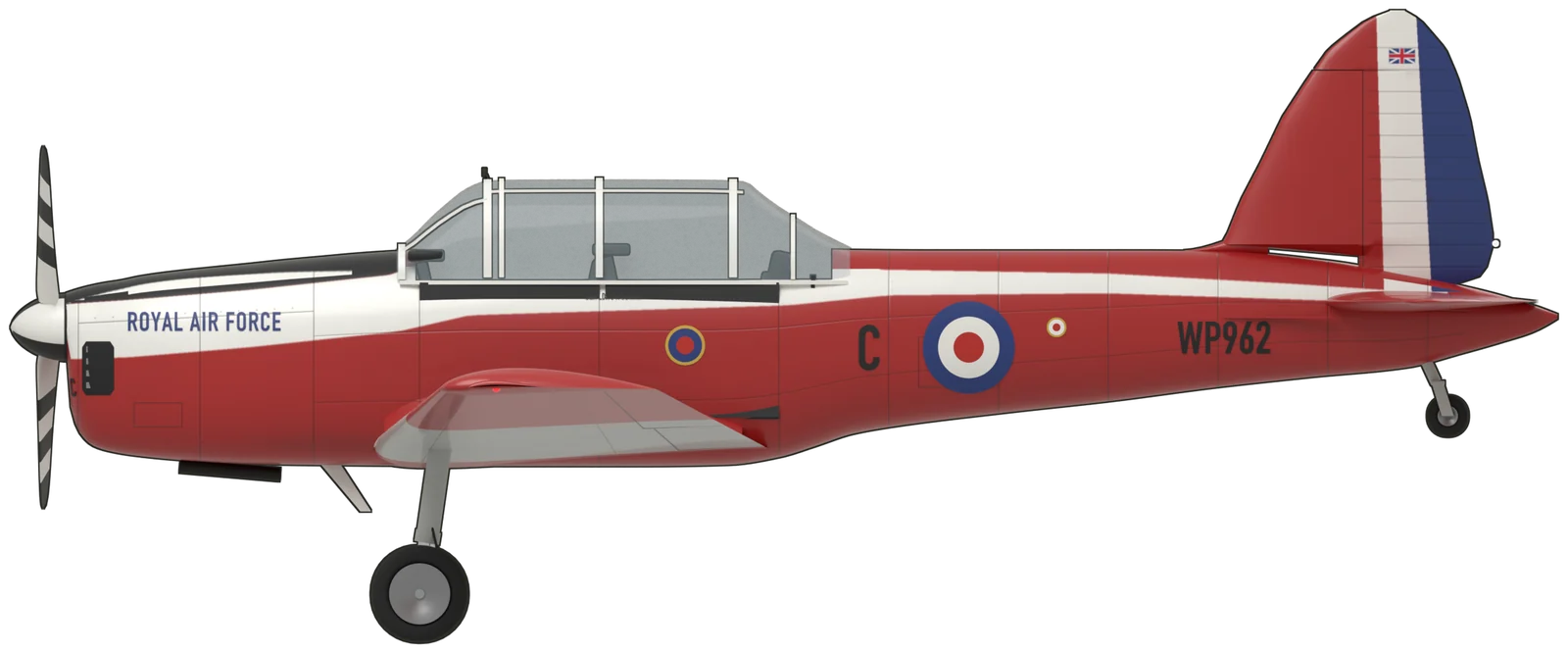
3D model
Turn it over
A procedural model built in Blender from published dimensions, drawings and photographs, painted as WP962 'C' in the red and white trainer scheme it wears at the RAF Museum, London. Drag to orbit, scroll or pinch to zoom · download .glb (857 KB)
History
The Chipmunk
The Chipmunk was the first aircraft designed by de Havilland’s Canadian company. Its chief designer, the Polish engineer Wsiewołod Jakimiuk, drew a neat all-metal, low-winged two-seater with a tailwheel and a sliding canopy to replace the Tiger Moth, and the prototype first flew at Downsview, Toronto, on 22 May 1946.
The RAF chose it as its standard primary trainer. De Havilland built the T.10 in England, at Hatfield and at Broughton near Chester, and from 1950 it taught pilots with the University Air Squadrons and the reserve flying schools. Later, the Air Experience Flights gave thousands of air cadets their first flights in it. Prince Philip and Prince Charles both learned to fly in Chipmunks.
Canada, Britain and Portugal built 1,283 between them. The Bulldog took over most of its RAF work in the 1970s, but Chipmunks flew with the Air Experience Flights until 1996 and with the Army until 1997. The Battle of Britain Memorial Flight still flies them to keep its pilots in practice on tailwheel aircraft.
This airframe
T.10 WP962
WP962 was built at Broughton in 1952 and stood in the line of training aircraft at the Coronation Review at Odiham in July 1953. It served No. 3 Air Experience Flight at Filton for thirty years, then No. 5 AEF at Cambridge as “C”. In 1997, flown mostly by Squadron Leader Tony Cowan, whose name it carries, it led Exercise Northern Venture: two Chipmunks flew round the Northern Hemisphere, across Russia, Alaska, Canada and Greenland, in 64 days. It made its last flight in February 1998 and has been on display at the RAF Museum in London since May 2000.
Where to see one
In the gazetteer
The gazetteer records the Chipmunk in 8 UK collections. The airframe modelled here is marked.