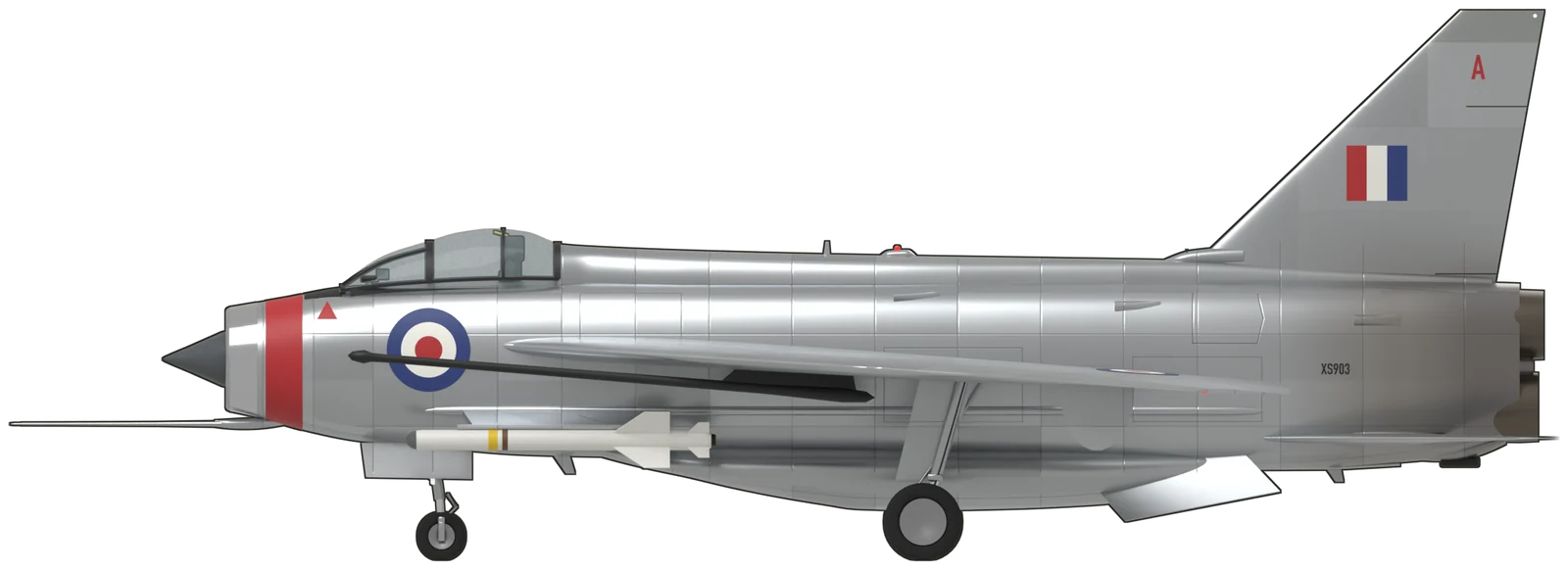
3D model
Turn it over
A procedural model built in Blender from published dimensions, drawings and photographs, painted as XS903 'A' of No. 5 Squadron in 1968. Drag to orbit, scroll or pinch to zoom · download .glb (1.0 MB)
History
The Lightning
The Lightning was built to climb. English Electric stacked two Rolls-Royce Avons one above the other in a deep, narrow fuselage, swept the wing back 60 degrees and fed the engines through a nose intake split around a radar cone. The P.1A research aircraft first flew in August 1954, and the Lightning became Britain’s only home-grown Mach 2 fighter.
It entered service in 1960 as a point-defence interceptor, meant to reach Soviet bombers before they reached Britain. Its rate of climb was astonishing and its fuel endurance famously short, and pilots loved it.
The F.6 added a much larger ventral tank and a cambered wing leading edge. Lightnings intercepted Soviet aircraft over the North Sea until the last squadrons stood down at Binbrook in 1988.
This airframe
F.6 XS903
XS903 first flew in August 1966 and joined No. 5 Squadron at Binbrook, flying as “A” in natural metal with a red nose band. It later served with No. 11 Squadron and was flown into Elvington in May 1988 for preservation at the Yorkshire Air Museum.
Where to see one
In the gazetteer
The gazetteer records the Lightning in 14 UK collections. The airframe modelled here is marked.
- Boscombe Down Aviation Collection
- Bournemouth Aviation Museum
- Gatwick Aviation Museum
- IWM Duxford
- Midland Air Museum
- Morayvia
- National Museum Of Flight
- Newark Air Museum
- Norfolk and Suffolk Aviation Museum
- Royal Air Force Museum London
- Royal Air Force Museum Midlands
- Solway Aviation Museum
- Tangmere Military Aviation Museum
- Yorkshire Air Museum