3D model
Turn it over
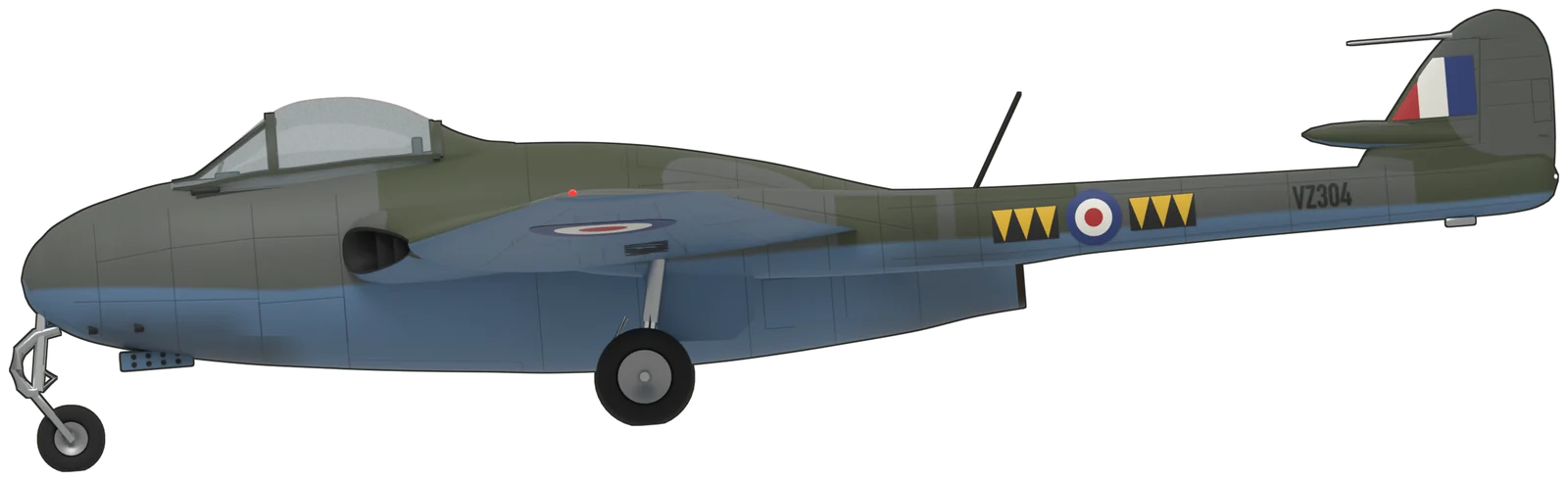
A procedural model built in Blender from published dimensions, drawings and photographs, painted as VZ304 in early-1950s day-fighter camouflage. Drag to orbit, scroll or pinch to zoom · download .glb (1002 KB)
History
The Vampire
Early jet engines were so feeble that every foot of tailpipe wasted precious thrust. de Havilland’s answer was to put the Goblin in a short central nacelle and carry the tail on two slim booms, which kept the jet pipe short and gave the Vampire its unmistakable shape. The prototype flew in September 1943, too late for the war, and the Vampire became the RAF’s second jet fighter.
On 3 December 1945 a Sea Vampire flown by Lieutenant Commander Eric “Winkle” Brown made the first landing by a pure jet aircraft on a carrier, HMS Ocean. Vampires set altitude records, flew the Atlantic and served with around thirty air forces, many of them building their own.
The FB.5 modelled here was the fighter-bomber, with clipped, strengthened wings and underwing stores. Its side-by-side two-seat cousin, the T.11, trained a generation of RAF jet pilots, which is a large part of why the Vampire is the most widely preserved type in the gazetteer.
This airframe
FB.5 VZ304
The model wears the early-1950s day-fighter scheme of VZ304 as it was photographed preserved at Duxford in 1983: Dark Green and Dark Sea Grey over PRU Blue, with bright Type D roundels and yellow-and-black unit bars either side of the boom roundels.
Where to see one
In the gazetteer
The gazetteer records the Vampire in 17 UK collections.
- Bournemouth Aviation Museum
- De Havilland Aircraft Museum
- Fleet Air Arm Museum
- IWM Duxford
- Midland Air Museum
- Montrose Air Station Museum
- Morayvia
- National Museum Of Flight
- Newark Air Museum
- Norfolk and Suffolk Aviation Museum
- Royal Air Force Museum London
- Solent Sky
- Solway Aviation Museum
- South Wales Aviation Museum
- Tangmere Military Aviation Museum
- Ulster Aviation Society (Maze Long Kesh)
- Yorkshire Air Museum