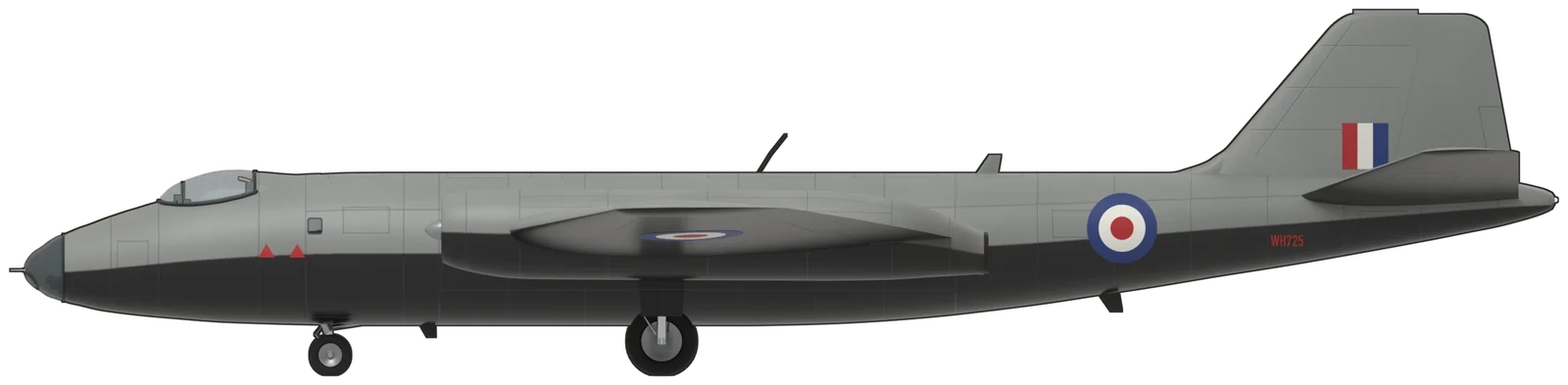
3D model
Turn it over
A procedural model built in Blender from published dimensions, drawings and photographs, painted as WH725 of No. 50 Squadron in 1953. Drag to orbit, scroll or pinch to zoom · download .glb (1.0 MB)
History
The Canberra
Britain’s first jet bomber came from English Electric, a company better known for trams and power stations, and from its chief designer W.E.W. “Teddy” Petter. Roland Beamont first flew the prototype in May 1949, and its broad, nearly unswept wing let it fly higher than the fighters of its day.
In February 1951 a Canberra made the first unrefuelled transatlantic crossing by a jet. The United States built it under licence as the Martin B-57, one of very few foreign designs ever adopted by the USAF, and more than a dozen air forces flew it.
In RAF service it went from nuclear bomber to interdictor to reconnaissance platform, and the last PR.9s retired in 2006, fifty-five years after the type entered service.
This airframe
B.2 WH725
WH725 is shown as delivered to No. 50 Squadron in 1953, in Medium Sea Grey over gloss black with Type D roundels and a red serial. It is preserved at IWM Duxford, where it is now displayed in High Speed Silver.
Where to see one
In the gazetteer
The gazetteer records the Canberra in 14 UK collections. The airframe modelled here is marked.
- Avro Heritage Museum
- Boscombe Down Aviation Collection
- Bournemouth Aviation Museum
- Gatwick Aviation Museum
- Midland Air Museum
- Newark Air Museum
- Norfolk and Suffolk Aviation Museum
- Royal Air Force Museum London
- Royal Air Force Museum Midlands
- Solway Aviation Museum
- South Wales Aviation Museum
- Tangmere Military Aviation Museum
- Ulster Aviation Society (Maze Long Kesh)
- Yorkshire Air Museum