3D model
Turn it over
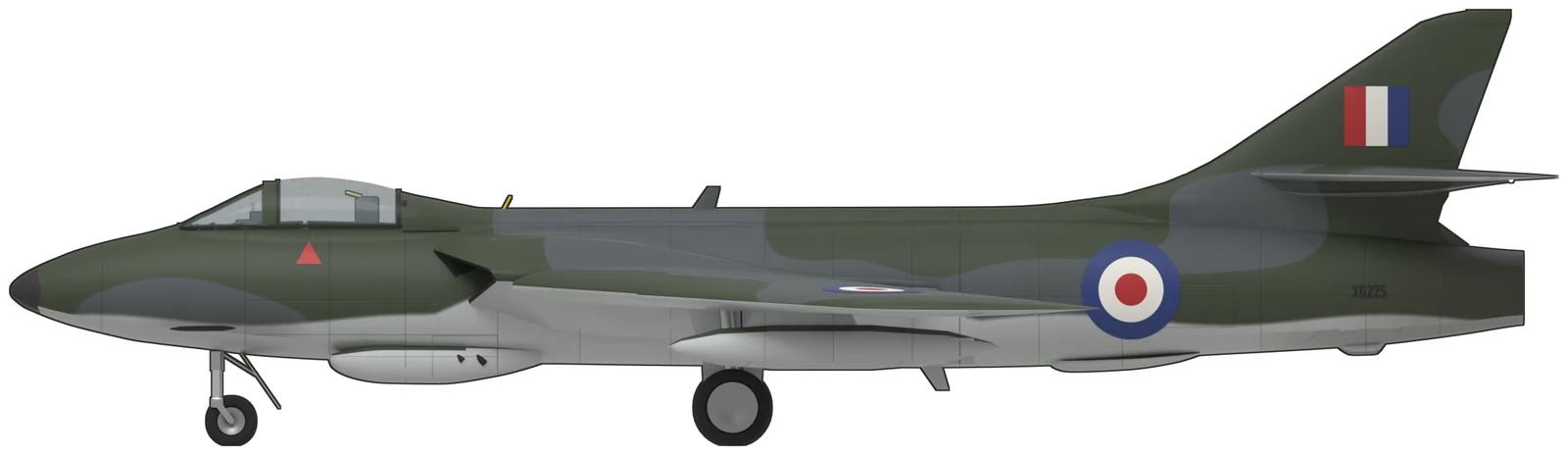
A procedural model built in Blender from published dimensions, drawings and photographs, painted as XG225 in the 1960s RAF day-fighter scheme. Drag to orbit, scroll or pinch to zoom · download .glb (1.1 MB)
History
The Hunter
Sydney Camm’s Hunter is often called the most beautiful jet fighter Britain ever built. The prototype first flew in July 1951 with Neville Duke at the controls, and in September 1953 Duke took a modified Hunter, WB188, to a world air speed record of 727.6 mph.
Early Hunters had their troubles, including engines that surged when the guns fired, but the F.6 of 1956, with the more powerful Avon 200 series and a dog-tooth wing leading edge, became the definitive RAF day fighter. In 1958 the Black Arrows of No. 111 Squadron looped twenty-two Hunters in formation at Farnborough.
Nearly 2,000 were built, and more than twenty air forces flew them, some well into the twenty-first century. The four Aden cannon sat in a single pack that dropped out of the belly for rearming.
This airframe
F.6 XG225
The model wears the 1950s RAF day-fighter finish of F.6 XG225: Dark Green and Dark Sea Grey disruptive camouflage over High Speed Silver, with Type D roundels.
Where to see one
In the gazetteer
The gazetteer records the Hunter in 14 UK collections.
- Boscombe Down Aviation Collection
- Bournemouth Aviation Museum
- Gatwick Aviation Museum
- IWM Duxford
- Midland Air Museum
- Montrose Air Station Museum
- Morayvia
- Newark Air Museum
- Norfolk and Suffolk Aviation Museum
- Royal Air Force Museum Midlands
- Solway Aviation Museum
- South Wales Aviation Museum
- Tangmere Military Aviation Museum
- Yorkshire Air Museum