3D model
Turn it over
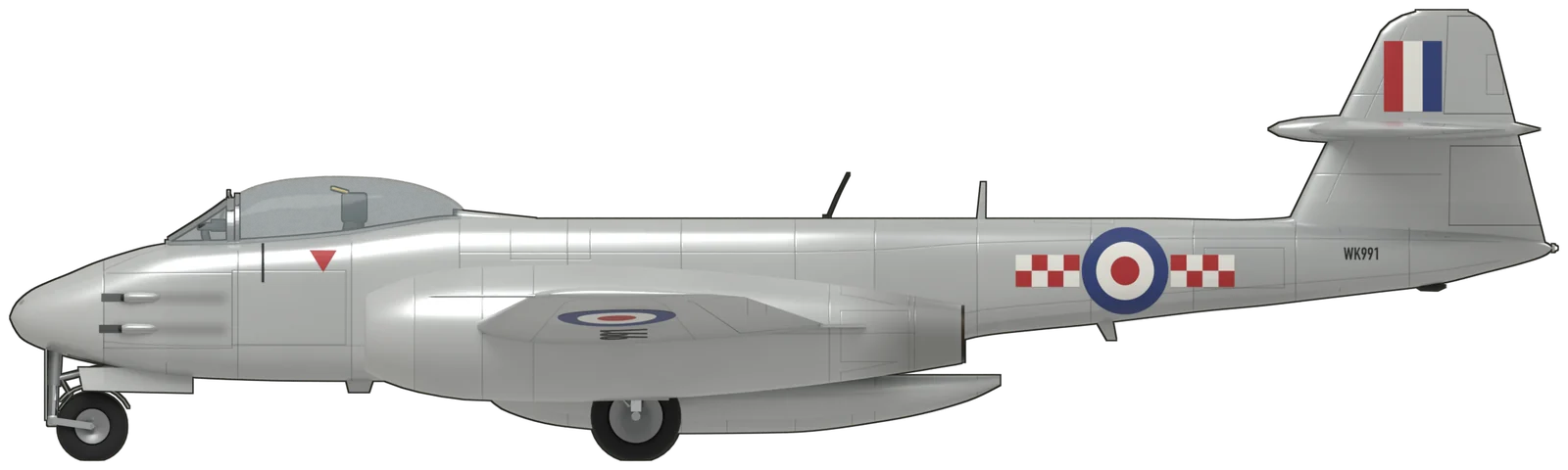
A procedural model built in Blender from published dimensions, drawings and photographs, painted as WK991 in No. 56 Squadron markings, c.1953. Drag to orbit, scroll or pinch to zoom · download .glb (1.0 MB)
History
The Meteor
Gloster’s Meteor was the only Allied jet fighter to see operational service in the Second World War. Frank Whittle’s early engines were too weak for one to do the job, so George Carter’s design used two, slung in the wings. The first Meteor flew in March 1943, and in July 1944 No. 616 Squadron took it into action against V-1 flying bombs.
After the war Meteors twice raised the world air speed record, in 1945 and 1946, and became the backbone of RAF Fighter Command, with export and licence-built examples serving a dozen air forces. The F.8 of 1948 had a longer fuselage, a taller tail, a clear blown canopy and a Martin-Baker ejection seat.
When the Hunter replaced it, later marks carried on as night fighters, trainers, target tugs and drones. A handful still fly with Martin-Baker as ejection-seat test beds.
This airframe
F.8 WK991
WK991 is preserved at IWM Duxford in the High Speed Silver of a 1950s Fighter Command day fighter, with the red-and-white chequers of No. 56 Squadron and the ventral tank it is displayed with.
Where to see one
In the gazetteer
The gazetteer records the Meteor in 14 UK collections. The airframe modelled here is marked.
- Bournemouth Aviation Museum
- Gatwick Aviation Museum
- IWM Duxford
- Midland Air Museum
- Montrose Air Station Museum
- Newark Air Museum
- Norfolk and Suffolk Aviation Museum
- Royal Air Force Museum London
- Royal Air Force Museum Midlands
- Solway Aviation Museum
- South Wales Aviation Museum
- Tangmere Military Aviation Museum
- Ulster Aviation Society (Maze Long Kesh)
- Yorkshire Air Museum