America’s air war in Indochina lasted longer than its part in the Second World War and Korea put together. It began in December 1961, when two Army companies of CH-21 ‘flying bananas’ arrived in Saigon by sea, and it ended with Marine helicopters lifting the last Americans off the embassy roof in April 1975. In between it consumed some 3,700 fixed-wing aircraft and more than 5,000 helicopters, and dropped more than three times the tonnage of bombs the US Army Air Forces dropped in the whole of the Second World War.
The numbers are vast and uneven. Over the North, a small air force of MiG-17s and MiG-21s, backed by thousands of guns and the first big surface-to-air missile system, made American pilots relearn dogfighting. In the South, the helicopter did everything: assault, gunship, ambulance, flying crane. And Australia, Britain’s closest partner in Korea, fought this one alongside the Americans, with Canberras, Caribous and Iroquois.
The helicopter war
About twelve thousand went; nearly half did not come back.
The Vietnam Helicopter Pilots Association has spent decades matching tail numbers to fates. Its 2018 tally lists 11,846 helicopters known to have served and 5,607 losses — combat and accident together. The Bell UH-1 dominates every column: it was the troop carrier (‘slick’), the gunship and the ambulance (‘Dust Off’). Army Hueys alone logged more than 10.7 million flight hours between October 1966 and 1975, probably more combat flying than any other aircraft type in history.
Helicopters lost, by type
helicopters= 100 helicopters
- Bell UH-1 Iroquois (all variants)of about 7,000 that served3,304
- Hughes OH-6A Cayuseof 1,422 — a two-in-three loss rate964
- Bell AH-1G Cobra303
- Sikorsky UH-34D Seahorse211
- Boeing Vertol CH-46 Sea Knight196
- Bell OH-13S Siouxof 275173
- Boeing Vertol CH-47 Chinook155
Losses include accidents. UH-1 total sums the VHPA’s UH-1, -1A, -1B, -1C, -1D, -1E, -1F, -1H, -1M and -1N lines; many UH-1Ds were rebuilt as UH-1Hs, so the two should be read together.
Source Vietnam Helicopter Pilots Association, ‘Helicopter Losses During the Vietnam War’ (updated 31 December 2018)
Share of all helicopter losses
% of 5,607 helicopters- 59% UH-1 Huey (3,304) 59
- 17% OH-6A Cayuse (964) 17
- 5% AH-1 Cobra (306) 5
- 19% All other types (1,033) 19
Source VHPA (2018)
Helicopter aircrew killed
people- Pilots
- Other crew
- 1,1511,231
- 1,0141,481
Does not include the passengers — soldiers, casualties, medics — who died aboard. The VHPA has no reliable count for South Vietnamese aircrew.
Source VHPA (2018): 2,165 pilots and 2,712 non-pilot crew killed in all; 1,151 pilots and 1,231 crew in Hueys
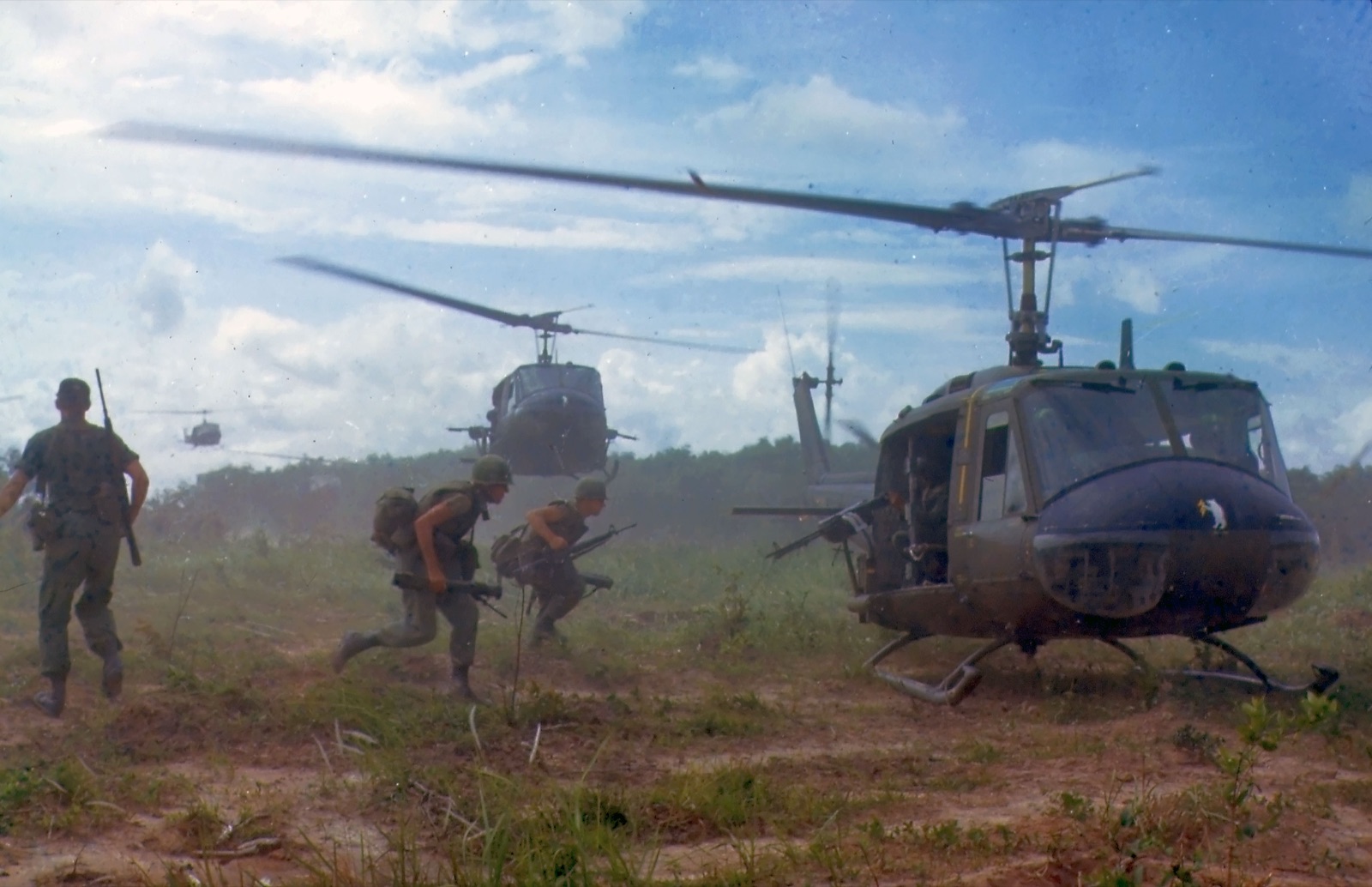
- UH-1D ‘slick’ on the ground, skids down, rotor still turning
- Door gunner’s M60 machine gun
- The next Huey coming in to land
- More of the lift in the distance — air assaults came in waves
Tonnage
More than three Second World Wars’ worth, mostly on the country being defended.
US bombs in three wars
tonsAircraft of all kinds, including helicopters and gunships, expended about 8 million tons in Indochina. Figures are approximate and the definitions differ slightly between wars.
Source Moïse, Historical Dictionary of the Vietnam War (2001); USAAF Statistical Digest, World War II (1945); Kiernan & Owen (2015)
Where the bombs fell, 1962–1973
tonsOwen and Kiernan’s 2006 analysis of the Air Force database put the Cambodia total at 2,756,941 tons from 1965 to 1973. South Vietnam — the ally — was by a wide margin the most heavily bombed country in history; Laos is second.
Source Moïse, Historical Dictionary of the Vietnam War (2001), from US Air Force figures
US military personnel in Vietnam, end of each year
people| Year | US personnel in South Vietnam |
|---|---|
| 1961 | 3200 |
| 1962 | 11300 |
| 1963 | 16300 |
| 1964 | 23300 |
| 1965 | 184300 |
| 1966 | 385300 |
| 1967 | 485600 |
| 1968 | 536100 |
| 1969 | 475200 |
| 1970 | 334600 |
| 1971 | 156800 |
| 1972 | 24200 |
| 1973 | 50 |
The air war outlasted the ground war: in 1972, with fewer than 25,000 Americans left in the South, US aircraft flew the heaviest bombing campaign since 1968.
Source US Department of Defense, year-end strength figures
Over the North
MiGs, missiles and the school that rewrote the exchange ratio.
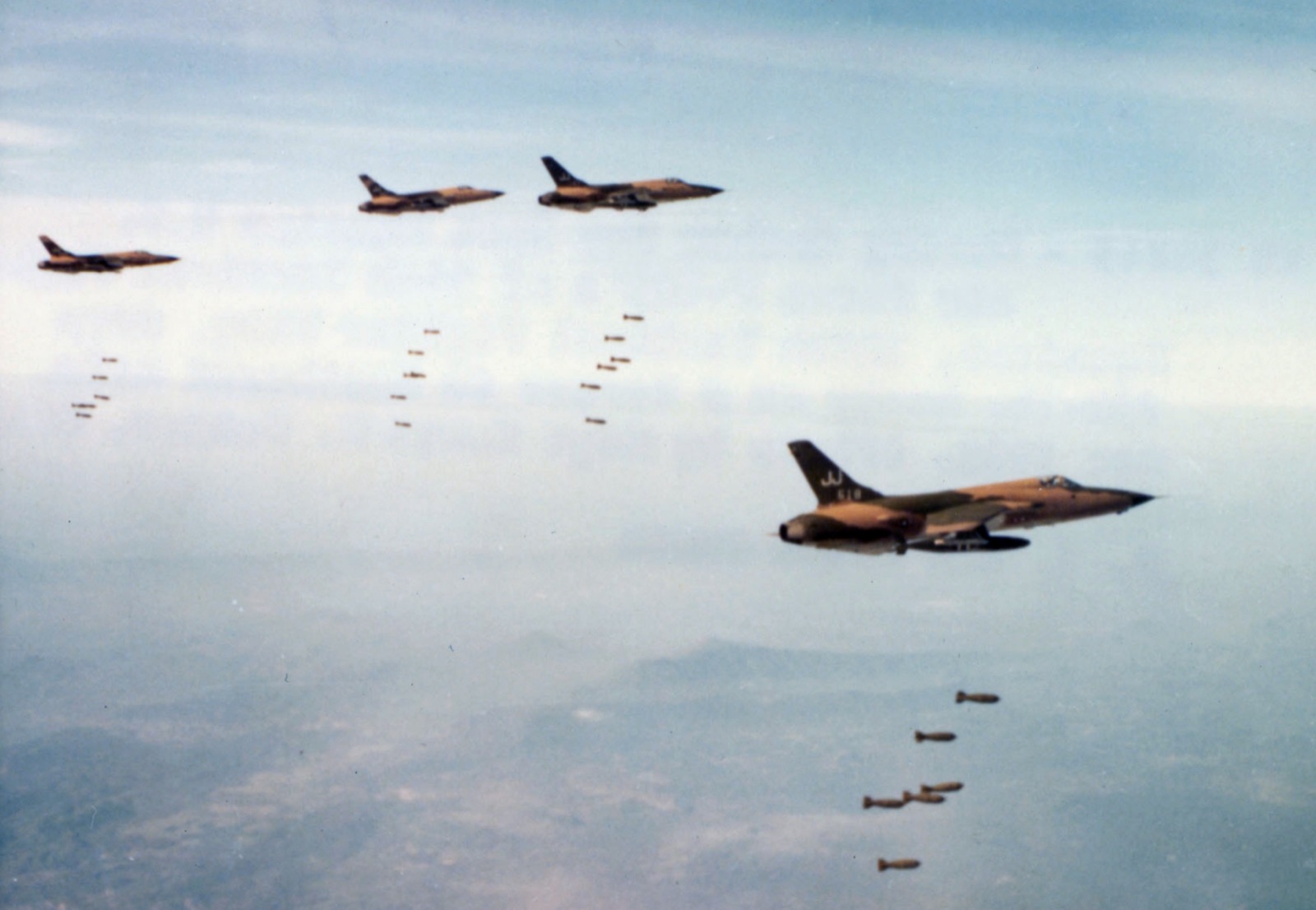
Rolling Thunder, the bombing of North Vietnam from March 1965 to November 1968, cost 922 American aircraft. Most fell to anti-aircraft guns; the SA-2 missile forced bombers down into the guns’ range, and the MiGs picked their moments. The Phantom had been designed to kill bombers with radar-guided missiles at long range, and early F-4s carried no gun. Against small, agile MiG-17s and MiG-21s flown by pilots under close ground control, the results were sobering. The US Navy studied why — the Ault report — and in March 1969 founded the Fighter Weapons School, Top Gun. The Air Force already had a Fighter Weapons School at Nellis, but did not overhaul its air-combat training until after the war, with Red Flag in 1975.
Air-to-air exchange ratios: Korea to Vietnam
enemy aircraft claimed per own aircraft lost in air combatUS claims set against US-acknowledged losses. North Vietnamese records admit roughly 150 aircraft lost in all; the Vietnamese air force claimed far more American aircraft than the US acknowledges.
Source Winnefeld, ‘Topgun: Getting it Right’, US Naval Institute Proceedings (1986); Michel, Clashes (1997); RAND (2008)
Phantom against MiG-21
McDonnell Douglas F-4J Phantom II
Mikoyan-Gurevich MiG-21MF
- 18 mLength16 m
- 12 mWingspan7.2 m
- 13,757 kgEmpty weight5,350 kg
- 28,030 kgMax take-off weight9,800 kg
- 159 kNThrust with afterburner65 kN
- 1,470 mphTop speed at altitude1,386 mph
- 2Crew1
- 8Air-to-air missiles carried4
Verdict The Phantom was twice the MiG-21’s size and had more than twice its thrust, radar to see a long way and eight missiles. The MiG was small, hard to spot, quick to accelerate and carried an internal cannon. Fought at close quarters under strict rules of engagement that often required visual identification first, the Phantom’s advantages shrank.
Source National Museum of the USAF; Gordon & Komissarov, Mikoyan MiG-21 (2008); figures vary by sub-type
Phantoms lost in Southeast Asia, by service
aircraft= 20 aircraft
- US Air Force (F-4 and RF-4)445
- US Navy138
- US Marine Corps95
All causes. The Phantom lost more aircraft in Vietnam than any other fixed-wing type — partly because there were so many of them.
Source Hobson, Vietnam Air Losses (2001), as tabulated by Wikipedia, Aircraft losses of the Vietnam War
US fixed-wing losses by type, all services, all causes
aircraftType totals combine the services and may differ slightly from other counts. Of the 2,251 aircraft the USAF lost, 1,737 fell to hostile action and 514 to accidents.
Source Hobson, Vietnam Air Losses (2001), as tabulated by Wikipedia, Aircraft losses of the Vietnam War
Source Schlight and Hobson via Wikipedia (Rolling Thunder); CIA memorandum, 1966; Hobson’s loss database (vietnamairlosses.com) for Linebacker I; USAF and USN
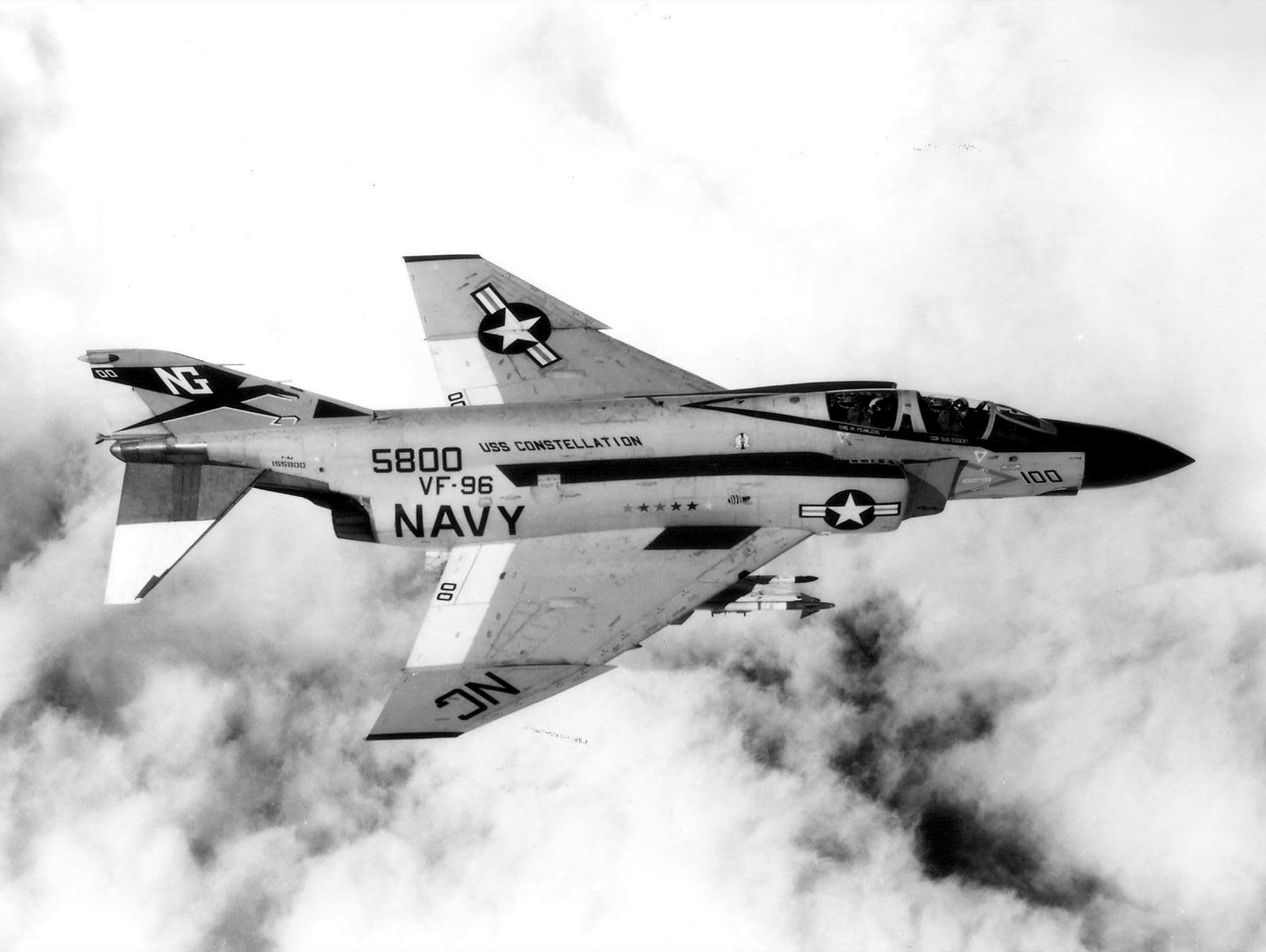
- VF-96 ‘Fighting Falcons’, USS Constellation
- Radar nose — the F-4J carried no gun
- Victory stars painted below the cockpit
- Air-to-air missiles on the inboard wing pylon
Arc Light and Linebacker
The strategic bomber in a war without strategic targets — until the last eleven nights.
The first B-52 strike of the war, on 18 June 1965, went badly: two bombers collided on the way in and eight men died. Arc Light went on for eight years. Flying from Guam, Okinawa and U-Tapao in Thailand, B-52s flew 126,615 sorties, most of them against jungle bases in the South and supply routes in Laos and Cambodia, unheard until the bombs landed. In December 1972 they were finally sent against Hanoi and Haiphong. Linebacker II lasted eleven nights, and fifteen B-52s were shot down — all by SA-2 missiles.
Linebacker II, 18–29 December 1972
aircraft= 25 aircraft
- B-52 sorties729
- B-52s shot downone more was lost in some counts15
- Other US aircraft lostfigures of 11 to 13 are given12
Some 20,000 tons of bombs in eleven nights. US aircrew losses were 43 killed and 49 captured; at least 1,624 civilians were killed in Hanoi and Haiphong.
Source USAF; McCarthy & Allison, Linebacker II: A View from the Rock (1979); Wikipedia, Operation Linebacker II
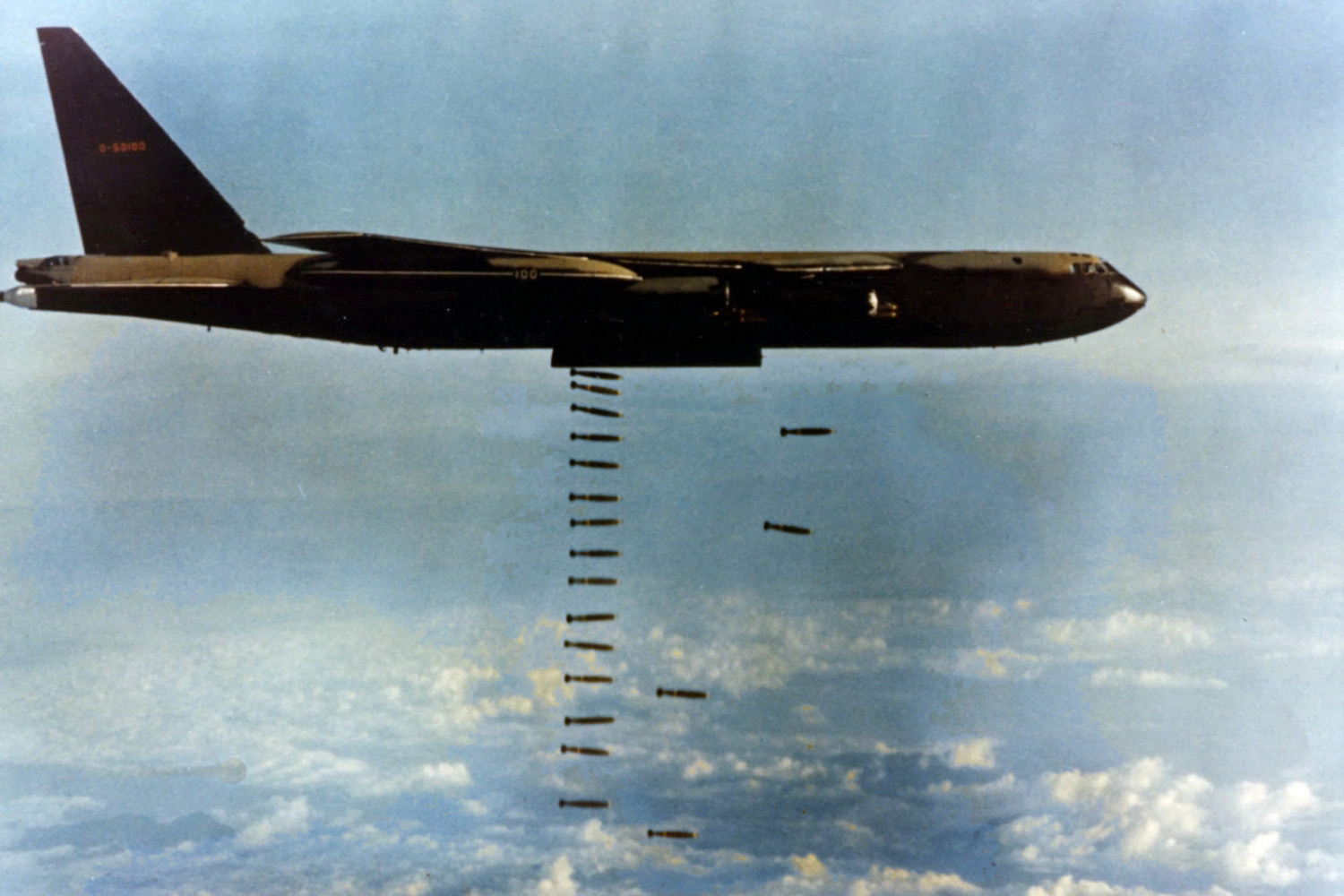
- Tail serial 0-50100: B-52D 55-0100
- Open bomb bay — the D model was modified to carry up to 84 bombs inside
- More bombs falling from the underwing racks
- Black undersides for night bombing, camouflage above
Fourteen years in the air
The first US Army helicopter units — CH-21 Shawnees — arrive in Saigon.
Gulf of Tonkin incident; first US air strikes on the North, and the first US airman captured.
Rolling Thunder begins on 2 March.
First Arc Light B-52 raid, 18 June.
An SA-2 destroys a USAF F-4C on 24 July: the first US aircraft lost to a surface-to-air missile.
Operation Bolo: F-4s posing as F-105s claim seven MiG-21s on 2 January.
No. 2 Squadron RAAF begins Canberra operations from Phan Rang.
Rolling Thunder ends on 1 November after 922 aircraft lost.
US Navy Fighter Weapons School — Top Gun — opens at NAS Miramar.
Cunningham and Driscoll become the first US aces of the war, 10 May, as Linebacker I begins.
Linebacker II, 18–29 December: 729 B-52 sorties, 15 B-52s lost.
US bombing of Cambodia ends on 15 August; the last Arc Light sortie is flown.
Operation Frequent Wind: helicopters evacuate Saigon, 29–30 April.
Source Wikipedia (campaign articles); Australian War Memorial; Grossnick & Evans, United States Naval Aviation 1910–2010
Australia’s air war
Wallaby Airlines, the Bushrangers and the Magpies.
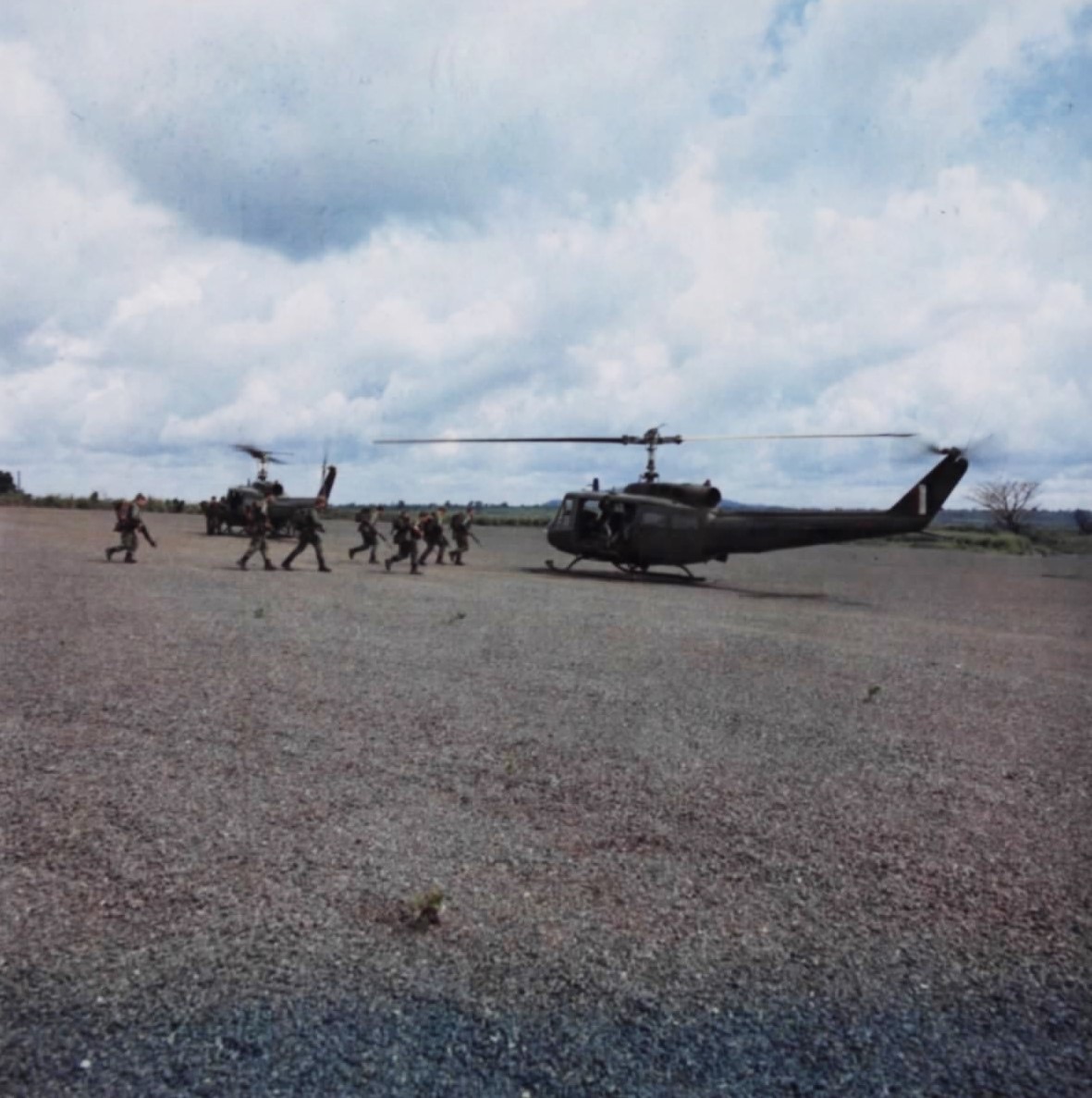
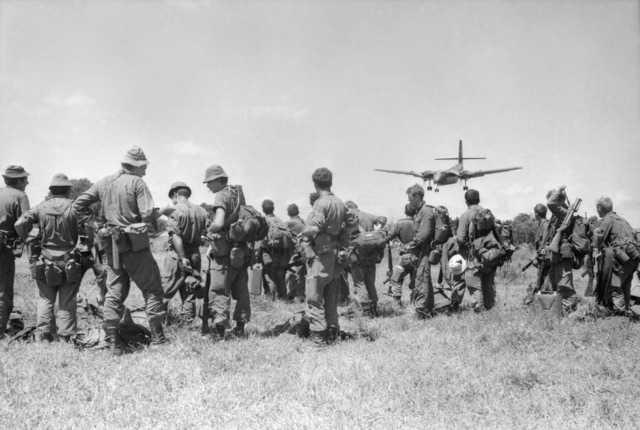
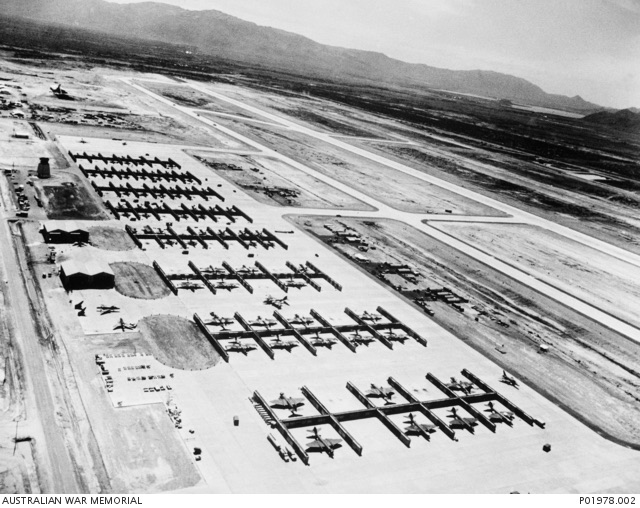
Australia sent three RAAF squadrons to Vietnam. No. 35 Squadron’s Caribous — ‘Wallaby Airlines’ — arrived first, in August 1964, and flew into strips too short for anything bigger. No. 9 Squadron’s Iroquois carried the Australian Task Force at Nui Dat, and from 1969 flew its own ‘Bushranger’ gunships. No. 2 Squadron, the ‘Magpies’, flew Canberra B.20 bombers from Phan Rang as part of a USAF wing; it flew only about 5 per cent of the wing’s missions but was credited with 16 per cent of its bomb damage, bombing at low level with great accuracy. Its two lost Canberras were the only Australian jet losses of the war.
Australian air units in the Vietnam War
| No. 35 Squadron (RAAF Transport Flight Vietnam) | RAAF | DHC-4 Caribou | Vung Tau | 1964 | 1972 | About 80,000 sorties; 677,000–700,000 passengers carried |
| No. 9 Squadron | RAAF | UH-1B, UH-1H Iroquois | Vung Tau | 1966 | 1971 | Troop lift, casualty evacuation and ‘Bushranger’ gunships |
| No. 2 Squadron | RAAF | Canberra B.20 | Phan Rang | 1967 | 1971 | 76,389 bombs dropped; two aircraft lost |
| RAN Helicopter Flight Vietnam | RAN | UH-1 Iroquois | Bearcat | 1967 | 1971 | Flew with the US Army’s 135th Assault Helicopter Company |
| 161 (Independent) Reconnaissance Flight | Australian Army | Cessna 180, Bell 47G Sioux, Pilatus Porter | Nui Dat | 1965 | 1971 | Reconnaissance and liaison for the Task Force |
| RAAF forward air controllers | RAAF | O-1 Bird Dog, OV-10 Bronco | with USAF units | 1966 | 1971 | Pilots attached individually to USAF FAC squadrons |
| No. 79 Squadron | RAAF | CAC Sabre | Ubon, Thailand | 1962 | 1968 | Air defence of Thailand; never in combat |
| RAAF aircraft lost in Vietnam: three Caribous (one to enemy fire, two in accidents), two Canberras and six Iroquois, by the most-cited count. Sortie and passenger figures vary between sources. | ||||||
Source Australian War Memorial; DVA Anzac Portal; RAAF Association; Air Force History and Heritage Branch, RAAF helicopter operations in Vietnam
The Vietnam war at one scale
drawn to one scale-
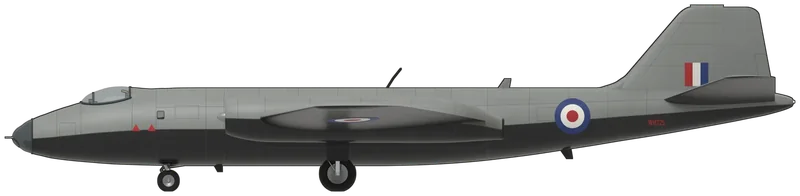 Canberra B.20 (No. 2 Sqn RAAF) — the USAF flew the licence-built Martin B-57 20.0 m
 -
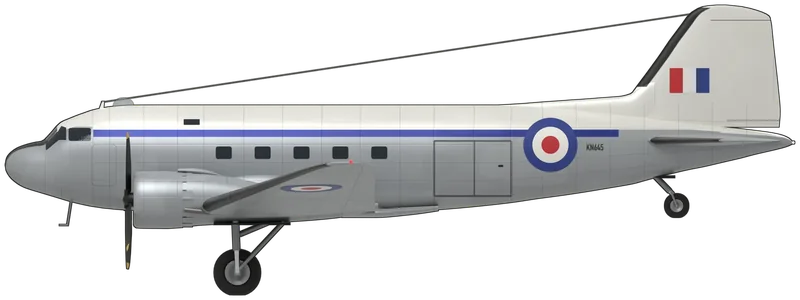 Douglas AC-47D ‘Spooky’ gunship 19.7 m
 -
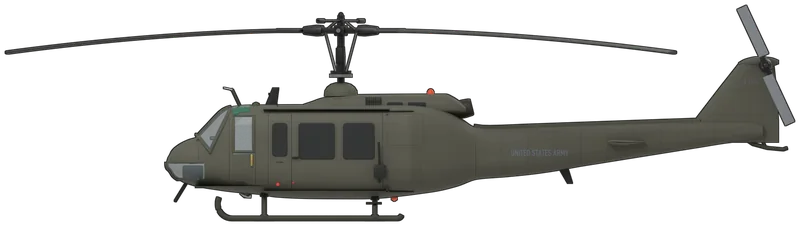 UH-1H Huey 17.4 m
 -
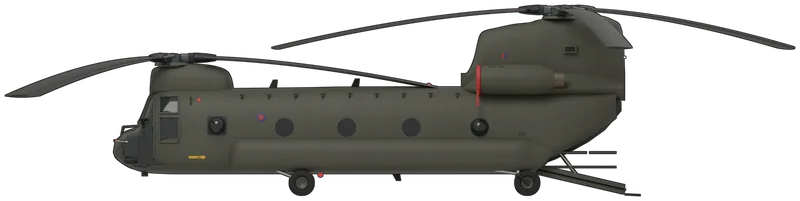 CH-47 Chinook 15.5 m
 -
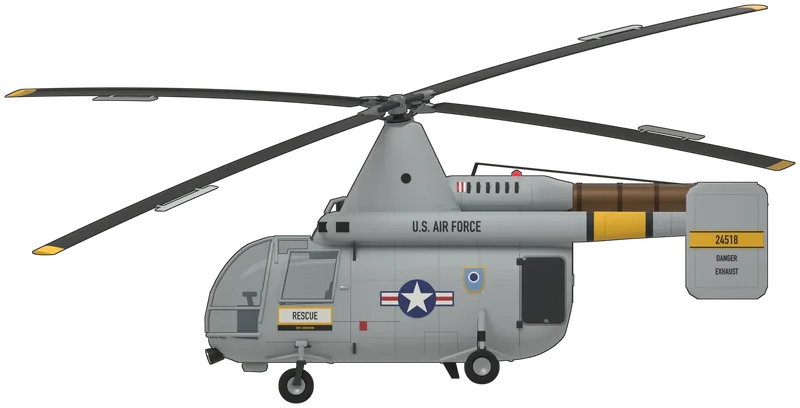 HH-43 Huskie 7.7 m
 -
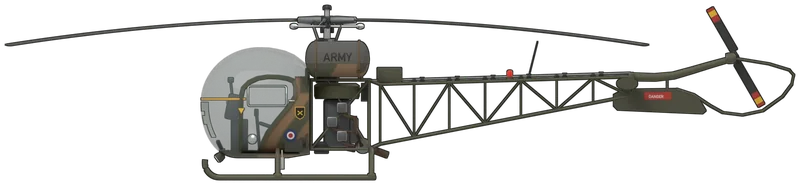 OH-13 Sioux 9.6 m
 -
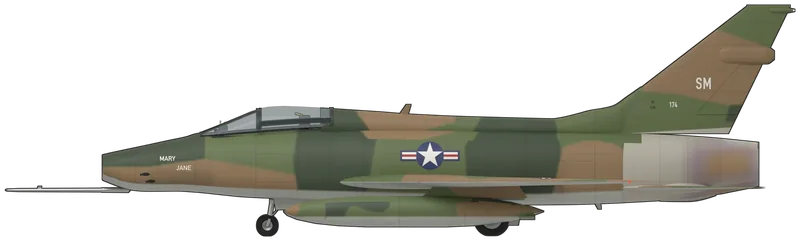 F-100 Super Sabre 16.5 m
 -
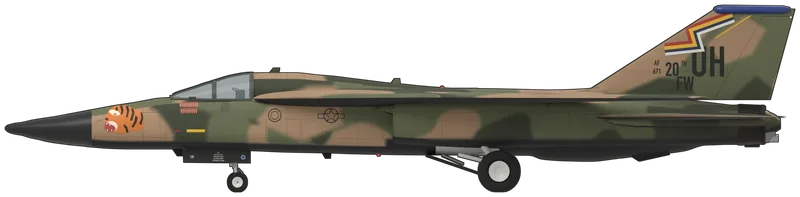 F-111 22.4 m
 -
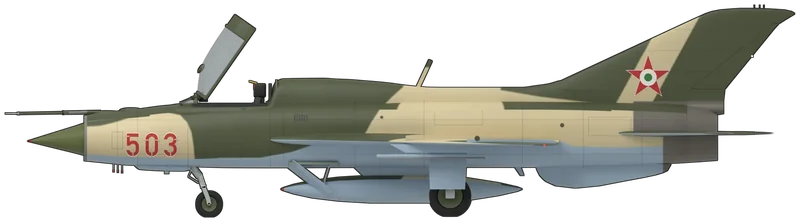 MiG-21 14.9 m
 -
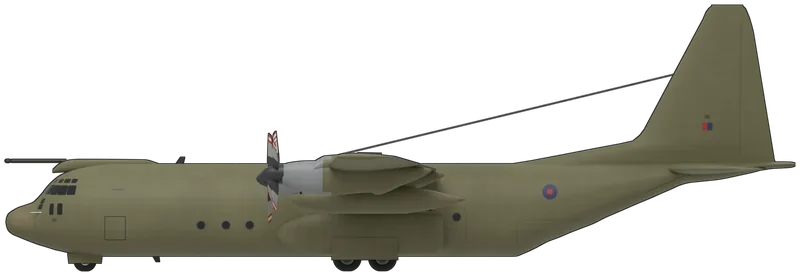 C-130 Hercules 34.4 m
Parked together: a Vietnam airfield
live 3D, true scale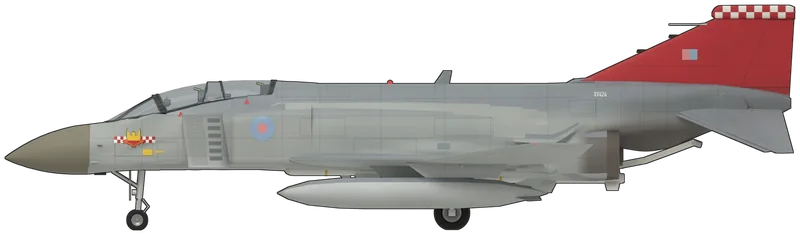
Drag to walk round · pinch or buttons to zoom
- F-4 Phantom II 17.6 m long, 11.7 m span
- Canberra B.20 20.0 m long, 19.5 m span
- AC-47 Spooky 19.7 m long, 29.0 m span
- UH-1H Huey 17.4 m long, 14.6 m rotor
- CH-47 Chinook 15.5 m long, 18.3 m rotor
- HH-43 Huskie 7.7 m long, 14.3 m rotor
- OH-13 Sioux 9.6 m long, 11.3 m rotor
- F-100 Super Sabre 16.5 m long, 11.8 m span
- F-111 22.4 m long, 19.2 m span
- MiG-21 14.9 m long, 7.2 m span
- C-130 Hercules 34.4 m long, 40.4 m span
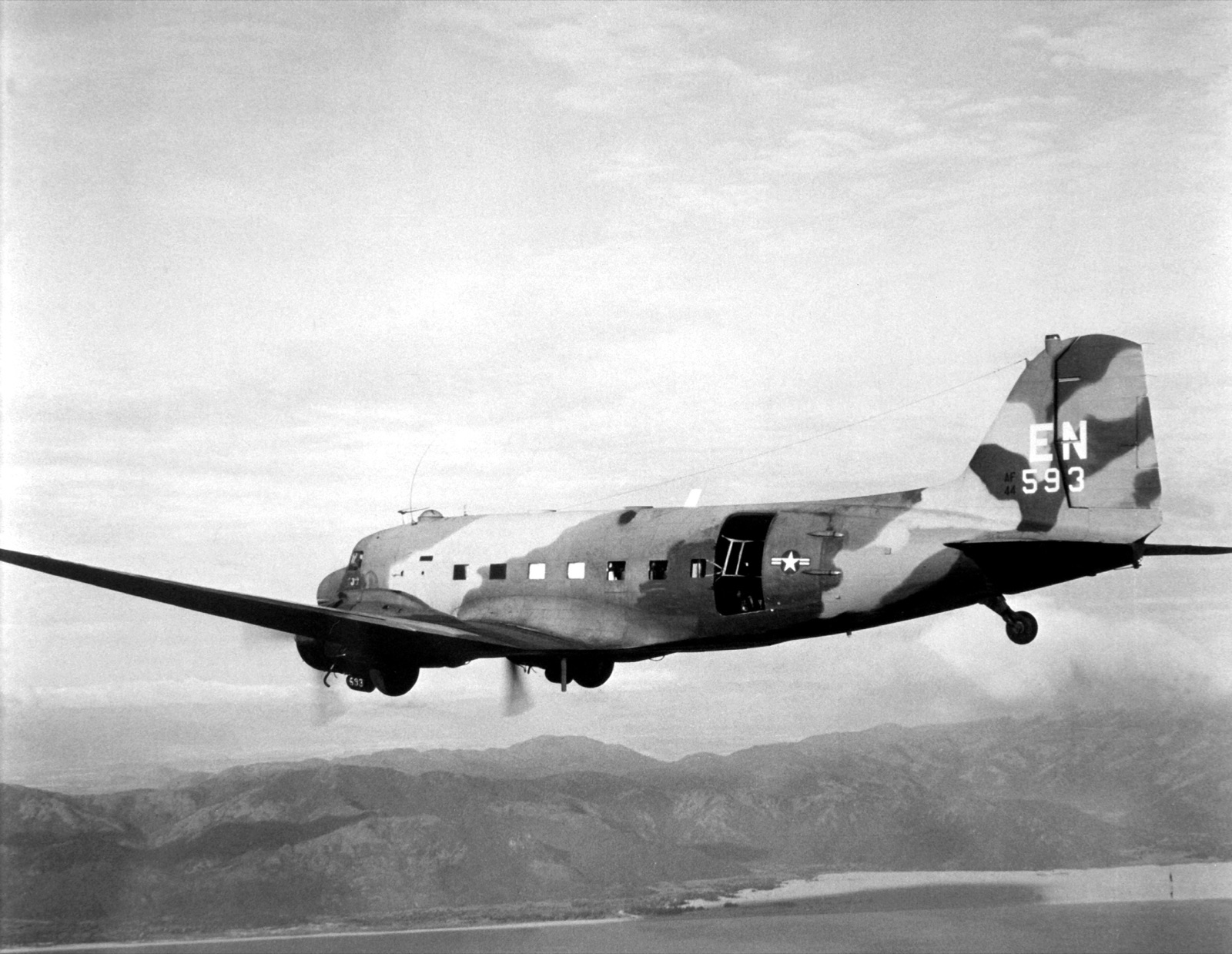
- Open cargo door on the left side — Spooky’s guns all fired to port
- Cabin windows, some removed for minigun barrels
- Tail code EN, 4th Special Operations Squadron
- Two Pratt & Whitney Twin Wasps, as on any Dakota
They can’t even bomb an outhouse without my approval.
Attributed to President Lyndon B. Johnson, on his control of Rolling Thunder targets
Where to see them
Vietnam-era types in British museums.
Where to see Vietnam War types in Britain
in British museums- McDonnell Douglas Phantom16 museums
Royal Air Force Museum London · IWM Duxford · Norfolk and Suffolk Aviation Museum · Tangmere Military Aviation Museum · Fleet Air Arm Museum · Midland Air Museum · Solway Aviation Museum · South Wales Aviation Museum · Ulster Aviation Society (Maze Long Kesh) · Royal Air Force Museum Midlands · National Museum Of Flight · Montrose Air Station Museum · Morayvia · City of Norwich Aviation Museum · Bentwaters Cold War Museum · British Phantom Group & Bristol Britannia XM496 (Kemble)
- English Electric Canberra32 museums
Royal Air Force Museum London · Norfolk and Suffolk Aviation Museum · Gatwick Aviation Museum · Tangmere Military Aviation Museum · Bournemouth Aviation Museum · Boscombe Down Aviation Collection · Royal Air Force Museum Midlands · Midland Air Museum · Newark Air Museum · Yorkshire Air Museum · Avro Heritage Museum · Solway Aviation Museum · South Wales Aviation Museum · Ulster Aviation Society (Maze Long Kesh) · Lincolnshire Aviation Heritage Centre · National Museum Of Flight · Morayvia · City of Norwich Aviation Museum · Suffolk Aviation Heritage Museum · Farnborough Air Sciences Trust Museum · RAF Manston History Museum · Wings Aviation Museum · Romney Marsh Wartime Collection · Robertsbridge Aviation Society · East Midlands Aeropark · RAF Defford Museum · Rolls Royce Heritage Trust · North East Land, Sea and Air Museums · South Yorkshire Aircraft Museum · Hooton Park Hangars · The Vulcan Experience (XH558) · Stoneykirk Aviation Museum
- Douglas C-47 Dakota9 museums
IWM Duxford · Royal Air Force Museum Midlands · Battle Of Britain Memorial Flight Visitors Centre · Yorkshire Air Museum · Boscombe Down Aviation Collection · Wings Aviation Museum · Romney Marsh Wartime Collection · Metheringham Airfield Visitor Centre · South Yorkshire Aircraft Museum
Sources
- Vietnam Helicopter Pilots Association, ‘Helicopter Losses During the Vietnam War’ (Gary Roush, updated 31 December 2018)
- Chris Hobson, Vietnam Air Losses: USAF, Navy and Marine Corps Fixed-Wing Aircraft Losses in Southeast Asia 1961–1973 (Midland, 2001)
- Wikipedia, Aircraft losses of the Vietnam War (tabulating Hobson and VHPA)
- Edwin E. Moïse, Historical Dictionary of the Vietnam War (Scarecrow Press, 2001) — air war tonnage figures
- Taylor Owen and Ben Kiernan, ‘Bombs over Cambodia’, The Walrus (2006); Kiernan & Owen, ‘Making More Enemies than We Kill?’, The Asia-Pacific Journal (2015)
- Army Air Forces Statistical Digest, World War II (1945)
- Marshall L. Michel III, Clashes: Air Combat over North Vietnam 1965–1972 (Naval Institute Press, 1997)
- James A. Winnefeld, ‘Topgun: Getting it Right’, US Naval Institute Proceedings 112/10 (1986)
- Wikipedia, United States Navy Strike Fighter Tactics Instructor program
- Wikipedia, Operation Rolling Thunder
- Wikipedia, Operation Linebacker II
- National Museum of the United States Air Force, ‘Arc Light’ fact sheet
- Steven J. Zaloga, Red SAM: The SA-2 Guideline Anti-Aircraft Missile (Osprey, 2007)
- Wikipedia, List of U.S. aircraft losses to missiles during the Vietnam War
- DVA Anzac Portal, No 35 Squadron RAAF during the Vietnam War
- DVA Anzac Portal, No 9 Squadron RAAF during the Vietnam War
- RAAF Association, ‘2 Sqn Canberras in Vietnam’
- Air Force History and Heritage Branch, RAAF in the Vietnam War: RAAF helicopter operations in Vietnam
Photographs
- UH-1D Hueys lift men of the 2nd Battalion, 14th Infantry out of the Filhol Rubbe — SFC James K. F. Dung, US Army, Public domain · source
- F-105D Thunderchiefs of the 34th Tactical Fighter Squadron bombing on radar cues — US Air Force, Public domain · source
- F-4J BuNo 155800, ‘Showtime 100’ of VF-96 from USS Constellation. In this aircra — US Navy, Public domain · source
- B-52D 55-0100 drops its load over Vietnam. The ‘Big Belly’ D could carry 108 bom — US Air Force, Public domain · source
- Men of B Company, 2nd Battalion Royal Australian Regiment, run to board No. 9 Sq — PFC Laszlo Kondor, US Army, Public domain · source
- Soldiers of 5RAR wait as a No. 35 Squadron Caribou comes in to collect them, Oct — Christopher John Bellis, Australian War Memorial (BEL/69/0741/VN), Public domain (PD-Australia) · source
- Phan Rang air base, July 1967: rows of revetments shared by USAF wings and No. 2 — US National Archives (342-KKE-28349), Public domain · source
- AC-47D 44-76593 of the 4th Special Operations Squadron in flight, 1968: a wartim — US Air Force, Public domain · source
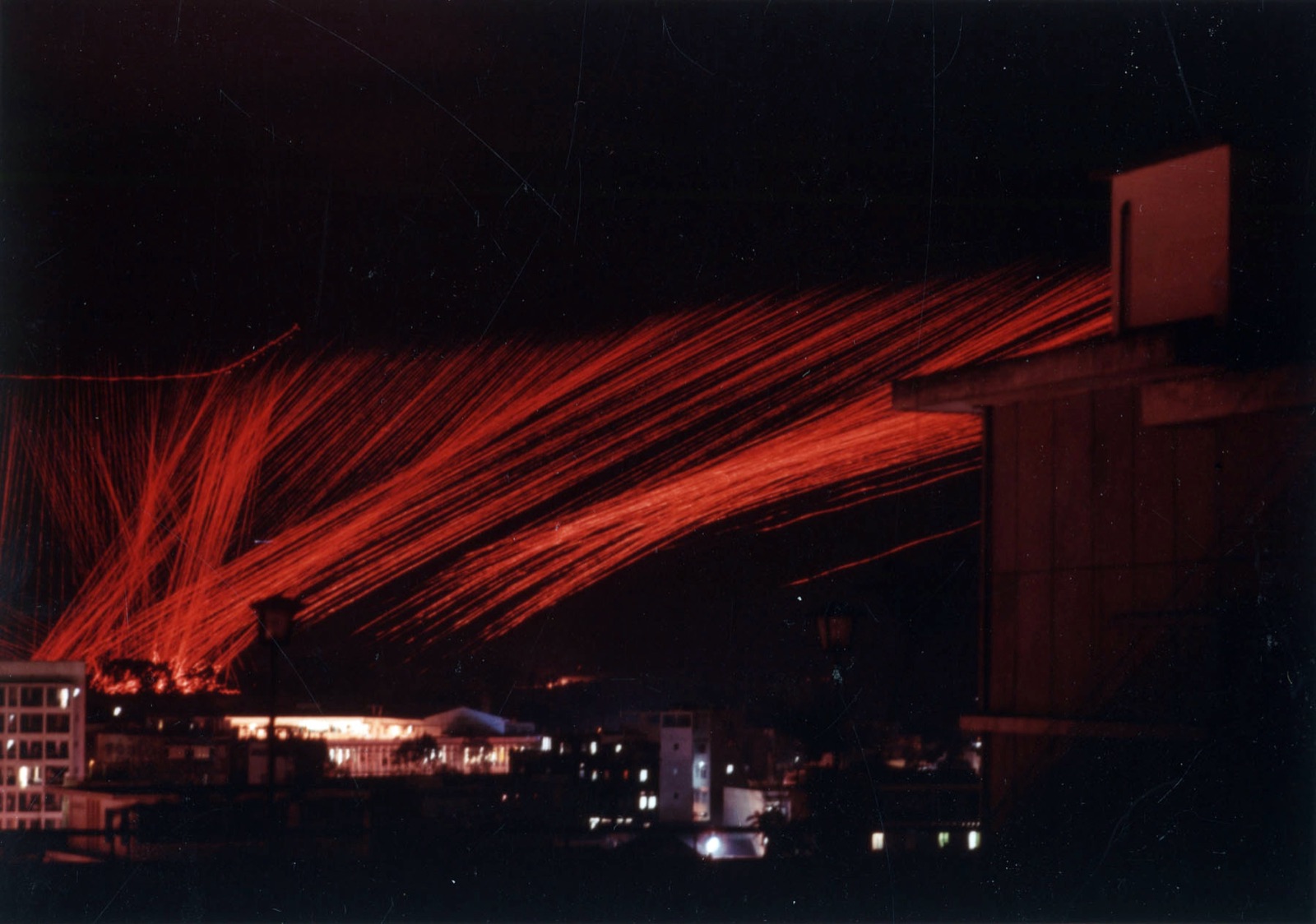
- A time exposure of an AC-47 ‘Spooky’ firing over the outskirts of Saigon during — US Air Force, Public domain · source
Figures are drawn from the sources above; where they disagree the most widely cited figure is used and the range is given in the notes. Side profiles and 3D models are the gazetteer’s own procedural models, drawn to scale from published dimensions. Spotted an error? Tell us.